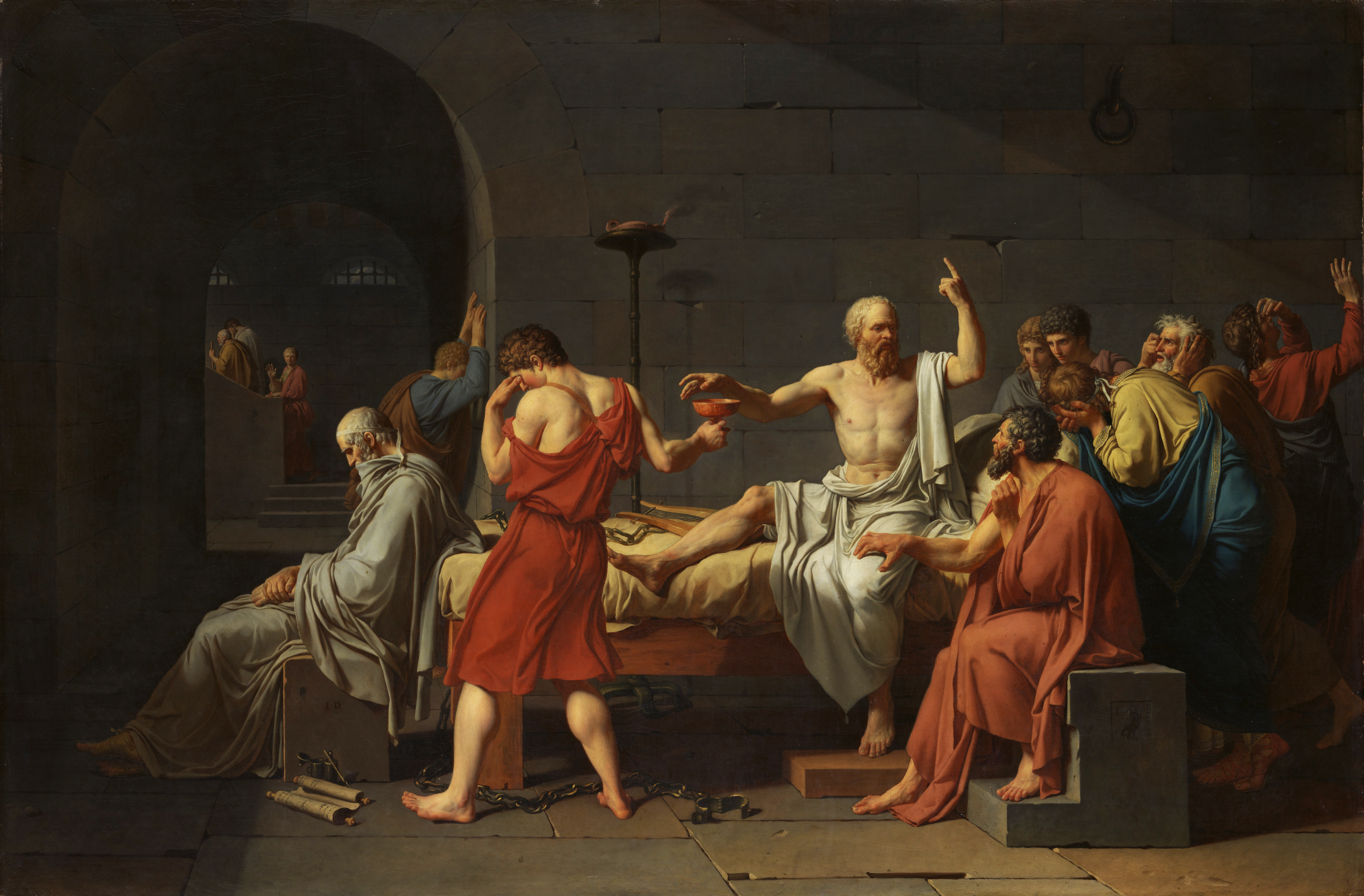
In the spring of 399 BC, an Athenian jury of around five hundred ordinary citizens (not a king, not a tyrant, a democracy) voted to put a seventy-year-old man to death for the crime of impiety and corrupting the young. He had a chance to talk his way out of it, and he used the chance to make the jury angrier. He had a chance to flee prison, and his friends had the bribe money ready, and he argued them out of it. Then he drank the poison himself, calmly, while the people who loved him wept, and spent his last conscious minutes telling them to pull themselves together.
The man was Socrates, and the first strange thing about him is that he never wrote a book. Not a treatise, not a dialogue, not a letter we can point to. The most influential teacher in the history of Western thought left behind exactly nothing in his own hand. Everything we have comes secondhand, from people who were either mocking him on a comic stage, admiring him in their memoirs, or, in one extraordinary case, possibly borrowing his name to float ideas of their own.
The second strange thing is his whole method, the thing he actually did all day, every day, in the marketplace. He would walk up to people who were confident they knew what justice was, or courage, or piety, and ask them to explain it, and then take their explanation apart, question by question, until it collapsed and they were left knowing less than they thought they knew when they started. He built nothing. He took apart. He claimed, repeatedly, to have no wisdom of his own at all. He compared himself to a horsefly biting a sluggish horse.
So this is the puzzle. How does a man who wrote nothing, taught no doctrine, founded no school, and insisted he knew nothing, end up as the pivot the entire tradition rests on, the figure who, as Cicero put it three centuries later, called philosophy down from the heavens and into the cities and homes of men, and made it about how to live? The answer lies in the silence, in the method, and in the death. The silence comes first, because it is not an accident of the record. It is the central fact about him, and it has a name.
The break
Before Socrates, Greek philosophy was cosmology: the study of what the world is fundamentally made of, and how it works. The thinkers we now call the pre-Socratics (the name itself measures everything against him) were trying to find the one underlying stuff or principle behind the changing surface of things. Thales said water, Anaximenes said air, Heraclitus said everything is fire and flux, the atomists said tiny uncuttable bodies moving in the void (the Greeks chapter). These were not foolish guesses; they were the first attempts in the West to explain nature by nature itself rather than by the doings of gods, and that is a genuine intellectual revolution. But their question pointed outward, at the heavens and the elements. How a person ought to live was not really on the menu.
Then a second movement arrived. The Sophists were the first professional teachers, itinerant experts who travelled the Greek world charging fees to teach young men how to argue, how to persuade, how to win in the law courts and the assembly. In a participatory democracy where a man's fortunes turned on his ability to speak, this was an enormously valuable, practical skill, and the best Sophists (Protagoras, Gorgias, Hippias) were serious, learned, formidable thinkers, not charlatans. But there was a corrosive idea riding along with the skill. If real knowledge about the big questions is out of reach (and the pre-Socratics had argued themselves into such tangles that this looked plausible) then truth is not something to be discovered. Truth is whatever one can persuade people to accept. Protagoras put it as "man is the measure of all things": there is no view from nowhere, only this person's take and that person's take, and the able speaker simply makes his take win. On that view, teaching virtue means teaching rhetoric, because winning the argument just is being right.
Socrates' move, the break the whole rest of philosophy grows out of, is to turn the question inward and refuse the Sophists' bargain at the same time. He stops asking what the cosmos is made of and starts asking what justice is, what courage is, what piety is, not as a rhetorician who wants to win the dispute, but as a man who genuinely thinks there is a real answer and that he does not have it. Against the cosmologists: the urgent question isn't the stars, it's how I should live, the care of my own soul. Against the Sophists: truth is not just persuasion. There really is such a thing as what justice is, and the proof that we don't yet know it is that every confident definition falls apart under questioning, including (especially) the smooth ones the Sophists sell. The concrete move is a method, the relentless cross-examination he ran on everyone he met, and a posture, the insistence that admitting one's ignorance is the one honest place to start. Cicero, looking back across three hundred years, summed it up: Socrates called philosophy down from the heavens, settled it in the cities and even the homes of men, and compelled it to ask about life and right and wrong. That is the pivot. Everything after it (Plato, Aristotle, the Stoics, the whole moral tradition) is on the near side of this turn.
Chapter 1
The man who wrote nothing
"...how on one occasion he had stood for an entire day and night absorbed in reflection amid the wonder of the spectators."
Socrates wrote nothing, and the three people who tell us about him describe three different men. This is not a quirk of the sources to be smoothed over in a sentence. Scholars have a name for it, the Socratic problem, and the modern consensus is blunt about it: the problem is, in the words of the standard reference works, "seemingly impossible to clarify." No one has solved it. Any account of what Socrates thought has to start with where the picture comes from, and how the three portraits clash.
Start with the earliest, and the most unflattering. In 423 BC, when Socrates was in his mid-forties, the comic playwright Aristophanes put him on the Athenian stage in a play called The Clouds, and the Socrates of that play is a fraud and a buffoon. He runs a "Thinkery," a kind of sham philosophy-school, where he teaches young men slick rhetorical tricks for getting out of paying their debts, charges fees for it, studies pointless natural-philosophy questions about the heavens and the bugs, and treats the gods of the city with open contempt. He's introduced dangling in a basket so he can think loftier thoughts; he's barefoot, unwashed, rolling his eyes. This is the Sophist-buffoon, and it looks far more like Anaxagoras or one of the fee-taking Sophists than like the Socrates Plato will give us. (The Clouds we can read is a revised second draft, prepared a few years later for a re-staging that never happened; the original 423 script is lost.) This could be dismissed as mere comedy, except for one thing. It is genuinely contemporary. Aristophanes was writing about a living man his audience could see in the marketplace, and the portrait was current when Socrates was in his prime. That matters enormously, because it is the oldest charge against him, and the one he says he can never quite shake.
The second portrait comes from Xenophon, a practical, level-headed Athenian soldier and historian who actually knew Socrates and wrote several works recalling him (the Memorabilia chief among them) after his death. Xenophon's Socrates is a sensible, down-to-earth moral advisor: pious in the ordinary civic way, full of homely good counsel about managing a household, keeping fit, doing one's duty as a citizen and a soldier. He is admirable, useful, and a little dull. He is not the restless intellectual explorer making claims about the soul and the nature of reality. The catch with Xenophon is that scholars note he was away from Athens for much of the relevant period, so a good deal of his Socrates is reconstruction. What he gives us is a corrective, a check against the temptation to read the most philosophically thrilling version as simply the truth.
And then there is Plato, the portrait that conquered the world, the richest, the most philosophically alive, and the most suspect for exactly that reason. Plato knew Socrates, was perhaps twenty-eight when Socrates died, and spent the next half-century writing dialogues in which Socrates is almost always the central speaker. The trouble is that Plato's Socrates grows. Scholars sort the dialogues into rough tiers, and the seam between them is the whole game. In the early dialogues (the Apology, the Euthyphro, the Crito, the Laches, the Charmides) Socrates only ever cross-examines; he tears down bad definitions and offers no positive doctrine of his own, and most scholars think this is the closest we get to the historical man. But in the middle dialogues (the Meno, the Phaedo, the Symposium, the Republic) a whole machinery appears that the early Socrates never touched: the theory of Forms, the immortal soul, recollection, the philosopher-king. The consensus is that here "Socrates" has quietly become Plato's mouthpiece, saying things the real Socrates very likely never said. So a strict rule holds throughout: "Socrates argued X" means Plato's early-dialogue Socrates, the one nearest the man. The Forms and the immortal soul belong to Plato, and they have their own chapter (the Plato chapter). The focus here stays close to the marketplace cross-examiner.
So which one is real? The answer is that scholars are always reconstructing him, never simply reading off the truth. Most of them work like this: take Plato's early dialogues as the best evidence for Socrates' own views, use Xenophon as a sanity check, and treat Aristophanes as contemporary satire that tells us less about Socrates' actual ideas than about how he appeared to ordinary Athenian opinion, which turns out to matter at the trial. No one claims to have separated the man from his portraitists cleanly. That gap is not something to paper over; it is the texture of the whole subject.
What can we say about the man behind the three portraits with some confidence? He was born in Athens around 470 BC, in a district called Alopece, to a father, Sophroniscus, who worked stone (later legend, traced to the biographer Diogenes Laertius six centuries on, upgrades him to a "sculptor" and has young Socrates carving statues, but the plainer stoneworker reading is safer) and a mother, Phaenarete, who was a midwife. Socrates himself uses that detail, in Plato's Theaetetus, for one of his best self-descriptions: he says he practices his mother's trade on the mind, helping others give birth to ideas while himself producing none. He married a woman named Xanthippe, who later tradition turned into the archetypal shrewish wife, though that caricature is mostly the work of much-later anecdote; the contemporary Xenophon presents her quite differently. In his Symposium he has Socrates explain that he chose a difficult partner on purpose, reasoning that if he could learn to get along with her, he could get along with anyone at all. They had three sons. And he was, by every account, strikingly ugly (snub-nosed, thick-lipped, bald, pop-eyed), a fact his friends teased him about and he cheerfully agreed with.
One thing the sources do agree on, and it cuts against the image of the philosopher as an unworldly talker: Socrates was a tough, brave soldier. He served as a hoplite (a heavily-armored Athenian citizen-infantryman) in three campaigns of the long war against Sparta: the siege of Potidaea, the disastrous defeat at Delium, and the expedition to Amphipolis. Plato gives the vivid bits through the mouth of Alcibiades, the brilliant, dangerous young aristocrat who adored him: Socrates out-enduring everyone in the brutal cold of Potidaea, barefoot on the ice while better-dressed men suffered; and the famous image from the epigraph above, Socrates standing rooted in one spot for a full day and a night, lost in some problem, while soldiers gathered to gawk, until dawn came and he said a prayer to the sun and walked off. At Delium, when the Athenian line broke and men fled in panic, Alcibiades says Socrates retreated coolly, "stalking about like a pelican, rolling his eyes as Aristophanes had described him in the Clouds" (Alcibiades himself reaching for the comic portrait to capture the real man), keeping his head while others lost theirs. The man who would die for refusing to do an injustice had already, repeatedly, risked dying for his city on the battlefield.
Chapter 2
The method — how to take an answer apart
"I am that gadfly which God has given the state and all day long and in all places am always fastening upon you, arousing and persuading and reproaching you."
Now to the thing he actually did, because Socrates is a method before he is a set of opinions. The method has a Greek name, the elenchus (elenchos, meaning cross-examination or refutation), and seeing how it works explains both why people loved him and why a city eventually killed him. The shape is always the same. He finds someone who is confident he knows what some big moral word means (justice, courage, piety, friendship) and he asks, with apparently sincere humility, to be taught. The man offers a definition. And then Socrates, asking only questions, never lecturing, draws out what else the man believes, and shows that those other beliefs contradict the definition. The definition collapses. They try again. It collapses again. And at the end both of them are stuck (the Greek word is aporia, a state of puzzled, productive helplessness), except that the man now knows he doesn't actually understand the word he uses every day, which Socrates regards as a real improvement on the confidence he started with.
The clearest way into the elenchus is to run one, move by move. Take the dialogue called the Euthyphro. The setting is loaded: Socrates is on his way to court to face his own impiety charge, and he runs into a young man named Euthyphro who is, of all things, prosecuting his own father for the death of a hired worker. Euthyphro is supremely confident this is the pious thing to do, so confident he's hauling his own father into court over it. Socrates, who is about to be tried for impiety, pounces: wonderful, here's an expert on piety exactly when I need one. Teach me. What is piety? Define it, so I can hold up my own conduct against the standard.
Euthyphro's first answer: piety is what I'm doing right now, prosecuting a wrongdoer, no matter who he is. Socrates blocks this immediately, and the block is itself one of his most important moves. Euthyphro has given him an example, he says, not a definition. The question was not which actions are pious; it was what piety itself is, the single thing that all pious actions have in common, the standard by which they get called pious in the first place. Without that, there is no telling whether prosecuting a father is pious; it would just assume the very thing in question. (This is one of Socrates' genuine philosophical contributions, the one Aristotle later credits him with: the demand for the universal, the "what is it?" question, the insistence that one must know what justice is, in general, before judging whether any particular act is just. Examples can't answer the question; they presuppose its answer.)
Euthyphro's second answer: all right, piety is what is loved by the gods. Now Socrates springs the famous trap. Euthyphro believes, Socrates points out, that the gods quarrel; his own myths are full of gods fighting. And what do they quarrel about? Not facts that can be weighed or measured, but exactly the disputed things: what's just, what's noble, what's good. So the gods disagree among themselves about these. Which means one and the same act could be loved by some gods and hated by others. But then, on Euthyphro's definition, that act would be both pious (loved by some) and impious (hated by others) at the same time, which is a contradiction. The definition eats itself.
Euthyphro's repair: fine, piety is what all the gods love, unanimously. And here comes the deepest cut of the whole dialogue, a question so sharp it still has a name in philosophy. Socrates asks: is a pious thing pious because the gods love it, or do the gods love it because it is already pious? The direction of the arrow matters. If things are pious because the gods happen to love them, then piety is arbitrary; the gods could love cruelty tomorrow and cruelty would become pious, which is monstrous. But if the gods love pious things because those things are already, independently pious, then "loved by the gods" isn't what piety is at all; it's just a consequence of piety, a sign that comes along after. Either way the definition fails: it has told us a symptom of piety (the gods approve of it) but not its essence (what it actually is). And here the dialogue, like so many early dialogues, simply ends. Euthyphro suddenly remembers he's late for something and hurries off, leaving the question wide open. No answer is reached. None.
The feeling of the Euthyphro's ending is what most summaries lose. What Socrates did, and, more strikingly, what he didn't do, is the heart of it. He never told Euthyphro what piety is. He never offered a definition of his own to replace the broken ones. He took three confident answers and dismantled each one, and walked away leaving the man (and the reader) holding nothing but the knowledge that the obvious answers don't work. The elenchus only ever strips. It never builds. That is not a failure of the method; in the early dialogues it is the method. Socrates produces no positive doctrine of piety, justice, or courage; he produces the demolition of everyone else's, and the unsettling discovery that the people regarded as experts can't survive five minutes of questioning. (Scholars argue about whether the method secretly builds something, whether Socrates' own consistent beliefs quietly survive the cross-examinations and add up to a positive . But the early dialogues, on their face, present pure demolition, and that is both the accurate reading and by far the more startling story.)
The steelman: why this apparently destructive game is one of the most valuable things anyone has ever done. The alternative makes the case. Most people walk around their whole lives wielding huge words (justice, courage, love, good) with total confidence and no actual grip on what they mean, and that unexamined confidence is exactly what lets them be led by the nose by a clever speaker, or do terrible things while certain they're doing right. The elenchus is the antidote. It can't, by itself, hand anyone the truth, but it can reliably burn away the false belief that one already has it, which is the necessary first step toward ever getting it. A man who has been through the elenchus and reduced to aporia is, for the first time, in a position to actually inquire, because he has stopped mistaking his opinion for knowledge. In a democracy drowning in persuasive speech, a method that exposes empty confidence is not a parlor trick; it's a civic defense. Plainly: before anyone can learn something real, they have to find out they don't already know it, and Socrates was the world's greatest specialist in showing people, gently and devastatingly, that they didn't.
Which is exactly why he calls himself, in the epigraph, a gadfly, a horsefly. Athens, he tells the jury at his trial, is like a large, well-bred horse that has grown sluggish and dull, and he is the fly that God has fastened on it to sting it awake. All day, everywhere, he lands on his fellow citizens and bites, "arousing and persuading and reproaching you." It is not a comfortable thing to be on the receiving end of, being shown in public that one does not understand the words one lives by. The horse, he knew perfectly well, might one day get annoyed enough to swat the fly. He told the jurors so to their faces.
Chapter 3
The wisest man in Greece knows nothing
"I am better off than he is — for he knows nothing, and thinks that he knows. I neither know nor think that I know."
There is a famous sentence attributed to Socrates: "I know that I know nothing." It is on coffee mugs. It is the one-line summary of the man. And it is, in that exact form, something he never said, a paraphrase that hardened into a quotation over centuries of textbook retelling. The phrase "I know that I know nothing" appears nowhere in Plato in those words. What Plato's text actually says is more careful, more interesting, and more important than the bumper sticker, and the difference between them is the difference between understanding Socrates and getting him exactly backwards.
It comes in the Apology, Plato's record of Socrates' defense speech at his trial, and it takes the form of a story: Socrates explaining to the jury how he got the strange reputation that landed him in court. A friend of his named Chaerephon, an impulsive man, once went to the oracle at Delphi (the most sacred prophetic shrine in the Greek world, the mouthpiece of the god Apollo) and asked the priestess a bold question: is anyone wiser than Socrates? And the oracle answered: no one. (Socrates is careful to note that Chaerephon is now dead, but that his brother is right there in the courtroom to confirm the story; this isn't just Socrates' word, it has a named witness.)
What Socrates does with this is the key to the whole idea. He does not take it as a compliment. He is baffled and disturbed by it, because he is quite sure he has no wisdom, "small or great." So the oracle has handed him a contradiction: the god says no one is wiser, but Socrates knows he isn't wise. A god cannot lie. So what does it mean? And he treats the oracle not as a verdict to accept but as a riddle to solve, and his way of solving it is pure Socrates: he goes out and cross-examines the people with the biggest reputations for wisdom (the politicians, the celebrated poets, the skilled craftsmen) to find someone wiser than himself and prove the oracle's riddle wrong by counterexample.
And here is what he finds, the same thing every time. He goes to a politician famous for wisdom, questions him, and discovers the man doesn't actually know the fine and good things he's so sure he knows; but worst of all, the man thinks he knows them. The poets, he finds, write beautiful things but can't explain them and assume that makes them wise about everything else. The craftsmen genuinely do know their crafts, but on the strength of that they each imagine they're experts on the greatest matters too, and that false confidence cancels out the real skill. In every case the pattern repeats: these men believe they know things they do not know. And Socrates draws the one conclusion that resolves the oracle's riddle, the line in the epigraph: "I am better off than he is — for he knows nothing, and thinks that he knows. I neither know nor think that I know." That's the wisdom the oracle meant. Not that Socrates knows some special truth (he keeps insisting he doesn't) but that he, alone among them, doesn't fool himself about it. He concludes that the oracle was using him as an example to tell all of Athens something: "He is the wisest, who, like Socrates, knows that his wisdom is in truth worth nothing."
The distinction that the coffee-mug version destroys is the entire point. Socratic ignorance is not the claim that he knows nothing. It is not global , not "nothing can be known," not a shrug. It is something much more precise: he is aware of his own ignorance about the biggest questions (what virtue is, what justice is, what the good life is), the very questions on which everyone else is overflowing with confident, untested answers. He is not claiming there are no truths. He is claiming he hasn't got human wisdom, the kind that would let him answer those questions with authority, and, decisively, that the people who think they do have it are wrong. In fact the same Apology shows Socrates claiming to know certain things with great firmness: he says he knows that it is base and evil to do injustice and to disobey one's better, whether god or man (more on that in the next chapter). So the man who supposedly "knows that he knows nothing" states flatly that he knows some things. The ignorance is targeted, not total.
Plainly: Socrates' wisdom is not having more answers than other people; it's having fewer false certainties. Everyone around him is walking around sure they understand justice and goodness; he's the one man honest enough to notice that he doesn't, and that noticing is the whole of his "wisdom." Strip out the precision, flatten it to "I know that I know nothing," and a sharp, specific, useful idea turns into a vague cynical pose, which is the opposite of what he meant. He didn't despair of knowledge. He cleared the ground for it by getting honest about not having it yet. And the further conclusion the Apology draws is almost humble to the point of vertigo: "real wisdom is the property of God," and the most a human can manage is to know that his own wisdom "is worth little or nothing." That is not a man who gave up on truth. It's a man who refused to counterfeit it.
Chapter 4
Nobody does wrong on purpose
"...first and chiefly to care about the greatest improvement of the soul."
So far Socrates looks like pure demolition: strip the definitions, expose the false confidence, claim no doctrine of his own. But there are a few positive convictions that run through the dialogues consistently enough that scholars treat them as genuinely Socratic, and they are some of the strangest, most counterintuitive claims in all of philosophy. They cluster around a single radical thought: that virtue is a kind of knowledge, and that, as a direct consequence, no one ever does wrong on purpose. Both of those sentences sound, on first hearing, simply false; but the version that sounds false is the crude one, and the real version is genuinely hard to refute.
Take the first claim, that virtue is knowledge. The idea is that each of the virtues turns out, under examination, to be a form of expert knowledge about what is genuinely good and bad. Courage isn't raw fearlessness: a man who charges into danger because he's too ignorant to see the risk isn't brave, he's reckless; real courage is knowing what is truly to be feared and what isn't, and acting on that knowledge. The point sharpens on a case Socrates knew in his own body, the rout at Delium, where he served (Chapter 1). Two soldiers hold the line as the Athenian formation collapses around them. One holds because he's too dull to grasp that the army is breaking and he could be killed in the next minute; he simply doesn't see the danger. Is he brave? No; he's just ignorant, and the instant he understands the situation he'll run like the rest. The other holds because he does see exactly how bad it is, and also sees something the panicking men have lost sight of: that a man who throws away his shield and runs is more likely to be cut down from behind, and that the line holding one more minute may save everyone. He has weighed the real goods and real dangers correctly, and acts on that weighing. That second man is the brave one, and what makes him brave isn't a feeling, it's the knowledge. Strip the knowledge out and "courage" turns into either recklessness or luck. Piety is knowledge of what the gods truly require. Justice is knowledge of what is genuinely good for people. This makes the virtues not separate personality traits a person might have one of and lack another, but facets of a single underlying knowledge of the good, which is why Socrates is always pushing his interlocutors toward the suspicion that one can't really have one virtue without the rest. The smart defender's case: this isn't as odd as it sounds, because we already think this way about every skill. A good doctor isn't someone with a knack for healthy-looking gestures; he's someone who knows medicine. Why should being good at living, at the most important art there is, be the one expertise that requires no actual knowledge, just good vibes and willpower? Socrates' claim is that goodness is a competence, and competences are built on knowledge.
And now the bomb, the famous Socratic paradox, which follows from the first claim with brutal . If virtue is knowledge of what is truly good, and if everyone, by their nature, wants what is good for themselves, then anyone who actually knew what was good would do it. Which means every time a person does wrong, it can only be because they didn't really know it was wrong; they mistook something harmful for something good. Wrongdoing is always, at bottom, a mistake, an error of knowledge, never a clear-eyed choice of evil. Hence the paradox: no one does wrong willingly. Nobody, knowing the full truth that an act will genuinely harm them, freely chooses it. The thief, the tyrant, the cheat: none of them is choosing evil; each is ignorant, each has misjudged where his real good lies. Socrates even uses this in his own defense at trial: if I corrupted the young, he tells the jury, I must have done it unwillingly, for harming the people around me would only come back to harm me, and no one does that knowingly. The startling conclusion is that there are no wicked people, only ignorant ones.
The steelman. Start where we already grant the point without a fight: expertise. When a surgeon amputates the wrong leg, we don't say she chose to maim her patient out of weakness of will; we say she made an error, she didn't, in the decisive sense, know what she was doing. Moral failure, Socrates claims, has exactly that shape. The premise underneath is deceptively powerful: nobody pursues what they genuinely believe, in the very moment of acting, to be bad for them. The premise holds up under scrutiny. When someone does the thing they "know" they shouldn't (eats the thing, sends the text, takes the bribe) the instant of choice tells the story. In that instant the bad option is somehow gleaming, dressed up as good: pleasant now, worth it, fine just this once. The person is not, in that exact moment, choosing what looks worse; they've let what's worse look better. On Socrates' view that's precisely the failure: the knowledge that it's bad got overpowered, blurred, temporarily un-known. Real, stable, unshakeable knowledge of the good, the kind that couldn't be talked over in the heat of the moment, would, he claims, be impossible to act against. A person can only do wrong in the gap where genuine knowledge isn't. Plainly: people don't chase misery on purpose; they chase what looks good and get it wrong, so being bad is really being mistaken, and the cure for vice is knowledge, not punishment.
And now the obvious objection, the one that occurred to the ancient Greeks too and has bothered readers ever since, because it's strong. It's weakness of will, knowing the better and doing the worse anyway, what the Greeks called akrasia. Surely, the complaint runs, this happens constantly: a person knows perfectly well that the cigarette is killing them, knows it with full clarity, and lights it anyway. The knowledge is right there and the craving simply overrides it. That looks like doing wrong while fully knowing better, exactly what Socrates says is impossible. Aristotle (Plato's most famous student, the next giant in the line and the man who would systematize half of human knowledge) made this objection the centerpiece of his disagreement (in the Nicomachean Ethics), and most people since have sided with Aristotle: Socrates, the complaint goes, has too cerebral a picture of the human being, one where reason is the only driver and there's no separate, unruly engine of appetite that can drag a person where their reason says not to go. (It is no accident that Plato, Socrates' own student, would later split the soul into warring parts precisely to make room for this, the appetite that can defeat reason, which is a quiet admission that the master's tidy intellectualism left something out; that's the Plato chapter.) Socrates' reply is to bite the bullet: he insists the smoker doesn't really, fully, stably know, that his "knowledge" in that moment is exactly the thing that's failing. Whether that's a profound insight about how knowledge works or a refusal to admit the obvious is a fight that is genuinely still going.
Underneath all of this (the virtue-is-knowledge, the no-one-does-wrong-willingly) sits the conviction that makes Socrates Socrates, the one stated most directly in the epigraph and in his defense speech: the care of the soul. His entire mission, he tells the jury, has been to go around Athens "persuading you all, old and young alike, not to take thought for your persons or your properties, but first and chiefly to care about the greatest improvement of the soul." The soul (psyche) is the real person, the seat of their virtue and wisdom and character, and it matters more than the body, the money, the reputation, infinitely more. Most people, Socrates thought, have the priorities exactly inverted: they pour their lives into wealth and status and physical comfort and never once tend the one thing that is actually them. The elenchus, the whole biting gadfly business, was never an intellectual game. It was soul-care: forcing people to examine their lives because an unexamined soul, fat with false certainty, is a soul going to waste. He even tells the jury, in the Crito's companion logic, that a life with a soul ruined by injustice "has no value"; better to die with one's soul intact than live with it corrupted. This is the conviction that, in a few months, he would prove he actually held, by drinking the hemlock rather than save his skin at the cost of his soul. (Plato would later build his elaborate theories of the immortal, three-part soul on top of this Socratic foundation, but those towers are Plato's; the care-of-the-soul bedrock is Socrates'.)
Chapter 5
The trial
"There can be no reward so fitting as maintenance in the Prytaneum, O men of Athens, a reward which he deserves far more than the citizen who has won the prize at Olympia in the horse or chariot race, whether the chariots were drawn by two horses or by many."
In 399 BC, three Athenian citizens brought a formal indictment against Socrates, then about seventy years old. The lead accuser was a man named Meletus; behind him stood Anytus, a powerful and respected democratic politician, and a third, Lycon. The charges were two: impiety (asebeia), specifically, "failing to acknowledge the gods of the city" and "introducing new deities," and corrupting the youth. A jury of around five hundred citizens would hear it, vote on guilt by simple majority, and, if they convicted, vote separately on the penalty. There were no professional judges and no appeal. This was the democracy judging one of its own.
Take the charges at face value first, because the modern reflex (Athens killed Socrates because it feared free thought) is an anachronism that misses almost everything. The impiety charge was not a thought-crime in our sense, because Athenian religion was not private faith; it was civic religion, woven into the calendar, the festivals, the army, the very identity of the city. The gods of Athens were Athens. To be seen rejecting them, or smuggling in some private divine voice of one's own, was not a quiet difference of opinion; it read as a threat to the civic order itself, like refusing to salute anything the community held sacred. And the "new deities" charge had a specific target: Socrates' famous daimonion, his personal divine sign. He described it, in the Apology, as a kind of inner voice he'd had since childhood, but a strange one: "a voice which comes to me and always forbids me to do something which I am going to do, but never commands me to do anything." A divine veto, never a divine instruction. He took it seriously; he said it had kept him out of politics (and thereby kept him alive longer). To the prosecutors, a man who took private orders from his own personal daimonion instead of the city's gods was exactly "introducing new deities."
But the charges are only the surface, and the thing the indictment couldn't say out loud, the political subtext, is doing most of the real work. Athens in 399 BC was a city with fresh, terrible wounds. It had just lost the catastrophic twenty-seven-year Peloponnesian War to Sparta (surrendering in 404 BC), and in the wreckage of defeat its democracy had been violently overthrown and replaced, for a brutal thirteen months, by a Spartan-backed junta of oligarchs remembered as the Thirty Tyrants, who murdered and robbed their fellow citizens on a horrifying scale before the democracy fought its way back in 403. The knife: the leader of the Thirty, Critias (the worst of them) had in his youth been an associate of Socrates. So had Alcibiades, the dazzling traitor who had wrecked Athens' enormous Sicilian expedition, defected to Sparta, switched sides again, and done perhaps more damage to the city than any single man alive. Two of the most hated names in recent Athenian memory had stood, years before, in Socrates' circle, listening to him question whether the many really knew what was good, whether the crowd should rule. To a jury that had buried friends and lost a generation, "corrupting the youth" did not sound abstract. It sounded like Critias and Alcibiades.
Why, then, didn't the prosecutors just say so, stand up and name Critias and Alcibiades? Because they legally couldn't. When the democracy was restored in 403, it had proclaimed a general Amnesty: a binding agreement that no one could be prosecuted for their conduct during the civil war and the terror. It was a remarkable act of political mercy that probably saved the city from cycles of revenge, and it meant the one thing everyone in that courtroom was actually thinking about, Socrates' link to the men who had nearly destroyed Athens, was the one thing no one was allowed to mention. So the prosecution reached for the charges it could bring (impiety, corruption) and let the unspeakable subtext do the rest. It was not noble Athens versus a martyr to free speech. It was a traumatized democracy, weeks out of an amnesty it couldn't violate, trying a strange old man it half-blamed for the catastrophe, on charges that were real in their own right and a permitted stand-in for the accusation it was forbidden to make.
Plato's Apology (the word means "defense," not "saying sorry") is his account of how Socrates answered. And the staggering thing about it is that Socrates does not really defend himself in the way a man fighting for his life would. He refuses to weep, refuses to parade his children before the jury for pity (the standard move), refuses to flatter. Instead he restates his whole mission unapologetically: the oracle, the gadfly, the examined life, the care of the soul. He addresses the oldest slander first (the Aristophanes caricature from decades earlier, the cloud-headed Sophist studying the heavens and teaching tricks) and says flatly that it's false, that it has poisoned the jury's minds since they were children, and that it's the hardest charge to fight precisely because it has no single accuser he can cross-examine. He all but tells the jurors that he is the best thing that ever happened to them and that condemning him will harm Athens more than it harms him. The jury convicted, by the narrowest of margins. Plato has Socrates note that a swing of just thirty votes would have acquitted him, which points to a split of about 280 to 221 out of the roughly 500 jurors. It was that close.
Then came the penalty phase, and it produced one of the most defiant moments in the history of philosophy, the line in the epigraph. Under Athenian procedure, after a guilty verdict the prosecution proposed one penalty (death) and the defendant proposed a counter-penalty, and the jury picked one of the two. The sane move was to propose something heavy enough to look contrite (a steep fine, exile) and let the jury choose the lesser punishment. Socrates instead stood up and proposed that, given that he had spent his life as Athens' greatest benefactor, stinging it awake, the fitting "penalty" was free meals for life in the Prytaneum, the state dining hall, the singular honor reserved for Olympic victors and the city's heroes. He said he deserved this reward "far more than the citizen who has won the prize at Olympia in the horse or chariot race." It was, depending on how one reads the man, either staggering arrogance or a final, unbreakable refusal to pretend he'd done wrong in order to live. His friends, horrified, scrambled to get him to propose an actual fine, and he grudgingly offered a sum they guaranteed. Too late. The jury, insulted, voted for death, and, by the ancient reports, voted for it more heavily than they had voted to convict. His provocation cost him votes. He seems to have known it would.
Chapter 6
The death, and the three roads out
"Crito, I owe a cock to Asclepius; will you remember to pay the debt?"
He didn't die at once. A sacred Athenian ship had sailed to the island of Delos on an annual religious mission just before the trial, and a law forbade any execution while it was away. So Socrates spent roughly a month in prison, waiting for the ship to return, and that month is the setting for two more of Plato's dialogues, the Crito and the Phaedo, which give us his final days. They also give us his last and most complete demonstration that he meant every word he'd said about the care of the soul.
In the Crito, his wealthy old friend Crito comes to the cell before dawn with an escape plan fully arranged: guards bribed, refuge waiting, the whole thing ready. Everyone expects Socrates to take it; staying is suicide. He refuses, and the reason he refuses is the man entire. He imagines the Laws of Athens themselves coming to speak to him: he has lived under them for seventy years, raised his children there, taken every benefit of their protection and never left when he could have; by staying, he made an implicit agreement to abide by their judgments. To break out now because a verdict went against him would be to break that agreement, to answer the city's injustice with an injustice of his own. And that, the Laws say, is the one thing he has told everyone all his life must never be done: never return injustice for injustice, never do wrong even to those who have done wrong. "Think not of life and children first," runs the principle, "and of justice afterwards, but of justice first." To flee would be to save his body by corrupting his soul, to unsay his entire life in its final act. He stays. (The reasoning is arguable, and generations have argued it, but no one can say he failed to live by it.)
The Phaedo gives the death itself, and Plato, in a characteristic touch, writes himself out of the scene, having the narrator note that "Plato, if I am not mistaken, was ill" and absent. Whatever the truth of that, the account is unflinching and strangely calm, because Socrates makes it so. When the hour comes he asks the jailer how the poison works; the jailer, who has come to respect him, is in tears. Socrates takes the cup of hemlock and drinks it "quite readily and cheerfully," without a tremor, while his friends, unable to hold themselves together, break down weeping around him, and he gently scolds them for it, reminding them he had sent the women away precisely to avoid this kind of scene, and telling them to be quiet and brave. Then he walks about until his legs grow heavy, lies down, and the man who administered the poison presses his feet and legs, asking if he can feel anything. The cold numbness creeps upward, from the feet toward the heart (Plato traces it with terrible precision) and Socrates understands that when it reaches his heart he will be gone.
And then, with the numbness near his waist, he uncovers his face for a moment and speaks his last words, the line in the epigraph, which are among the most discussed in all of philosophy: "Crito, I owe a cock to Asclepius; will you remember to pay the debt?" Crito promises it shall be paid, and asks if there is anything else. There is no answer. A moment later he is still. Why, with his dying breath, does Socrates ask his friend to sacrifice a rooster? Because Asclepius was the god of healing, and it was customary to offer him a cock in thanks upon recovering from an illness. The reading most scholars draw, and it fits the whole argument of the Phaedo, is quietly devastating: Socrates is treating his own death as a cure. If the soul is the real self and the body is the thing that weighs it down, if death is the soul's release from the long sickness of bodily life, then dying is getting well, and a thank-offering is owed. His final act is to complete a religious duty and, in the same breath, to tell his grieving friends one last time, in code, that they have it backwards: this isn't the bad thing. (Even here the fidelity rule holds: this serene, death-welcoming Socrates is deep in Plato's Phaedo, the dialogue most loaded with Plato's own theory of the immortal soul. How much is the historical man and how much is Plato giving his master the death his philosophy deserved, we cannot fully separate. But the calm, and the refusal to fear, run through every source.)
So that is the death. But what came after is the strangest proof of how little Socrates pinned down. He left no doctrine and no school, only a method and a way of living and an electric example. And from that single teacher, his followers walked off in wildly incompatible directions, each convinced he was the true heir. Three roads especially matter.
The first road runs through Antisthenes to the Stoics. Antisthenes, a follower of Socrates, fastened onto the master's toughness, his indifference to comfort, wealth, and reputation: Socrates barefoot on the ice, owning nothing, needing nothing. He pushed it into a whole way of life built on virtue-through-self-sufficiency and the rejection of every social pretension, and that became Cynicism (whose most outrageous exemplar, Diogenes of Sinope, lived in a jar, made shamelessness a philosophy, and, by the much-later tradition, told Alexander the Great, who offered him anything he wanted, only to stand out of his sunlight). And down that line, from Diogenes through Crates of Thebes to a young man named Zeno of Citium (a different Zeno from the paradox-spinning Zeno of Elea; this one from Citium, on Cyprus), came , the great philosophy of inner self-mastery, of virtue as the only true good and externals as indifferent, that would govern the moral imagination of the entire Roman world. The Stoic conviction that a good man cannot really be harmed, that the only thing that matters is the state of one's own soul, is Socrates at the prison cell, drinking the hemlock, refined into a system.
The second road runs through Aristippus to the exact opposite. Aristippus, also a companion of Socrates, looked at the same teacher and drew a contrary lesson: he fastened onto Socrates' equanimity and self-possession and concluded that the point of it all was to enjoy life skillfully, that pleasure is the highest good, and the wise man is the one who masters pleasure rather than being mastered by it. This became the Cyrenaic school, an ethics of refined hedonism, about as far from Stoic austerity as a philosophy can get, and it came straight out of the same Socratic circle. One teacher; two students; pleasure-is-everything and pleasure-is-nothing. That is how un-pinned-down Socrates was.
And the third road runs through Plato, and swallows the world. Socrates' most gifted follower took the method and the moral seriousness and built on top of them a vast positive system the master never had (the theory of Forms, the immortal three-part soul, the philosopher-king, the Academy that would run for centuries) and where a young Aristotle would one day enroll as a student, the next link in the chain (the Plato chapter). It is through Plato, above all, that Socrates conquered the future: every later age met Socrates mostly as the hero of Plato's dialogues. Which loops right back to where we began, and to the irony at the center of the man. The most influential teacher in Western philosophy wrote nothing, founded nothing, claimed to know nothing, and left behind not a doctrine but a question (how should I live?) and an enduring example of taking that question seriously enough to die for. Three students who couldn't agree on what he taught carried three contradictory philosophies out of his one classroom. He would, one suspects, have been delighted. It would have given him something to ask about.