Western PhilosophyStuff Happened · Philosophy
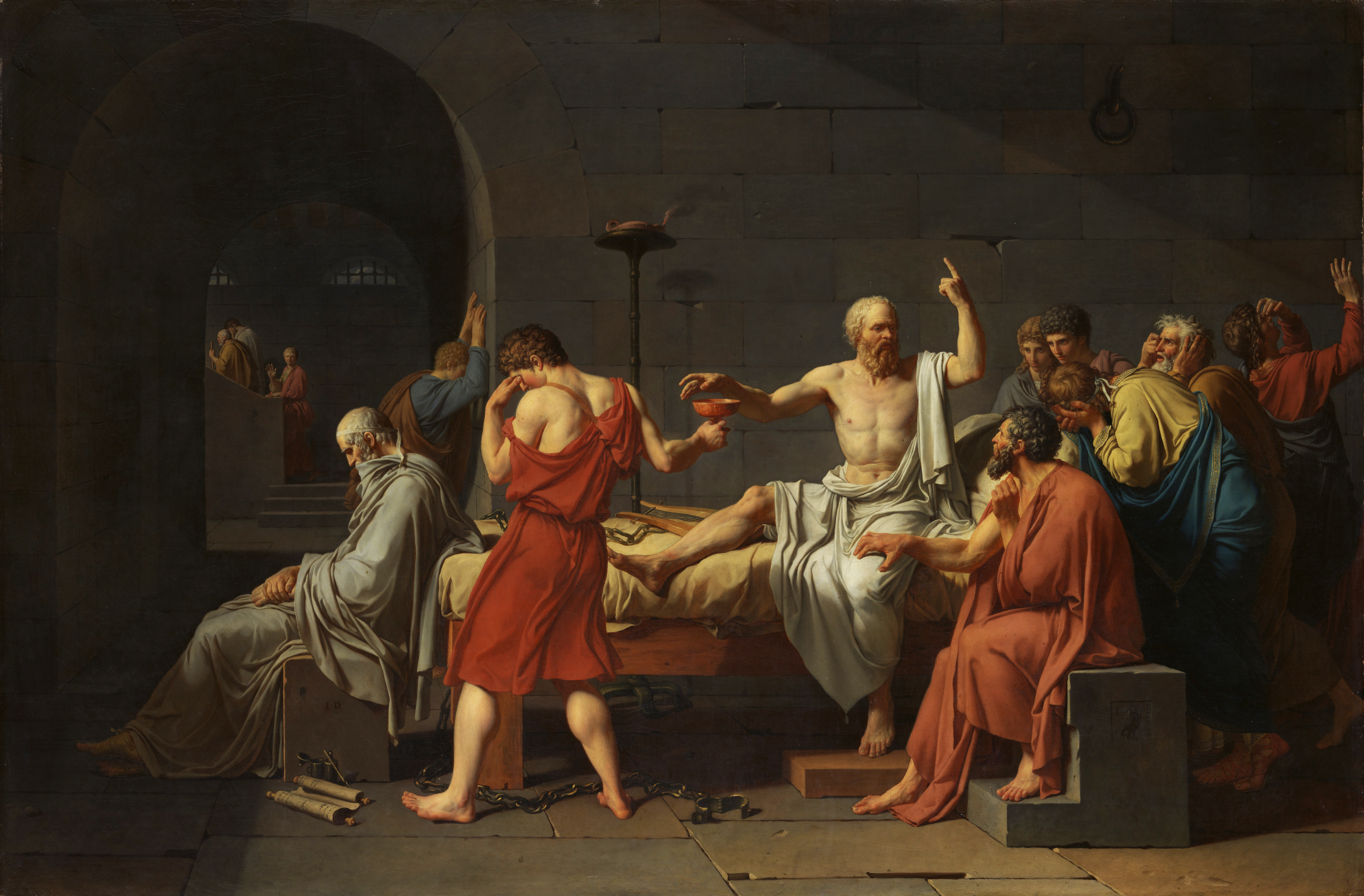
A Neoclassical painting of an old man seated upright on a prison bed, one hand reaching for a cup, the other raised, surrounded by grieving men in robes
School

Independent

all eras · 4 thinkers

Most philosophy is a relay race. A school forms around a founder, students refine the master's system, objections get absorbed, and the tradition rolls forward as a shared project others can join. The thinkers gathered here did the opposite. Socrates founded nothing, wrote nothing, and was executed by his own city for asking too many questions. Schopenhauer lectured to an empty hall, having deliberately scheduled his classes against the most famous philosopher in Germany, and was ignored for thirty years. Marx spent his life in exile and a library reading room, certain that the whole business of interpreting the world was a way of leaving it alone. Nietzsche published books almost no one read, collapsed into eleven years of silence, and called himself not a man but dynamite. None of them built a system to enroll in; each took a hammer to the comfortable consensus of his age. They share no doctrine, only a stance: the conviction that truth is something a single person wrests from the crowd, against the crowd, usually at a cost. The strange fact the relay-race picture misses is that these outsiders, not the patient system-builders, are the ones who most decisively shaped what came next.


These thinkers founded no school and joined none. They are listed together only because they refused every other label: the source, the loner, the dynamite.
The core claim
Before
Philosophy is a tradition one joins and builds on: the truth is a shared edifice, assembled across generations, and a thinker proves himself by adding to the structure he inherited
After
Philosophy is the solitary individual standing against the consensus of his age: the truth is something one person wrests from the crowd, against the crowd, and the system everyone has agreed to is the first thing to be doubted
The whole Independent storyThe tradition across the centuries, in the house voice
Inside the read
The anti-tradition
Socrates: the gadfly who wrote nothing
Schopenhauer: shouting into the empty hall
Marx: change the world
Nietzsche: the dynamite
Why the outsiders shape what comes next
The thinkers
Socrates
c.470 – 399 BC
Wrote nothing, questioned everything, and died for it.
Read
Schopenhauer
1788 – 1860
The world is blind will — striving, suffering, without purpose.
Read
Marx
1818 – 1883
Philosophers have interpreted the world; the point is to change it.
Read
Nietzsche
1844 – 1900
God is dead — and we must become who we are without him.
Read