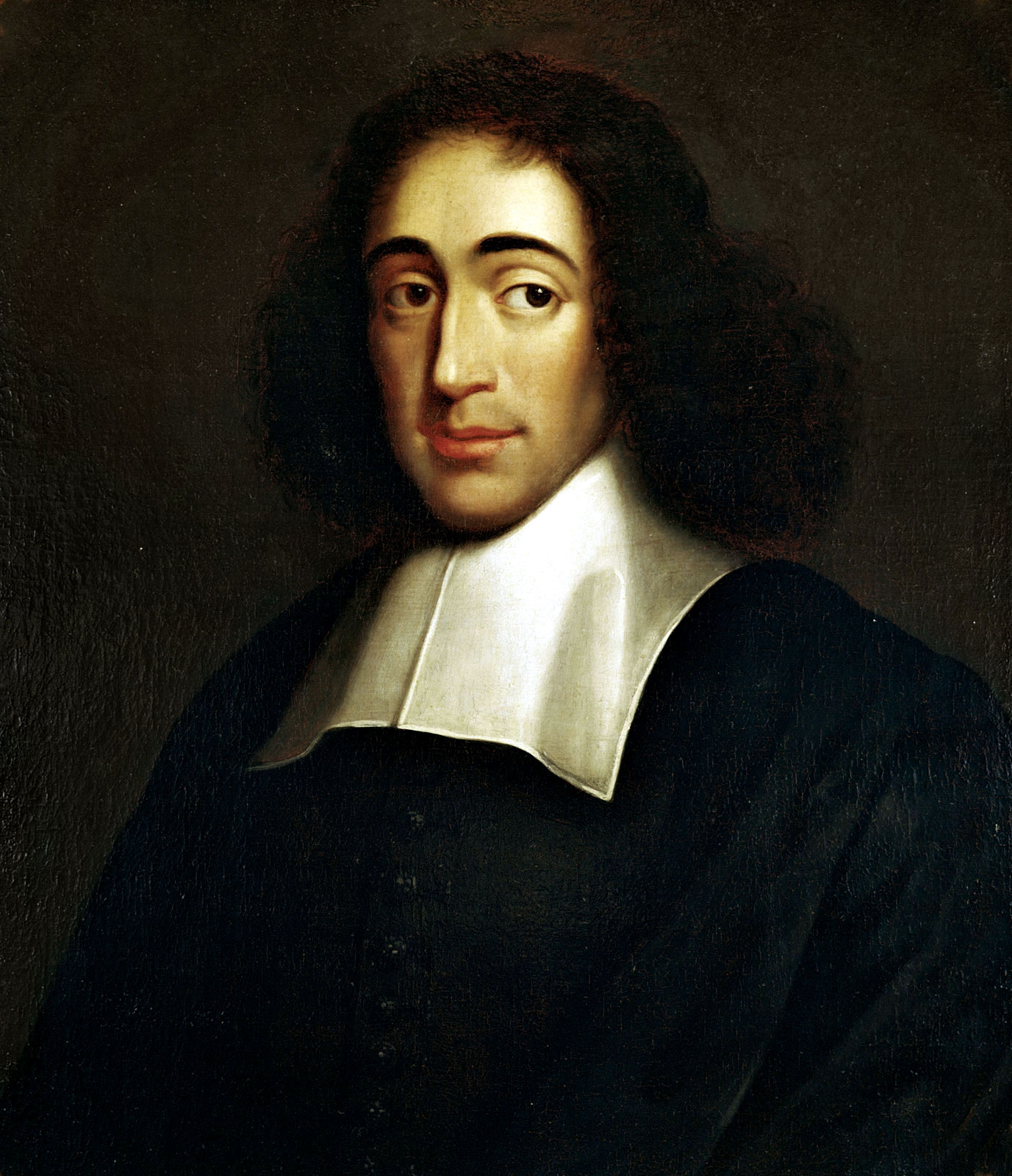
On 27 July 1656, in the Portuguese synagogue of Amsterdam, the elders read out the harshest writ of expulsion the congregation ever issued. It cursed the man it named by day and by night, sleeping and waking, going out and coming in. It forbade every member of the community to speak with him, to do him any kindness, to read anything he wrote, or to come within four cubits of him. The document does not say what he had done. It speaks of "abominable heresies" and "monstrous deeds" and leaves the rest to the imagination. The man it cast out was twenty-three years old, the son of a respected merchant family, and his name was Baruch de Spinoza. The ban was never lifted. It is still in force.
He did not fight it. He did not convert to anything else; no church took him in and he sought none. He left his family's import business to his half-sister after a lawsuit, took the Latin form of his name (Benedictus, which means the same as the Hebrew Baruch: "blessed"), and went quiet. He learned a trade, grinding optical lenses to a precision that drew praise from the best scientists in Europe, and he lived on what the lenses brought in, plus small gifts from friends, in a series of rented rooms in towns near Leiden and The Hague. He turned down a university chair because it came with conditions on what he could teach. He turned down a pension large enough to bend him. He wanted exactly one thing, and it was the one thing the ban had tried to take: the freedom to follow an argument wherever it went.
Where it went was somewhere no one in Europe had been willing to go in the open. Descartes, a generation earlier, had rebuilt the world on the certainty of the thinking self and propped it up with a God who guaranteed the rest (the rationalists chapter, and the Descartes read). Spinoza had read Descartes closely, taught him, written a textbook on him. And he concluded that Descartes had stopped three steps short of the conclusion his own method demanded. Follow the reasoning honestly, Spinoza decided, and the result is not a thinking soul, a separate material world, and a God overseeing both. The result is one thing: one single infinite substance, of which a person's mind and body and the stone in the road and the law of falling weights are all just temporary expressions. He had a name for it that he used as a single breath: Deus sive Natura, God, or Nature.
He wrote it down in the strangest book in the history of philosophy: the Ethics, built like a geometry textbook, with numbered definitions and axioms and propositions, each proof signed off with Q.E.D., as if blessedness could be demonstrated the way Euclid demonstrates that the angles of a triangle make a straight line. He did not publish it in his lifetime; he knew what it would cost. His friends printed it the year he died, his initials on the title page in place of his name. The man who took Descartes' two worlds and a God above them proved, step by numbered step, that there is only ever one.
The break
The view Spinoza broke from was not a strawman, and it was not only Descartes. It was the entire shared furniture of seventeenth-century Europe, and it deserves its strongest statement. On that view there are, at bottom, several different kinds of being. There is God, an infinite person: a maker who exists necessarily, who freely chose to create a world he did not have to create, who stands over it as an author stands over a book, and who can be addressed, obeyed, and disobeyed. There is created matter, the stuff of bodies, extended in space and pushed around by mechanical law. And there are created minds or souls, immaterial, free, made in some likeness of God, capable of surviving the death of the body. Three kinds of thing, in a clear hierarchy, with God at the top making free choices about the rest. This is a coherent picture, it is the picture of the Bible read straight, and it had organized Western thought for fifteen centuries. Descartes' two created substances (the Descartes read) sit inside it without strain.
Spinoza's break begins with a single technical word and a refusal to flinch from where it leads. The word is substance: in this tradition, a substance is something that exists on its own, that depends on nothing else to be what it is. Descartes had said there were many substances (God, and each created mind, and matter). Spinoza takes the definition seriously and asks the obvious question nobody had pressed: if a substance is by definition something that depends on nothing else, how could there be more than one? A created mind depends on God to exist; so by the definition it is not really a substance at all. Followed all the way down, the reasoning leaves only one thing that fits the definition of "depends on nothing else": the infinite, self-caused whole. There is exactly one substance. Everything the tradition had called a separate created thing is, on this reasoning, not a substance but a mode: a particular, temporary modification of the one substance, the way a wave is not a separate thing from the sea but a passing shape the sea is taking.
The concrete move, the thing that makes this modern philosophy's most radical system, is the identification stated flat: that one substance is God, and that same one substance is the whole of Nature, and these are not two facts but one fact said twice. Deus sive Natura. The little Latin word sive means "or" in the sense of "in other words," not "or else." God is not a person who made Nature and could have made it differently or not at all. God is Nature's own infinite, necessary existence, considered as the active source from which everything follows. Nothing stands outside this whole, because for something to stand outside it, it would have to be a second substance, and there cannot be two. There is no maker over the world, because the world and the maker are the same single thing. There is no view from nowhere, no author closing the book, no outside.
Everything that scandalized Spinoza's century, and most of what is genuinely his, falls straight out of that one identification. If there is no God outside Nature choosing freely, then nothing in Nature is chosen either; everything follows by necessity from the one substance's nature, and free will is an illusion (Chapter 3). If mind and matter are not two substances but two attributes of the one thing, the problem Descartes could not solve (how an immaterial mind moves a material body) simply dissolves, because they were never two things to interact (Chapter 2). And if blessedness is real, it cannot be a reward handed out by a personal God in another life, so it has to be something a person reaches here, by understanding (Chapters 4 and 5). With the maker taken off the top of the world, the whole rest of the system is the working-out of what is left.
Chapter 1
The ban
"Men think themselves free inasmuch as they are conscious of their volitions and desires, and never even dream, in their ignorance, of the causes which have disposed them so to wish and desire."
He was born Bento de Spinoza on 24 November 1632 in Amsterdam, into the community of Portuguese Jews who had fled the Iberian Inquisition and rebuilt their lives in the tolerant Dutch Republic as merchants and traders. (The three forms of his first name run together through his life: Bento in the Portuguese of his household, Baruch in the Hebrew of the synagogue, Benedictus in the Latin he wrote his philosophy in. All three mean the same thing, "blessed.") His father, Michael, was a successful importer and a pillar of the congregation. The boy was educated in the community's own school, in Hebrew and the Bible and the Talmud and the great medieval Jewish philosophers, and he was clearly brilliant. He was, by every expectation, headed for a life inside that world: the family business, the synagogue, a respected name.
Something went wrong, quietly, in his early twenties. He had begun reading outside the curriculum, in Latin, in the new science and the new philosophy; he had fallen in with freethinkers; and he had started saying things. What exactly he said is not recorded in his own hand from those years, but the community's reaction tells the shape of it. On 27 July 1656, when he was twenty-three, the elders of the Talmud Torah congregation pronounced the cherem against him: the herem, the writ of excommunication and ban. It was, by the congregation's own later memory, the most severe such document it ever issued, and it was never rescinded.
The text of the ban is precise about the punishment and silent about the crime, and that silence is itself a fact worth keeping straight, because retellings love to fill it in. The document curses him, forbids any member of the community to communicate with him in speech or writing, to show him any favor, to be under one roof with him, or to come within four cubits of him, and it forbids anyone to read anything he composes. But it states only that the elders had long known of his "evil opinions and acts," his "abominable heresies," and his "monstrous deeds." It names not one specific doctrine. So the honest report is that the surviving document does not tell us what he was banned for. The standard inference, from what he later wrote, is that he had denied the things the community could not let pass: a providential, personal God who acts in history; the Torah as literally dictated by God; the immortality of the individual soul. That inference is reasonable. It is not the document talking.
His response set the pattern for the rest of his life. He did not recant, and he did not seek another fold; no church received him and he asked none to. After a legal fight with his half-sister over their father's estate (which he won, then largely handed back, keeping only his mother's bed), he stepped fully out of the merchant world. He took the Latin name Benedictus, learned the trade of grinding optical lenses, and lived on it. The lenses were not a hobby. Lens-grinding was skilled, exacting work at the cutting edge of the new science (telescopes and microscopes both needed good glass), and Spinoza was good enough at it that the astronomer and physicist Christiaan Huygens, no easy judge, praised his lenses. The trade let him eat without owing his opinions to anyone.
And that independence is the whole key to the man, because it was offered away from him more than once and he kept refusing. He lived plainly in rented rooms, moving from Amsterdam out to the village of Rijnsburg near Leiden, then to Voorburg, then to The Hague, working on his books in the hours the lenses left him. When the University of Heidelberg offered him a professorship of philosophy, with a guarantee of "the most extensive freedom in philosophizing," he turned it down, because the offer also asked him not to disturb the established religion, and he could see that no honest philosophy could promise that in advance. He turned down a large pension from an admirer when it came with strings. He accepted a small annuity from the family of a dead friend only after insisting it be cut to a sum he could live on without being owned. He wanted to be poor enough to be free.
He published almost nothing under his own name and lived long enough to see what publishing cost. In 1670 his Theologico-Political Treatise came out anonymously, with a false imprint, and it caused exactly the storm he had braced for: it was condemned by church authorities, formally banned, and denounced across Europe as one of the most dangerous books ever written (Chapter 5 is what was in it). After that he kept the great work, the Ethics, in his desk. He let trusted friends read the manuscript and circulate it quietly, but he would not print it, because he had measured the temper of his age and found it unsafe for the truth. The Ethics appeared only after he was dead, in a collected edition his friends rushed out in 1677, his name on it as nothing but his initials. He had written the most systematic case in modern philosophy for a world without a personal God, and he had the sense to publish it from beyond reach of the people it would enrage.
He died on 21 February 1677, at The Hague, forty-four years old, of a lung disease (consumption, almost certainly tuberculosis) that was very likely made worse by the trade that had kept him free: the fine glass dust thrown off by years of grinding lenses, breathed in day after day in small rooms. He left no fortune, few possessions, and a desk of manuscripts. He had been cursed by his own people, banned by the state, and denounced by the churches, and he had, by the testimony of those who knew him, lived one of the calmest and most contented lives any philosopher is recorded to have lived. The man who proved there is no personal God to reward the virtuous seems to have been, himself, remarkably hard to disturb.
Chapter 2
One substance
"Besides God no substance can be granted or conceived."
The Ethics opens not with a person, a place, or a problem, but with a definition. "By God," it begins, in Elwes's translation, "I mean a being absolutely infinite—that is, a substance consisting in infinite attributes, of which each expresses eternal and infinite essentiality." That is the first move and it is a quiet ambush. The word doing the work is substance, and Spinoza is using it in its strict philosophical sense, inherited from the whole tradition: a substance is a thing that exists in and through itself, that depends on nothing else to be what it is, that needs no other thing in order to exist. Everything in the system follows from holding that definition steady and refusing to let it slip.
The argument, stripped to its spine, is short and merciless. A substance, by definition, depends on nothing else. Now consider any two supposedly separate substances. If they were truly distinct, each would have to be fully self-contained, depending on nothing outside itself, including the other. But anything finite is bounded by something outside it (a finite thing is precisely a thing that other things limit and act on), so a finite thing depends on what bounds it, and therefore is not, in the strict sense, a substance at all. The only thing that could genuinely depend on nothing else is something infinite, unbounded, with nothing outside it to limit it. And there cannot be two of those, because each would limit the other and neither would be infinite. So: exactly one substance, infinite, self-caused. "Besides God," Spinoza writes at Part I, Proposition XIV, "no substance can be granted or conceived."
The plain version is easier than the proof. Most people picture reality as a vast collection of separate things (people, planets, atoms, thoughts) each with its own little independent existence, all set inside a God who made them. Spinoza says that picture has it backwards. There is one thing, and it is everything, and it depends on nothing because there is nothing else for it to depend on. What look like separate independent objects are not independent at all. They are local, temporary features of the one thing, the way a whirlpool is not a separate object floating in the river but a shape the river is briefly making. A person, a stone, an idea, a storm: each is what Spinoza calls a mode, a particular passing modification of the single substance, real as a wave is real, but no more a thing-on-its-own than a wave is.
Then the second half of the definition, the part that does the work Descartes could not finish: the one substance has "infinite attributes." An attribute, in Spinoza's vocabulary, is a fundamental way the one substance is, a basic aspect under which a mind can grasp its whole nature. The substance has infinitely many of these, but human beings can know only two of them, and they happen to be exactly the two that Descartes had cut into separate worlds. One attribute is Thought: the substance, considered as mind, as ideas. The other is Extension: the very same substance, considered as matter, as bodies in space. And these are not two things. They are one thing described two ways. Mind and matter are not two substances that somehow have to interact. They are two attributes of a single substance, two faces of one coin, and the coin is God-or-Nature.
This is the precise point where Spinoza answers Descartes, and naming the difference exactly is the whole payoff. Descartes had two complete substances, mind and body, sharing no property in common, and was left with the famous unanswerable problem of how an unextended thought could ever move an extended arm (the interaction problem that Elisabeth of Bohemia pressed and he could not solve; the Descartes read). Spinoza's answer is to deny that there are two things there at all. A decision and the arm's motion are not a ghostly mind reaching across a gap to shove a physical body. They are one and the same event in the one substance, described once under the attribute of Thought (as a decision) and once under the attribute of Extension (as a motion). Spinoza states the matching law at Part II, Proposition VII: "The order and connection of ideas is the same as the order and connection of things." The mental story and the physical story run in perfect parallel, never crossing, because they are not two stories. They are the same story in two languages. There is nothing to interact, so there is no problem of interaction. The hardest knot in Descartes is not untied; it is shown never to have been there.
Both easy labels for the resulting God are wrong. Spinoza was denounced in his own century as an atheist, and he has been praised since as a mystic "intoxicated with God." Neither fits cleanly. He is not an atheist in the ordinary sense: he affirms, in proof after proof, that God necessarily exists, that God is the one infinite substance, that everything is in God. But his God is nothing like the God of the synagogue or the church. This God did not choose to create the world, because there was never a moment of choice and never an alternative; the world follows from God's nature with the same necessity by which a triangle's angles follow from its definition. This God has no purposes, grants no favors, hears no prayers, issues no commands, plays no favorites, and offers no afterlife of reward. To worship it in the ordinary way would be a category mistake, like thanking gravity. The charge of atheism and the praise of piety are both reaching for the same fact: Spinoza kept the word "God" and emptied it of the person. What is left is the world itself, understood as infinite and necessary. Deus sive Natura.
Chapter 3
Nothing could have been otherwise
"From the necessity of the divine nature must follow an infinite number of things in infinite ways."
Once the maker is removed from above the world and identified with the world, a hard consequence comes due immediately, and Spinoza pays it without blinking. A personal God who freely chooses to create can choose otherwise; on that picture the world is one of many God could have made, and within it human souls, made in God's image, get a little share of that same freedom to choose. Take the choosing God away and that whole structure collapses. There is no choice anywhere, at any level, because there is no chooser standing outside the causal order to make one. Everything that happens follows necessarily from the nature of the one substance, exactly as the properties of a triangle follow necessarily from what a triangle is. "From the necessity of the divine nature," Spinoza writes at Part I, Proposition XVI, "must follow an infinite number of things in infinite ways." Nothing in the universe could have been even slightly otherwise.
That includes every human action, and Spinoza says so flatly: free will is an illusion. Not free will as in political freedom, and not the freedom he will rescue in the last chapters, but the specific belief that a person, faced with a decision, could genuinely have done otherwise than they did. Spinoza denies it. Every choice a person makes is the necessary outcome of prior causes (their nature, their history, their body's condition, the situation pressing on them), causes that stretch back in an unbroken chain, every link of which had to be exactly what it was. The will is not a tiny uncaused engine sitting outside the causal order, free to tip events one way or the other. It is part of the order, caused like everything else.
His explanation of why the illusion is so universal is the sharpest single line in the whole book, and it has the rare quality of being testable against ordinary experience. People feel free, he says, only because they are aware of their wants and unaware of what produced them. "Men think themselves free," runs the passage at the Appendix to Part I, "inasmuch as they are conscious of their volitions and desires, and never even dream, in their ignorance, of the causes which have disposed them so to wish and desire." The feeling of freedom is not the perception of an uncaused choice. It is the experience of a desire whose causes are hidden from the person having it. A person feels the want and does not see the machinery that made the want, so it seems to come from a free self at the center. Remove the ignorance and the freedom goes with it.
His own image makes the point cleaner than any restatement. Suppose a stone is thrown through the air. While it flies, it has, of course, no awareness at all. Suppose the stone were conscious, aware of its motion through the air and aware of nothing else, with no knowledge of the hand that threw it. The stone would be utterly convinced that it was flying of its own free will, that it sailed through the air because it chose to and wanted to. It would be wrong, and it would be wrong in exactly the way human beings are wrong about their own choices: conscious of the motion, blind to the throw. A man who reaches for a drink is sure he freely chose to; he is simply the stone, aware of the flight, ignorant of the arm.
The natural objection arrives at once, and Spinoza meets it head-on, because it is the objection that determines whether the whole system is livable or monstrous. If nothing could have been otherwise, if every cruelty and every kindness was strictly necessary, then what becomes of blame, of praise, of any reason to do one thing rather than another? Why not lie in bed? Spinoza's answer is that understanding necessity does not make a person passive; it changes the kind of action they are capable of. A person who grasps the real causes of things stops raging at the world for not being other than it had to be, stops the futile resentment of what could never have been different, and acts instead from clear understanding rather than from blind passion. This is not resignation. It is the difference between being pushed by forces whose causes are hidden and acting from a nature that is understood. The freedom Spinoza denies is the freedom to break the causal order. The freedom he offers is the freedom to comprehend it, and to be moved by that comprehension rather than by the dark.
Chapter 4
Bondage and the affects
"Everything, in so far as it is in itself, endeavours to persist in its own being."
Most philosophy treats the emotions as interruptions, storms that blow through an otherwise rational mind and have to be ridden out or suppressed. Spinoza does something almost no one had done before him: he treats the emotions as a subject for geometry. Part III of the Ethics sets out to study the affects (his word for the emotions: love, hate, fear, hope, joy, sadness, envy, pity) with the same cold method as the rest, and he is explicit about the strangeness of the project. He proposes, he says, to consider human actions and desires exactly as if they were a question of lines, planes, and solids. No moralizing, no horror at human weakness, no praise of virtue. Just an analysis of how the affects work, the way a geometer analyzes a figure. The emotions are not failures of reason. They are natural events with natural causes, and they can be understood.
The engine that drives the whole account is one concept, and it is Spinoza's most quietly influential idea: the conatus. Every single thing, he argues, insofar as it exists at all, strives to keep on existing. "Everything, in so far as it is in itself," reads Part III, Proposition VI, "endeavours to persist in its own being." This is not a desire some creatures happen to have. It is what it is to be a particular thing at all: a thing is a pocket of the one substance that holds itself together and resists dissolution, and that self-maintaining effort, that striving to persist, is the thing's very essence. In a stone the conatus is just inertia, the tendency to stay as it is. In a living body it is the drive to survive. In a human mind, aware of itself, the conatus shows up as will and as desire. The whole of human motivation, on Spinoza's account, is this one striving, taking different shapes.
From that single root the emotions deduce themselves with an elegance that is genuinely surprising. The basic affects are just three. There is the conatus itself, the striving (Spinoza calls it desire). There is joy, which is what the mind feels as it passes to a greater power of persisting, when the striving is succeeding and the self is becoming more capable. And there is sadness, which is what the mind feels as it passes to a lesser power, when the striving is being thwarted and the self is being diminished. Everything else is built from these. Love is simply joy, plus the idea of an outside cause of that joy; a person loves whatever they understand to be making them more capable, more alive. Hate is sadness plus the idea of an outside cause; a person hates whatever they understand to be diminishing them. Hope is joy mixed with uncertainty about a future thing; fear is sadness mixed with the same uncertainty. The whole turbulent emotional life of a human being is variations on a single theme: the rise and fall of one thing's effort to keep being itself.
And this is where the title of Part IV comes from: "Of Human Bondage." A person is in bondage, on Spinoza's account, exactly to the extent that they are driven by affects whose causes they do not understand. Consider a man consumed by jealousy. He is wretched, sleepless, cruel to the person he claims to love, acting against his own clear interest, and utterly unable to stop, because he experiences the jealousy as simply happening to him, an overwhelming force with no handle on it. He is passive before it; it moves him and he does not move it. Spinoza calls such an affect a passion, in the old sense of something suffered, undergone, done to the person. The jealous man is the thrown stone again, conscious of the flight, blind to the throw, except now the flight is agony. To be ruled by passions whose causes stay hidden is what it is to be unfree, and most human misery, Spinoza thinks, is precisely this: being shoved around by emotions that feel like fate because their machinery is out of sight.
The way out is the hinge of the entire , and it is not what any religion of his day was selling. The remedy for a passion is not to suppress it by willpower (which is impossible, since the will is just the conatus and has no separate lever to pull) and it is not to repent of it before a God who will forgive it. The remedy is to understand it. An affect that is a passion, Spinoza argues, ceases to be a passion as soon as we form a clear and distinct idea of it: the moment the jealous man genuinely understands the causes of his jealousy (the events, the insecurities, the bodily states, the whole chain that produced this feeling in him by necessity), the feeling changes its character. It stops being a force happening to him and becomes something he comprehends, and in comprehending it he is no longer merely its victim. He does not stop having a nature; he starts acting from it with his eyes open rather than being dragged by it in the dark. Knowledge does not cancel the emotions. It converts them from things that own the person into things the person owns. That conversion is the whole movement from bondage toward freedom, and freedom, for Spinoza, turns out to have a destination.
Chapter 5
The intellectual love of God
"Blessedness is not the reward of virtue, but virtue itself."
The last part of the Ethics is titled "Of Human Freedom," and it asks the question the whole machine was built to answer: given that nothing could be otherwise, that there is no personal God to save anyone, and that the self is a passing mode of the one substance with no soul to survive it, what is the best a human life can be? Spinoza's answer is not consolation and not resignation. It is something he is prepared to call blessedness, and it is reached by a particular kind of knowing. He distinguishes three kinds of knowledge: the first is vague experience and hearsay, the muddled way most beliefs are picked up; the second is reason, the clear grasp of how things follow from general laws (this is the knowledge of the Ethics itself); and the third, the highest, he calls intuitive knowledge, which sees particular things directly as flowing from the eternal nature of God-or-Nature, grasping the individual case as a necessary expression of the whole.
From that highest knowledge a specific joy arises, and giving it its name is the climax of the system. When a person understands particular things this way, as following necessarily from the eternal nature of the one substance, they feel joy; and joy, recall, paired with the idea of its cause, is love. Here the cause understood is God-or-Nature itself. So the joy of understanding the world as a necessary expression of God is a love of God. Spinoza names it precisely at Part V, Proposition XXXII, Corollary: "From the third kind of knowledge necessarily arises the intellectual love of God" (in his Latin, the amor Dei intellectualis). It is crucial how unlike ordinary devotion this is. It is not warm feeling toward a person in the sky; the God here is not a person and does not feel anything back in the way a lover does. It is the steady joy of a mind that comprehends reality as it necessarily is, directed at the totality that reality is. To understand the world deeply enough is, on Spinoza's account, automatically to love it, because deep understanding is itself a kind of joy, and joy with a cause is love.
Spinoza then makes a claim that sounds like mysticism but is, in his system, a tight deduction: this love is part of God's own self-relation. Because the human mind is an idea in the attribute of Thought, and that attribute is God's, the intellectual love by which the mind loves God is not something separate from God reaching toward God. It is, Spinoza argues, part of the infinite love with which God loves himself. The human mind understanding Nature is Nature understanding itself through that mind. And in this, he says, our salvation lies. "Our salvation, or blessedness, or freedom," reads the Note to Part V, Proposition XXXVI, "consists... in the constant and eternal love towards God." Three words for one state: salvation, blessedness, freedom. They are the same thing, and that thing is the mind's settled love of the necessary order it has come to understand.
The single most important thing about this blessedness, the line that separates Spinoza from every religion of reward and punishment around him, is that it is not paid out later for good behavior. The Ethics ends, at Part V, Proposition XLII, on exactly this: "Blessedness is not the reward of virtue, but virtue itself; neither do we rejoice therein, because we control our lusts, but, contrariwise, because we rejoice therein, we are able to control our lusts." The order of that sentence is where the whole ethics turns. The ordinary religious picture says: master the desires now, and bliss comes later as the reward. Spinoza reverses it. Blessedness is not earned by mastering the desires; the desires come under control because blessedness has been reached. The joy of understanding is not the prize for being good. It is what being good is, and being good and being free and being happy are, in the end, the same condition: a mind that understands, and is moved by its understanding rather than by its blind passions. There is no afterlife in this. The blessedness is available now or not at all, in this life, by this knowing, to anyone who does the work.
There is a wholly different book that belongs in this chapter, because it is where Spinoza turned the same convictions on politics and religion, and it is the book that nearly cost him everything: the Theologico-Political Treatise of 1670, published anonymously and promptly banned across Europe. Two arguments in it changed the world more quickly than the Ethics did. The first was a method for reading the Bible: Spinoza insisted that Scripture be studied like any other ancient document, as a human text with a human history, written by particular people in particular circumstances for particular purposes, its books to be dated and compared and understood in their own contexts rather than received as the direct dictation of God. This is one of the founding moves of what became modern biblical scholarship, and to his contemporaries it was an outrage. The second argument was political, and it gives the treatise's final chapter its ringing title: "That in a Free State every man may Think what he Likes, and Say what he Thinks." Spinoza argued that the genuine purpose of the state is not to control belief but to secure freedom; that a government cannot in fact command what people think, and destroys itself trying; and that freedom of thought and expression is not a danger to public peace but a condition of it. The man whose own community had cursed him by day and by night for his opinions wrote the early modern world's clearest case that no authority has the right to do such a thing to anyone. It was banned, of course. He had expected nothing else.
Chapter 6
The afterlife of one substance
"For the eternal and infinite Being, which we call God or Nature, acts by the same necessity as that whereby it exists."
When Spinoza died in 1677 and his friends rushed the Ethics into print, his name was already a curse word across learned Europe. "Spinozism" became a label one threw at an enemy to end his career, a synonym for atheism, fatalism, and the dissolving of God into mere matter. For a century after his death almost no one defended him in public, though a remarkable number of people read him in private. He was the philosopher denounced by day and studied by night. The very completeness of his system, the way it followed without a gap from one definition to a world with no personal God and no free will, made it both impossible to ignore and dangerous to be caught agreeing with.
He sits, in this era, as one of the three great rationalist system-builders, and the cleanest way to see what is his is to set him beside the other two, all three answering the same Descartes. Descartes had left the wound of two substances that could not interact (the Descartes read). Spinoza healed it by collapsing the two into one: there are not two substances to interact, only one substance with two attributes, so the problem dissolves. Leibniz, the third of them, went the opposite way: where Spinoza reduced everything to a single substance, Leibniz multiplied substance into infinitely many simple units he called monads, each one self-contained and windowless, never interacting at all but kept in step by a harmony God established at the first instant. The two men actually met: Leibniz visited Spinoza at The Hague in 1676, the year before Spinoza died, and came away both fascinated and alarmed, careful afterward to distance himself in public from a system whose necessity left no room for the free choices Leibniz's God and Leibniz's monads required. One substance, two substances, infinite substances: the three rationalist systems are three answers to the single question of how many fundamental things there are, and Spinoza's answer (exactly one) is the most economical and the most disturbing.
The recovery, when it came, was sudden and total. In the late eighteenth century a fierce public controversy in Germany over whether the recently dead Lessing had secretly been a Spinozist (the "Pantheism Controversy") put Spinoza back at the center of European thought, and this time the verdict reversed. The Romantics and the German Idealists, Goethe above all, found in Deus sive Natura not a cold atheism but an overwhelming vision of a single living whole, divine and natural at once, that a person could love. Hegel said flatly that to be a philosopher one must first have been a Spinozist (the German Idealists chapter, era 4). The man burned as the great atheist of the seventeenth century became, in the nineteenth, the philosopher of God-intoxication. Both readings are picking up something real in the same text, which is the surest sign of a genuinely new idea: it does not fit the boxes that existed before it.
What he permanently changed is larger than any of the systems. Spinoza is the first major European philosopher to build, in the open and in full, a complete picture of reality with no personal God in it, no special place for human beings above the rest of nature, no free will, and no afterlife, and then to argue that such a world is not bleak but contains everything a human being needs to live well. That combination (a thoroughly disenchanted universe plus a real, this-worldly blessedness available in it) is one of the permanent options in Western thought, and almost everyone who has reached for it since has reached, knowingly or not, back toward him. His biblical criticism helped found the modern study of Scripture. His argument for freedom of thought helped found the modern defense of free expression. And his single substance, of which mind and matter are two faces, keeps returning under new names whenever someone tries to say that the mental and the physical are not two separate realities but one reality seen two ways.
Measure him the way he would have insisted on being measured: not by whether his conclusions are comforting, but by whether they follow. He set out to demonstrate, in the cold steps of geometry, that there is one infinite substance and no other; that it is God and Nature said twice; that everything follows from it by necessity and nothing could have been otherwise; that the self is a passing mode of it with no soul to outlast the body; and that the best a human life can be is to understand all this clearly enough to love the whole of which it is a part, here, now, without reward and without appeal. Whether the proofs hold is still argued. What is not in question is that he meant every step, lived by it with a calm that astonished everyone who met him, and refused every offer that would have made it safer to think. He had been cursed by day and by night and forbidden to anyone within four cubits, and he spent the rest of his life grinding glass and demonstrating, line by line, that the universe is one thing and that understanding it is the only blessedness there is. The community that banished him has never lifted the ban. The argument it banished has never gone away.