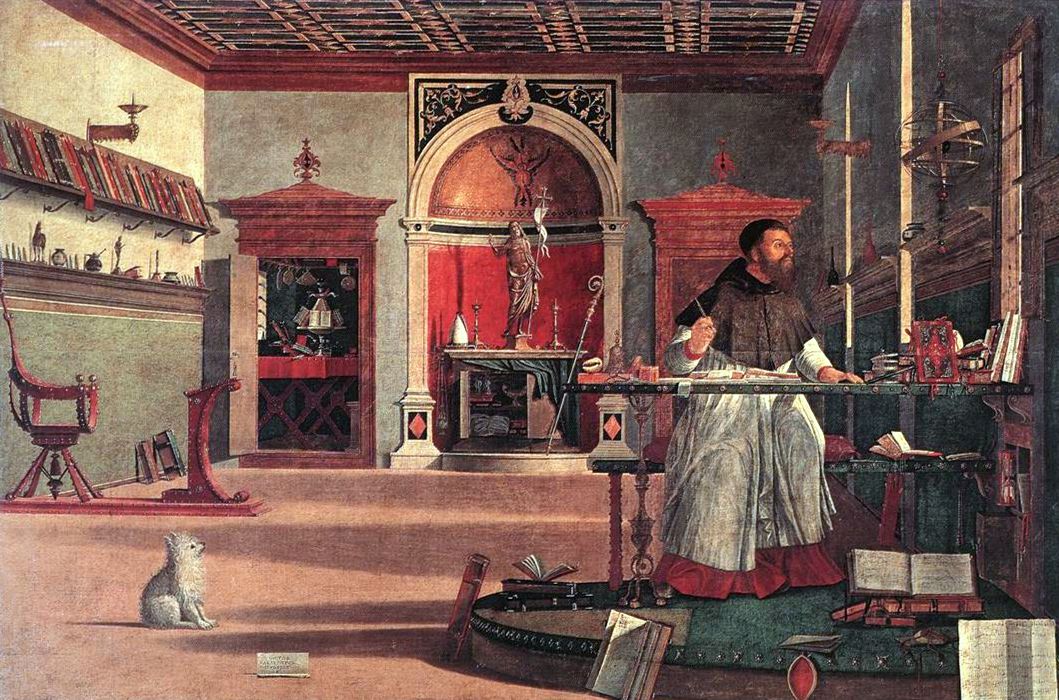
Around the year 397 a North African bishop in his early forties sat down to write the story of his own life, and produced something the ancient world had never seen. Augustine of Hippo (354–430) called it the Confessions (in Latin the Confessiones), and the title is the first thing to get right, because it does not mean what a modern reader assumes. The Latin verb behind it, confiteri, carries two senses at once: to confess one's sins, and to confess, acknowledge, praise God. The book is both, inseparably. It is not a tell-all memoir, not misery-lit, not a celebrity's reckoning with his past. It opens in praise, before a single sin is named, and the confession of his wrongs and the confession of God's goodness turn out to be the same act.
The form shapes every sentence: the Confessions is not addressed to readers at all. It is one long prayer, spoken in the second person directly to God ("Thou," on every page) from beginning to end. The reader is not being told a story but overhearing a man talk to God, and let in on the conversation. That is why the book can be so naked. He is not performing for an audience he needs to impress. He is talking to the one listener who already knows the worst, and the reader simply leans at the same window.
Two clocks run through it, and they must be kept apart. The events happen in the 370s and 380s: Augustine's boyhood, his twenties and early thirties, up to his mother's death in 387. But he writes around 397 to 400, a bishop looking back across more than a decade, with the finest literary training in the Latin world. The famous scenes, the conversion in the garden and the vision at the window, are reconstructed years later by a master of persuasion who knows exactly what he is doing. "As Augustine tells it" is the honest frame to keep. All the dates here are CE; there is no BCE in this story.
The shape is a book with a hinge. The first nine books narrate a soul wandering and finally turning: boyhood, a heresy, a career, the garden. Then the autobiography stops, two-thirds of the way through, and the last four books turn the same gaze on the mind itself: on memory, on the nature of time, on the meaning of the first chapter of Genesis. People who love the conversion story often never reach the second half, and the second half is where the Confessions becomes philosophy. What follows walks the whole thing, both halves, the way it was built.
The break
Before the Confessions, writing about oneself meant writing about one's deeds. Caesar narrated his campaigns. The emperor Augustus left a marble list of his public achievements. Memoir was a record of action and office, what a man accomplished out in the world, told to secure his name. And philosophy, when it sought the good life, sought it outward and upward: in the order of the cosmos, in the well-run city, in the changeless Forms the mind could climb toward. The Platonist books Augustine would read pointed the mind away from the particular self and up toward something impersonal and universal. Neither the historians nor the philosophers turned the searching gaze inward onto one confused, desiring, particular self that does not yet know what it wants.
Augustine's break is to make the inner life the real subject, and to write it as prayer. He takes the Platonist turn inward and stops it at the self, then reports what is actually there: not a tidy soul climbing a ladder, but a will divided against itself, a memory of unfathomable depth, a heart that wants the good and wants the wrong thing more, in the same breath. He narrates the moment he could see the good clearly and still could not will it, the gap between knowing and doing that the philosophers could not close for him. And he addresses the whole report to God, so that examining himself and worshipping are one motion. The confession of sin is the confession of praise.
The concrete claim is this. The Confessions is the first book to make a person's interior (memory, desire, the divided will, the restless heart) the genuine subject of a sustained narrative, and to do it as a prayer rather than a performance. It opens the entire Western tradition of interiority, of taking one's own inner life to be a country worth mapping and a place where the deepest truth might be found. Everything later that treats the self as something to be examined from the inside runs back, more than anywhere else, to this book.
Chapter 1
The restless heart, and a boyhood
"Thou madest us for Thyself, and our heart is restless, until it repose in Thee."
That is the first sentence of the book, spoken to God before a word of the life story has begun. It states the whole thesis before the argument starts: a person is made for something, and until they reach it nothing will hold them still. The singular matters: Pusey's Augustine says "our heart is restless, until it repose in Thee," one heart, at rest only in one place. (The more familiar version, "our hearts are restless until they rest in Thee," is a different translator's wording; the one above is Pusey's, and it is the one quoted throughout.) The destination is named in the opening line. Everything that follows is the journey toward it, told backwards, by a man who already knows where it ends.
And then, instead of beginning at his birth, Augustine begins with what he cannot remember. Infancy he reconstructs by watching other babies: the grasping, the wailing, the jealousy of a child at the breast who resents another child sharing it. His point is not nostalgia; it is theological. Even the infant, before it can speak or choose, is already willful and grasping and disordered. Sin, for Augustine, is not a habit picked up later in life. It is the native condition of the restless heart, present before memory itself.
Boyhood he does remember, and the schooling in it left a mark. He was beaten by his teachers, hated learning Greek, and loved Latin literature, loved it, he confesses, in a way that troubles him looking back. He wept over Dido, the queen of Carthage in Virgil's Aeneid who kills herself when her lover Aeneas sails away, and he wept real tears for that fictional grief while remaining perfectly dry-eyed about the state of his own soul. A made-up queen's sorrow moved him more than his own condition did. He offers it as a small, exact example of a misdirected heart: feeling lavished on a fiction while the real thing nearest home goes unfelt. The disorder he will spend the whole book tracking is already here, in a schoolboy crying at a poem.
A word on who he was, since the book assumes its reader already knows. Augustine was born in 354 in Roman North Africa, the clever son of a modest family that spent what it had on his education, the one ladder a poor provincial could climb. His mother, Monica (MON-ih-kah, around 331 to 387), was a devout Christian whose prayers run under the whole book; she is its second protagonist, not a minor figure, and the story will end on her. His father, Patricius (puh-TRISH-us), was a pagan small landowner who was baptized only near death and gets very few lines. Monica is the one to keep in view: the Confessions is as much her story as his, and Augustine means it to be.
Chapter 2
The pears: stealing for the theft itself
"It was foul, and I loved it; I loved to perish, I loved mine own fault, not that for which I was faulty, but my fault itself."
The most analyzed crime in the history of philosophy is the theft of some pears by a bored sixteen-year-old. That is the whole event, and its smallness is the entire point. Idle at home one year, Augustine fell in with a gang of friends, and late one night they shook down a neighbor's pear tree and carried off the fruit. "A pear tree there was near our vineyard," he writes, "laden with fruit, tempting neither for colour nor taste." The pears were not even good. He was not hungry. He had better fruit of his own at home. They ate a few and threw most of the rest to the pigs.
Which is exactly what makes it worth thirteen pages. Strip away every ordinary motive (he did not steal from need, or for the fruit, or for the pleasure of eating it) and what is left? "For I stole that, of which I had enough, and much better," he writes. "Nor cared I to enjoy what I stole, but joyed in the theft and sin itself." The thing he wanted was the transgression. He did the wrong because it was wrong, for the thrill of doing it, and he is sure he would never have done it alone; it took the company, the laughter, the doing-it-together. The pears are Augustine's chosen specimen of a strange and disturbing thing: wrongdoing with no payoff but the wrongdoing itself.
And in the puzzle he finds something he keeps coming back to. "It was foul, and I loved it," he writes; "I loved to perish, I loved mine own fault, not that for which I was faulty, but my fault itself." The precise object of the love is not the thing he got by sinning, but the sin. A will that loves its own corruption, that takes pleasure in the act of going wrong as such: that is the thing the pears isolate, the way a lab isolates a single variable. A dramatic crime would have hidden it, because a dramatic crime has an obvious draw. A trivial one, done for nothing, exposes the will perversely in love with its own fault. That is the only reason the pears are in the book, and it is why oversells of the scene, Augustine the great sinner confessing a wicked youth, get it exactly backwards. The smaller the theft, the sharper the question.
Chapter 3
Carthage, lust, and nine years a Manichee
"Thou madest us for Thyself, and our heart is restless, until it repose in Thee."
Around 370 Augustine went to Carthage (the great Roman metropolis on the coast of modern Tunisia) to finish his training in rhetoric (the art of persuasive public speaking, which in the late empire was the gateway to a career in law or imperial service and could make a teacher rich). He arrived hungry for everything, into a city he later remembered as a cauldron of disordered, unholy loves. He fell for the theater, and confesses the strangeness of it: he loved to sit and be moved to grief by staged sufferings, to weep at sorrows that cost him nothing and that he would have hated to actually live, the Dido tears from boyhood, grown up. He took a mistress and lived with her, faithfully, for years.
Then the intellectual spark. In his studies he came across a now-lost work by Cicero (the great Roman orator) called the Hortensius, an exhortation to take up philosophy, to stop chasing money and fame and turn the mind toward wisdom for its own sake. It changed the direction of his desires; he treats it ever after as the moment the real search began. Fired up, he turned to the Bible to see whether it held the wisdom he now wanted, and recoiled. To a young man trained on Cicero's polished Latin, the scriptures read as crude, clumsy, beneath a person of taste. He shut the book. That recoil matters later: his road to faith will turn out to be a road back to a book he first threw down on literary grounds.
So the search went elsewhere, and it went to the Manichees (MAN-ih-keez); he stayed with them about nine years, roughly 373 to 382. The Manichees were a dualist sect founded by a third-century Persian prophet named Mani (MAH-nee), and their teaching was stark: the universe is the battleground of two eternal, co-equal powers, Light (good) and Darkness (evil), locked in endless war, and the human soul is a fragment of trapped Light struggling to get free of the Dark. Augustine joined as a hearer, the lower of the two Manichee ranks. The reason it gripped him is the reason the whole rest of his thought exists: it gave him an answer to the question that gnawed at him hardest.
The question was where evil comes from. If one good God made everything, then where did evil get in? The Manichee answer was a relief to a guilty, ambitious young man: evil is not God's doing and not the sinner's doing either, because evil is a foreign power, a dark substance at war with the light, and a person's own bad impulses are particles of that alien Dark caught inside, not really the self at all. It let him off a hook he could feel in his own chest. That relief is why he stayed nine years, and why, once he could see past it, he would spend so much of his life taking it apart. He knew its pull from the inside, because it had been his.
Chapter 4
Faustus, Rome, Milan, and Ambrose
"Thou procuredst for me, by means of one puffed up with most unnatural pride, certain books of the Platonists, translated from Greek into Latin."
The Manichee spell broke on a disappointment. For years they had told Augustine that every hard question he raised would be answered when their great teacher, the bishop Faustus (FOW-stus), arrived. Faustus came: eloquent, smooth, and, Augustine found, intellectually hollow, unable to answer the very doubts Augustine had been told to save for him. The let-down was the beginning of the end of his Manichee years. But a hollow spokesman is not a refutation; he left disenchanted, not convinced of anything better, a rising rhetorician with a lit-up mind and no home for it.
He moved up and out. In 383 he sailed to Rome, partly for the career, partly, he admits, to escape his mother's relentless surveillance, though Monica followed him anyway. A year later he won the prize that mattered: the chair of rhetoric in Milan (the city where the imperial court then sat), the most prestigious teaching post in the Western empire and a plausible step toward a governorship. He was thirty, successful, and intellectually homeless. Two things he met in Milan changed that, and both were arguments, not feelings.
The first was a man. Ambrose (AM-brohz, around 339 to 397), the formidable bishop of Milan, was a famous speaker, and Augustine went to hear him at first purely as a professional, to study a master's technique, and got ambushed by the content. Ambrose read the Old Testament allegorically: the crude stories that had embarrassed Augustine in Carthage, Ambrose treated as figures, the rough surface a shell over a deeper meaning. This dissolved Augustine's chief objection at a stroke. He had rejected Christianity partly because its book offended his taste; Ambrose showed him a way of reading that book that a man of taste could respect. The door he had bolted on literary grounds came open.
The second thing was a stack of books, the intellectual hinge of his whole life. Someone in Milan handed him, as he puts it, "certain books of the Platonists, translated from Greek into Latin": texts of Neoplatonism, the late, mystical revival of Plato's thought that taught the mind to climb from the visible world up to a single supreme source of all being. They were almost certainly the writings of Plotinus (ploh-TY-nus), the great third-century Neoplatonist. His phrasing about the man who provided them is barbed: God procured them for him, he says, "by means of one puffed up with most unnatural pride." The lender was insufferable; the gift saved him anyway. What those books taught him is the turn the next chapter is built on, so it gets its own telling. For now the shape is enough: a man converted by books at every turn, the Hortensius in Carthage, the Platonists in Milan, and soon a letter of Paul's in a garden. He reads his way into every change of his life.
Chapter 5
The books of the Platonists: God within, evil undone
"That evil then which I sought, whence it is, is not any substance."
The Platonist books gave Augustine three things he could not get from the Manichees, and together they broke the he had carried for nine years. The first was the idea that God need not be a body. The young Manichee had literally been unable to imagine a real, supreme thing that was not made of some stuff and spread out in space; even his God had been a kind of vast, luminous substance. The Platonists taught him that the highest reality is incorporeal: real, supreme, and made of no matter at all. That single thought rearranged everything, because it meant the Light-and-Dark picture, two great substances grappling, was answering the wrong question with the wrong kind of thing.
The second was the inward turn, the move the whole Confessions is built on. The Platonists pointed him not outward at the cosmos but inward, into himself, as the place to look for the truth. He puts it directly: "And being thence admonished to return to myself, I entered even into my inward self, Thou being my Guide." The road to the highest thing runs in, not out. This is the discovery that organizes the back half of the book, where he will go inward onto memory and time and find God present within. He learns the method here, from the Platonists, before he has any idea how far he will follow it.
The third was the one that finally dissolved the problem of evil, and it is the chapter's payload. "That evil then which I sought, whence it is, is not any substance," he writes. Evil is not a thing. It is not a power, not a dark substance, not an ingredient anyone made, because (the Platonists showed him) everything that exists, just insofar as it exists, is good in some measure, so evil cannot be one of the existing things. It is a privation: a good that should be present and isn't, a lack, a corruption, the way blindness is not a dark stuff in the eye but sight that is missing. And that reframes the killer question entirely. "Where does evil come from?" stops being a question with two terrible answers (God made it, or a rival did) and becomes a malformed question, like asking where darkness is manufactured. Evil is not made; it is a falling-away, a good gone missing or gone crooked. With that one distinction the wall he had been stuck behind for a decade simply was not there.
But the Platonists could only take him so far, and the limit is the seed of everything that follows. They showed him the destination (God incorporeal, the inward road, evil undone) and they could not give him the strength to arrive. They knew, he says, that the Word was God; they did not know that the Word was made flesh. They could describe the country and not get him into it. He now believed, intellectually, almost everything. He could see the good clearly. And he could not take the last step. Knowing the good, it turned out, was not the same as being able to will it, and that gap, between the mind that approves and the will that acts, is the thing that had him pinned, and the subject of the next chapter.
Chapter 6
The divided will and the garden
"Give me chastity and continency, only not yet."
This is the climax of the whole book, and it is not a battle with an enemy. It is a man at war with himself. Augustine now believed; he could not act. He wanted to let go of the ambition and the sex and the life he had, and he wanted to keep them, in the same breath: a will divided against itself, willing and refusing the same thing at once. He diagnoses it in the most honest sentence anyone had yet written about wanting to be good. Long before, he says, he had even prayed for the cure, and added a clause: "Give me chastity and continency, only not yet. For I feared lest Thou shouldest hear me soon, and soon cure me of the disease of concupiscence, which I wished to have satisfied, rather than extinguished."
It is usually quoted with a grin, as light self-knowledge, a man winking at his own weakness. In context it is the opposite, self-laceration. He is catching himself praying for a cure while privately dreading that the prayer might be answered too soon, because he is not finished enjoying the disease. He wanted to want the good. He did not yet want it. The two wills are both his, both real, pulling against each other, and the shame of watching them is the actual subject of Book VIII. The famous line is the symptom named, not the joke.
What finally moved him, he says, was other people's stories shaming him: accounts of men who had simply let go and turned, while he sat paralyzed, knowing better and doing nothing. It drove him into a garden in Milan in an agony of indecision, weeping, undone. And there, as he tells it, he heard a child's voice from a neighboring house, "a voice, as of boy or girl, I know not, chanting, and oft repeating, 'Take up and read; Take up and read.'" The Latin is tolle lege. The ambiguity is his own: boy or girl, he does not say, and the text does not say "a child" with any certainty. He took it as a command from God.
He went to where he had left a book of Paul's letters, opened it at random, and read the first passage his eye fell on. It was Romans 13, and here the words are Paul's, quoted by Augustine, not Augustine's own: "Not in rioting and drunkenness, not in chambering and wantonness, not in strife and envying; but put on the Lord Jesus Christ, and make not provision for the flesh, to fulfil the lusts thereof." And then the release: "No further would I read; nor needed I: for instantly at the end of this sentence, by a light as it were of serenity infused into my heart, all the darkness of doubt vanished away." The divided will was healed not by argument but in an instant, from outside.
Augustine handles the scene with care, and it repays the same. He is writing about eleven years after the fact, a trained rhetorician with a literary model in mind: the conversion of an Egyptian desert monk, Antony, who had also been turned by a verse heard at the right moment. So the honest claim is not "this is exactly what happened in the garden" but "this is how Augustine, a decade on, chose to tell it," and the choice is the revealing thing. He could have narrated a slow, reasoned change of mind. He narrated a voice and a flash of light, because the one thing he most wanted to say about his conversion was that he did not do it himself. Something reached into his stuck, divided will and turned it. His friend Alypius (uh-LIP-ee-us), reading beside him, took the next verse for himself and converted at his side.
Chapter 7
Monica: the vision at Ostia, and a death
"Lay this body any where; let not the care for that any way disquiet you: this only I request, that you would remember me at the Lord's altar, wherever you be."
The autobiography does not end on the conversion. It ends on his mother, and that is deliberate. Augustine resigned his rhetoric chair, withdrew to the country, and at Easter 387 was baptized by Ambrose, his son baptized at his side. Then he set out for home to North Africa with his mother Monica, and on the way they stopped at Ostia (OSS-tee-uh), the port of Rome, and there the book reaches its emotional and spiritual summit, which is not his conversion at all but a thing he and his mother do together.
He tells it quietly. "She and I stood alone, leaning in a certain window, which looked into the garden of the house where we now lay, at Ostia." Mother and son, talking of eternal life, of what the everlasting life of the blessed might be; and as they talked, their minds climbing together, they rose in thought past the heavens and the stars, past their own souls, and for a single instant, he says, "we slightly touched on her with the whole effort of our heart," her being eternal Wisdom itself. Then they fell back into ordinary speech. It is the only sustained mystical experience in the entire book, and it is shared: "she and I," together, for one instant. This is not Augustine's solo vision with his mother in the room. It is the two of them, ascending as one.
Days later, still at Ostia, Monica fell ill, and she knew she was dying far from the African town where she had always meant to be buried beside her husband. It no longer troubled her. "Lay this body any where," she told her sons; "let not the care for that any way disquiet you: this only I request, that you would remember me at the Lord's altar, wherever you be." Where her body lay had stopped mattering. "Nothing is far to God," she said; she did not fear that at the end of the world he would fail to find her and raise her up. She died there, at the port, and Book IX, and with it the whole life story, closes on her grave.
There is a silence in this book that the rest of it throws into relief. The book that makes Monica a heroine, a co-protagonist whose prayers shadow the entire arc, gives Augustine's partner of some fourteen years (the woman he lived with faithfully and who bore his son Adeodatus, ah-day-OH-dah-tus) no name at all, and no inner life. She is sent back to Africa when his career requires a respectable marriage, and she leaves the book the way she leaves his life, unnamed. Augustine names his mother, his friends, his teachers, and the woman he loved for a third of his life is a silence. The silence is part of the honest shape of the Confessions, and no one should fill it in. He does not.
Chapter 8
The turn inward: memory, time, and creation
"What then is time? If no one asks me, I know: if I wish to explain it to one that asketh, I know not."
Here the book turns, and most casual readers stop. The life story is over; Monica is buried; four books remain, and they are pure philosophy. Augustine has swung the inward gaze off his own history and onto the structure of the inner life itself, and this is where the Confessions becomes one of the great philosophical works of the ancient world. The first thing he explores is memory, and the awe in his voice is real. "I come to the fields and spacious palaces of my memory," he writes, "where are the treasures of innumerable images." It is a vast interior space, holding not just pictures of things seen but skills, feelings, ideas, and even the memory of forgetting. "Great is this force of memory, excessive great, O my God; a large and boundless chamber!"
And the search inside it loops back to the Platonists' lesson from Book VII. Augustine asks where, in all this immensity, God is to be found, and the answer is not among the stored images, as one more remembered thing, but above them: the truth he finds present within, the light by which he recognizes anything as true at all. He sought God outside, in the world, for years, and God was within the whole time. That is the burden of the most quoted lament in the book: "Too late loved I Thee, O Thou Beauty of ancient days, yet ever new! too late I loved Thee! And behold, Thou wert within, and I abroad, and there I searched for Thee." He had been searching abroad, outside, for what was at home in his own depths all along. (The popular form of that line, "Late have I loved Thee, Beauty ever ancient, ever new," is a modern translator's wording; the one above is Pusey's.)
Then comes the meditation that may be the most original thing in the book: the nature of time. It opens on the most honest sentence in the philosophy of time. "What then is time? If no one asks me, I know: if I wish to explain it to one that asketh, I know not." Everyone lives inside time their whole life; no one can say what it is. Augustine takes the puzzle by the throat. The past is gone; it does not exist now. The future has not happened; it does not exist yet. And the present has no length at all: the instant one tries to seize "now" it has already slipped into the gone-past. So all three parts of time seem to have no existence, a no-longer, a not-yet, and a vanishing edge. How can we even measure time, say that one sound lasted longer than another, when none of the thing being measured is ever actually there?
His answer is the inward turn applied to time. Time exists in the mind. Not out there as a cosmic river the soul floats on, but in here, as a stretching of the soul. The past exists as memory, present now; the future exists as expectation, present now; the present exists as attention, the mind's focus on the passing instant. There are not really three times but three modes of a single present in the soul (a present of things past, a present of things present, a present of things future) all of them happening now, in a mind stretched out across what it remembers and what it awaits. His word for that stretch is distentio (dis-TEN-tee-oh), a being-pulled-taut: time is the soul distended across past and future. To judge one note longer than another is not to measure sound out in the air; by the time the note is whole it is already gone. What is measured is the impression it left in the mind. Augustine is the first to make time psychological rather than cosmological, a fact about minds and not about the heavens, and it is one of the deepest pages anyone wrote in late antiquity.
The last two books turn from his own mind to a text: the opening of Genesis, "In the beginning God created the heaven and the earth." The narrative is gone for good now; this is sustained scriptural meditation, lighter to summarize than to live in. Augustine works through the creation (unformed matter, the firmament, the days) and along the way makes a strikingly generous argument: that a true text can carry more than one legitimate meaning, that where several honest readings of scripture are possible there is no need to insist only one of them is right. It is a deliberately open-handed way to read, from a man who could be anything but open-handed elsewhere.
And the work ends where it began. The first sentence said the heart is restless until it rests in God; the last book closes on that promised rest, the restlessness of the opening answered at the very end, the book curved back to its own first line, the journey arriving at the destination named before it started. That is the whole architecture of the Confessions in one gesture: a restless, scattered, outward-seeking self, set against rest, and gathering, and a God who was within the whole time. It is the first inward autobiography in Western literature, and it is written, from the first word to the last, as prayer.