After Sailor’s Creek, Lee kept moving west through the night and the next day, his men marching and starving in the same step. The army’s one hope was a trainload of rations waiting on the railroad at Appomattox Station, a few miles short of the larger town of Lynchburg. If the half-starved column could reach the cars, eat, and keep going, it might still slip around the Union pursuit and turn south. Everything now turned on a few boxcars of food and which side reached them first.
Sheridan understood that as clearly as Lee did, and his cavalry could move faster than infantry could march. On the afternoon of April 8, Brevet Major General George Armstrong Custer (North), the young and famously aggressive division commander, drove his troopers into Appomattox Station ahead of the Confederate infantry and seized the supply trains Lee was counting on. In the fight around the station Custer’s men also captured a large park of Confederate artillery and wagons, scattering the gunners and taking some twenty-five cannon. The food that was supposed to save Lee’s army was now in Union hands.
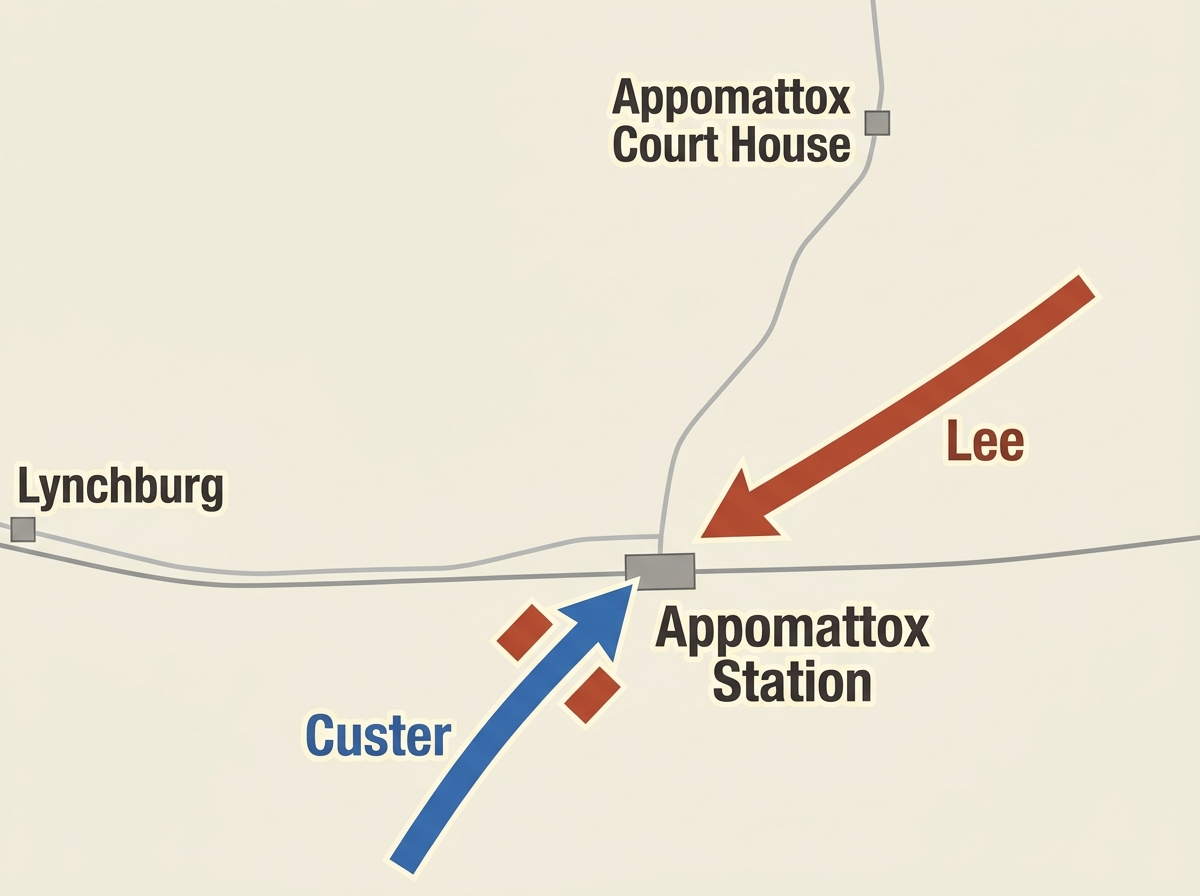
Worse than the lost rations was what the lost rations meant. With Custer astride the road at Appomattox Station, Sheridan’s cavalry was now in front of Lee’s army, not just behind it. The Confederates had been outrun. That night Lee’s campfires looked out on a ring of Union fires to the west, the direction he had to go, and he understood that the only way out lay straight through whatever was blocking the road in the morning.
A letter under flag of truce
Grant had already begun to write to him. On April 7 he had sent Lee a note pointing out that further resistance was hopeless and asking for the surrender of the Army of Northern Virginia. Lee was not yet ready, and his reply fenced for terms without conceding the point, asking what conditions Grant would offer. The notes went back and forth between the lines by courier over April 7 and 8 while the armies kept marching and fighting. Lee was buying time to see whether one more attack could open the road. If it could, he would take it. If it could not, the letters were the only thing left to write.
That night Lee called his senior officers together and settled on a last attempt. At first light the infantry of Major General John B. Gordon (South), with the cavalry alongside, would attack westward and try to break through whatever stood across the road. If it was only Sheridan’s cavalry, they could push it aside and the army might escape. If Union infantry had come up behind the cavalry overnight, there would be nothing to do. The whole question of whether the war went on came down to who was waiting in the dark beyond Gordon’s lines.