Before dawn on April 9, 1865, Palm Sunday, roughly nine thousand Confederates formed in the fields west of the village: Major General John B. Gordon’s (South) infantry and the cavalry of Major General Fitzhugh Lee (South), with what artillery remained. They were the last striking power the Army of Northern Virginia had left. Their orders were to break the line across the road and reopen the way west.
The attack went in a little before eight in the morning, the lead divisions under Major General Bryan Grimes (South) of North Carolina. At first it worked. The Confederates drove back Sheridan’s dismounted troopers, took some guns, and pushed the line off the high ground, and for a few minutes the road west was open. Then Gordon’s men crested the ridge and saw what lay beyond. It was not more cavalry. It was the massed infantry of Major General Edward Ord’s (North) Army of the James and Major General Charles Griffin’s (North) V Corps, tens of thousands of fresh troops in line of battle across the entire front, exactly the thing Lee had feared in the dark. The cavalry the Confederates had pushed aside simply slid out of the way and uncovered a wall of bayonets.
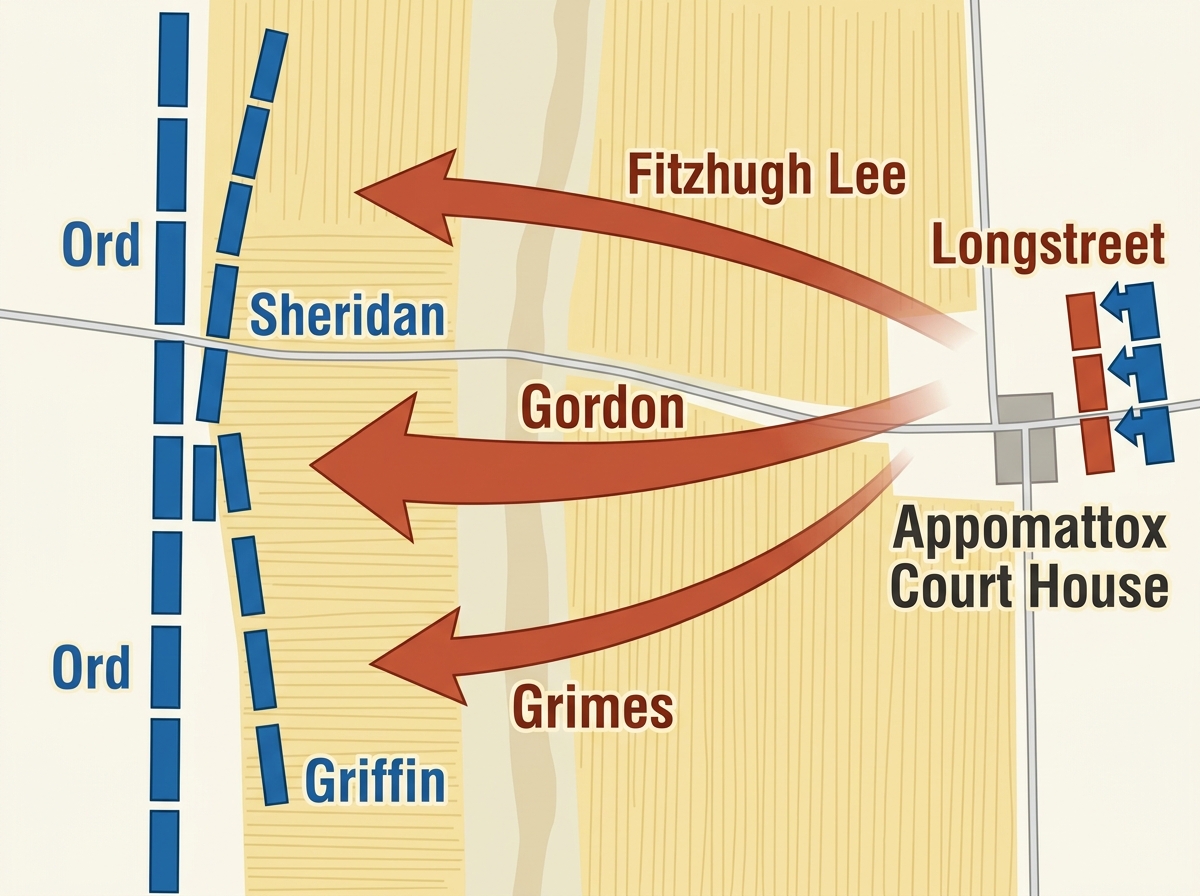
The attack stopped where it stood. There was nothing to break through and nowhere to go. Gordon sent word back to Lee that his command had been, in his own blunt phrase, fought to a frazzle, and that he could do nothing more unless heavily supported, support that no longer existed. The road west was shut. To the rear, Lieutenant General James Longstreet (South) was holding off the rest of Grant’s closing army with the other half of the Confederate force. The Army of Northern Virginia was surrounded on three sides and pressed against the village on the fourth.
Nothing left but the meeting
Lee already knew what the answer would be. He had told his officers the night before that if the road was blocked there was nothing for it but to see Grant, and that he would rather die a thousand deaths than do it. When Gordon’s message came, Lee said quietly that there was nothing left for him to do but go and see General Grant, and he would rather die a thousand deaths. He sent riders out under flags of truce, in places a soldier waving a white towel for a flag, to ask for the meeting that would end his army. The firing died away along the lines. After four years, the guns in Virginia went quiet by late morning on April 9.
The fighting at Appomattox Court House was small as Civil War battles went, a few hundred killed and wounded on the two sides together over the morning. But it was the period at the end of the sentence. Every other battle in this theatre had been fought to decide whether the war would go on. This one was fought to decide that it would not.