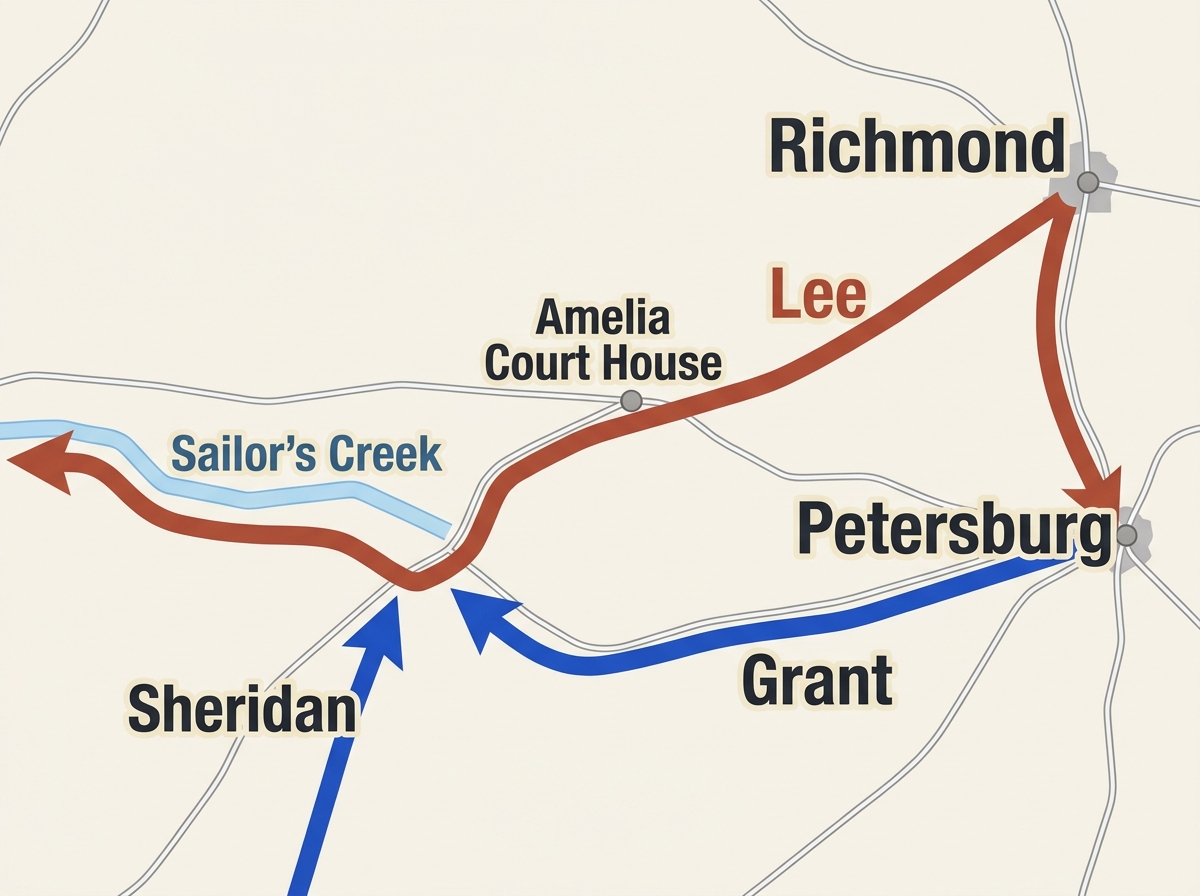
By the spring of 1865 the war the South had begun to preserve slavery was nearly lost, and the man who had carried it longest knew it. For almost ten months Robert E. Lee had held a line of trenches running for miles around Petersburg, the railroad town below Richmond through which nearly everything his army ate and fired had to pass. Lose Petersburg and you lost Richmond, the Confederate capital, and with the capital went the last pretense that the Confederacy was a country and not a shrinking pocket of starving men. Ulysses S. Grant had spent those ten months stretching his larger army farther and farther around the Confederate right, reaching for the last railroads, and Lee had fewer and fewer men to stretch with him.
On April 1, Major General Philip Sheridan (North) smashed the far end of Lee’s line at Five Forks, a road junction southwest of Petersburg, taking thousands of prisoners and dooming the last rail line into the city. Sheridan, Grant’s hard-driving cavalry commander, had been hammering at that flank for days. When it caved, the whole position was untenable.
Eastern TheatreFive Forks: the flank that broke the Petersburg lineThe next morning, April 2, Grant ordered an assault all along the front, and the worn-thin Confederate trenches came apart. Lieutenant General A. P. Hill (South), one of Lee’s most trusted corps commanders, rode forward to rally his lines and was shot dead by two Union stragglers. That night Lee got word to Richmond that the army was leaving, and on the night of April 2 and into April 3 the Confederates pulled out of Petersburg and the capital, setting fire to anything of military use as they went. Much of Richmond burned. The government of Jefferson Davis fled south by train.
Eastern TheatreThe fall of Petersburg: the assault that ended the siegeThe race west
What followed was a footrace for survival. Lee aimed his army west toward Amelia Court House, meaning to gather supplies, then turn south to join the only other Confederate army of any size, the one Joseph E. Johnston (South) still held together in North Carolina against William T. Sherman (North). If the two armies linked, the war might drag on. Grant’s job was simple to state and brutal to do: keep Lee from turning south, and run him to ground before he got there.
The supplies Lee expected at Amelia Court House were not there, and the day he lost hunting for food was a day Grant’s columns used to get ahead of him on parallel roads. Sheridan’s cavalry slashed at the Confederate flanks and rear the whole way, and Union infantry marched without rest to cut the roads in front. On April 6, at a stream called Sailor’s Creek, the pursuers caught a third of Lee’s strung-out army and tore it off, taking roughly 7,700 prisoners, among them nine generals. Watching the broken survivors stream back, Lee is said to have asked whether the army was dissolving. It very nearly was. He was down to perhaps thirty thousand men, many of them without weapons or shoes, and the gap between him and salvation was closing by the hour.