In the spring of 1861, a remarkable number of Americans believed the war that had just started would be over by autumn, and that they would win it in an afternoon. The Confederate States (the eleven Southern states that had broken away from the United States rather than accept limits on slavery) had fired on Fort Sumter, a U.S. fort in the harbor of Charleston, South Carolina, on April 12 and 13, and President Abraham Lincoln had answered by calling for 75,000 volunteers. Those volunteers signed up for 90-day enlistments, meaning they had promised the army only three months of their lives. That number was a confession of how short everyone expected this to be. Three months was thought to be plenty of time to march south, smash the rebellion in one big battle, and send everyone home before the harvest. Nobody enlists for ninety days if they think they are starting a four-year war.
Naval & CoastalFort Sumter: the shots that opened the warThe two sides were fighting over slavery, the system that held roughly four million human beings as property and on which the Southern economy was built. The Southern states had seceded, formally declared themselves out of the Union, to protect it, and several of those states said so directly in their official declarations of secession. The North did not march out that summer to end slavery; most of the men heading for Virginia would have told you they were fighting to put the Union back together. But the thing the Confederacy had seceded to defend, and the thing the war would ultimately be about, was whether human beings could be owned.
The 90-day war
The trouble with a 90-day army is that the clock runs out. By the middle of July 1861, those three-month enlistments were starting to expire, which meant the United States was about to watch its only real army melt back into a crowd of civilians without having fought anything. Two Union regiments (a regiment being roughly a thousand men, the basic building block of a Civil War army) had their time run out and literally turned around and marched back to Washington while the battle was beginning. They went home rather than re-enlist for one more day. If there was going to be a quick, war-ending victory, it had to happen now, before the men who were supposed to win it walked off the job.
The newspapers were not helping anyone stay calm. Starting June 26, 1861, the New York Tribune, the most influential paper in the country, run by the famous editor Horace Greeley, ran a standing demand at the top of its columns: "Forward to Richmond!", printed day after day like a drumbeat. Richmond, Virginia, was the prize. The Confederacy had moved its capital there from Montgomery, Alabama back in May, which put the rebel seat of government barely 100 miles (160 km) from Washington, close enough to feel like a quick march, and important enough that taking it might end everything. Between Greeley's drumbeat, an impatient Congress, and a public certain of victory, the pressure to attack became a wall.
You are green, it is true, but they are green also; you are all green alike.
The general who would have to do the attacking was Brigadier General Irvin McDowell (North), and he did not want to go. McDowell knew exactly what his army was: a mob of enthusiastic amateurs who had never fought, never marched far, never done any of it. He wanted more time to train them. He was overruled. The famous reply about both armies being equally raw is usually put in Lincoln's mouth in popular retellings, but careful scholarship attributes it to General Winfield Scott (North), the aging general-in-chief of the whole U.S. Army, and that is the safer attribution. Whoever said it, the sentiment was true and it did not save McDowell from the consequences. On the march to the battlefield, soldiers broke ranks to pick blackberries and wander off looking for water, because nobody had taught them yet that you do not do that. McDowell's plan would require precise, coordinated movements by exactly this army.
The spectators
When McDowell's army marched out of Washington toward Virginia, it was followed by a crowd. Hundreds of civilians, including United States senators and congressmen with their wives and families, rode out from the capital in carriages, packing picnic baskets and opera glasses, planning to find a good hill and watch the United States win the war the way you would watch a horse race. Senators Zachariah Chandler of Michigan, Ben Wade of Ohio, Henry Wilson of Massachusetts, and James Grimes of Iowa were among them. So was Representative Alfred Ely (North), a congressman from Rochester, New York, who had come out partly to check on a regiment he had helped recruit. They were certain it was going to be a show, and they had front-row seats. Almost none of them grasped that the thing they had come to watch was men killing each other a few hundred yards away.
Two armies and one railroad
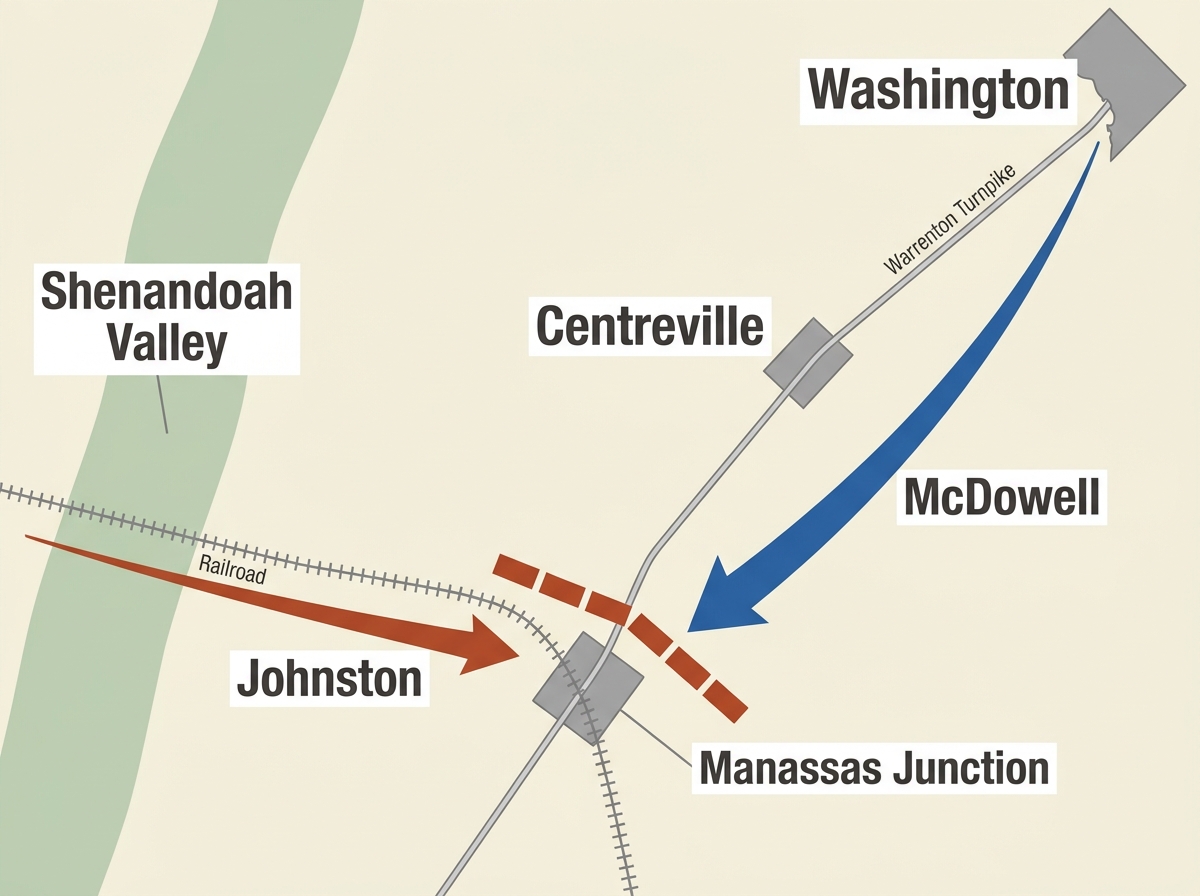
The Confederates had not been waiting passively. They had two armies in northern Virginia, and the whole battle turns on the relationship between them. The first, under Brigadier General P.G.T. Beauregard (South), the hero of Fort Sumter, sat at Manassas Junction, a spot whose entire importance was its railroads. It was where two rail lines crossed: the Orange & Alexandria Railroad and the Manassas Gap Railroad. Whoever held Manassas Junction held the overland gateway to Richmond, which is exactly why Beauregard, with around 21,000 to 22,000 soldiers, was dug in along a winding stream called Bull Run to block McDowell's path. The South would call the coming fight First Manassas, after the junction; the North would call it First Bull Run, after the creek. The two sides named battles by different rules all war long, the North after rivers, the South after towns, and the same fight often carries two names because of it.
The second Confederate army, around 11,000 to 12,000 soldiers under Brigadier General Joseph E. Johnston (South), was off to the west in the Shenandoah Valley, the long fertile farming valley that runs down the western side of Virginia behind the mountains. Johnston was being watched there by a Union force under Major General Robert Patterson (North), and that watching was the linchpin of McDowell's entire plan. The whole scheme only worked if Patterson kept Johnston pinned in the Valley, unable to come help Beauregard. The danger nobody on the Union side had fully reckoned with was that crossing rail line at Manassas. The Manassas Gap Railroad ran from the Valley straight to Beauregard's junction. If Johnston ever slipped away from Patterson, those tracks could carry his whole army to the battlefield faster than any army in history had ever moved.