Brigadier General Irvin McDowell's (North) plan was a good one. On the morning of Sunday, July 21, 1861, he set in motion a scheme that, with one more hour of speed or one more drilled division, might have won the war that summer. It was a smart plan handed to an army that could not yet walk in a straight line.
A Civil War army was built in nested layers: a regiment (roughly a thousand men) was the basic unit; a few regiments made a brigade (a few thousand); a few brigades made a division (bigger still). Generals moved these pieces around like a stack of blocks. Two more plain words are worth keeping handy: infantry are soldiers who fight on foot; cavalry are soldiers who fight on horseback. That is the whole vocabulary you need for the day.
Morning, July 21
The plan had two parts, the way a good boxing combination does. The first part was a feint, a fake attack meant to grab the enemy's attention and hold it in the wrong place. McDowell sent a division under Brigadier General Daniel Tyler (North), one of his division commanders, to make a loud demonstration at the Stone Bridge, where the main east-west road, called the Warrenton Turnpike, crossed Bull Run. Lots of noise, lots of cannon fire, the look of a serious assault, all designed to convince Beauregard that the real blow was coming there, at his right and center.
It was not. While Tyler hammered at the Stone Bridge, the bulk of McDowell's army, two divisions under Colonel David Hunter (North) and Colonel Samuel Heintzelman (North), two more of his division commanders, was swinging in a wide arc to the north and west to hit the Confederate flank, the exposed end of an army's line where it can be rolled up sideways like a rug. To get there they had to cross Bull Run at a ford, a shallow spot where a stream can be waded rather than bridged. The ford they aimed for was Sudley Springs Ford, about 3 miles (4.8 km) north of the Stone Bridge, well past the end of the Confederate line, so the Union flanking column could cross unopposed, then turn south and come crashing down on the rebel left from a direction Beauregard was not watching. Smash the flank, roll up the line, and cut Beauregard off from Manassas Junction behind him. On paper it was beautiful.
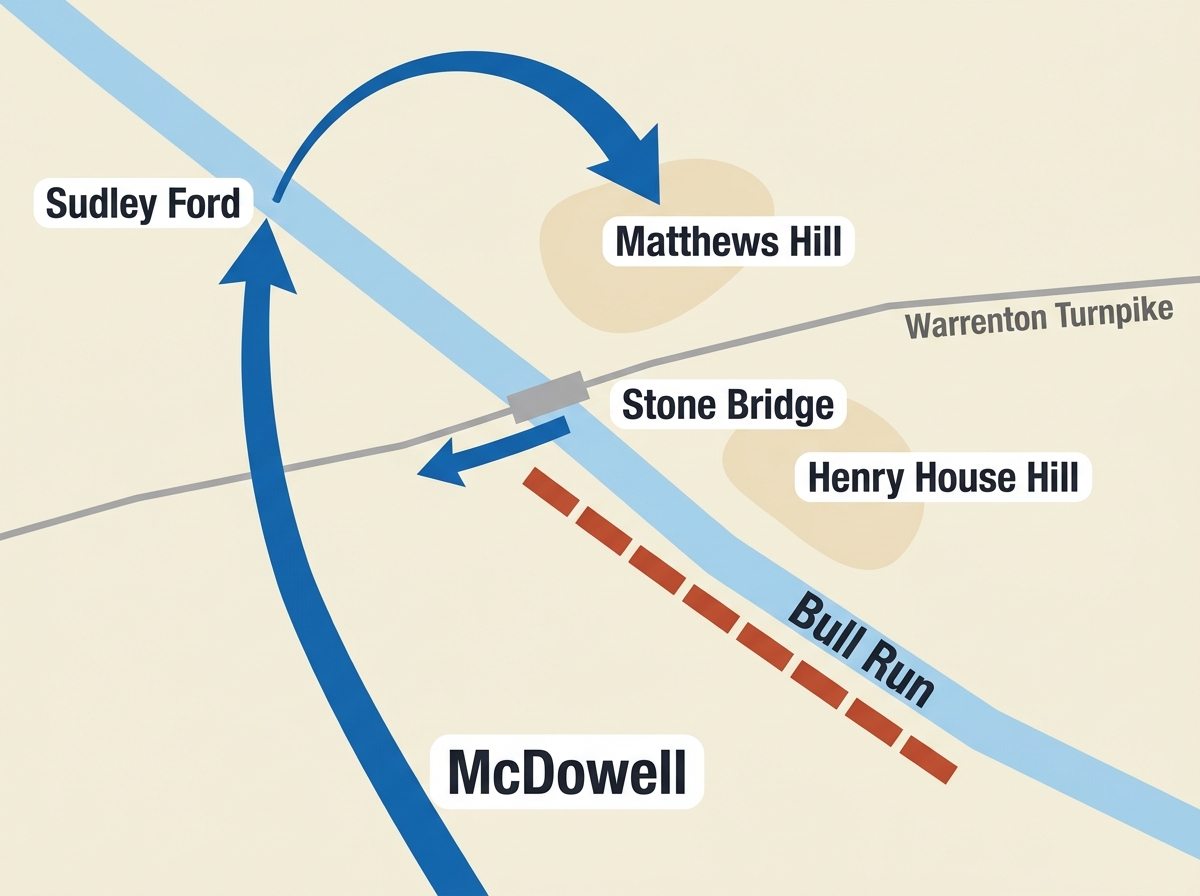
The trouble was the marching. Thousands of untrained men were strung out for miles on a narrow back road in the July heat, the column stretching and bunching like an accordion because nobody had drilled them in how to move this far, men falling out to gulp at every stream they passed, officers hoarse from shouting them back into line. The wide hook that was supposed to land at dawn instead dragged on for hours. The lead troops did not splash across Sudley Springs Ford until around 9:30 a.m., somewhere between two and a half and three hours behind schedule, and in those hours the surprise leaked away.
The warning came from one sharp-eyed man on the other side. A young Confederate signal officer, Captain Edward Porter Alexander (South), was scanning the country to the north when he caught a glint, sunlight bouncing off the bayonets of a column of men miles off, where no friendly troops should be. He worked out in an instant what it meant: an army was coming around the flank. Using wig-wag signaling, a system of waving flags in coded patterns to send messages across distance, used here in combat for the first time in history, he flashed a warning to the Confederate left: "Look out for your left, your position is turned." The total surprise was gone, but the flank attack was still coming, and it still had the weight to win.
Morning, July 21
The Confederate officer holding the threatened left, Colonel Nathan Evans (South), had barely 1,100 men, and he made a fast, smart decision: realizing the Stone Bridge attack was a bluff, he pulled most of his command away from it and rushed them north to Matthews Hill, the high ground sitting directly in the path of the oncoming Union flankers, and planted them there to buy time. Reinforcements scrambled up to help him: the brigades of Brigadier General Barnard Bee (South) and Colonel Francis Bartow (South). For a couple of hours Matthews Hill was a furious, stand-up fight, a handful of outnumbered Confederate brigades trying to hold back the entire weight of McDowell's hook.
They could not. There were too many Union troops, and worse was coming. Colonel William T. Sherman (North), the same Sherman who would become one of the war's most famous generals, found a second, unguarded ford upstream from the Stone Bridge, crossed with his brigade around 10:00 a.m., and slammed into the Confederate right on Matthews Hill, adding his weight to the pile. By around 11:30 in the morning, the Confederate line on Matthews Hill broke. Evans, Bee, and Bartow's men streamed back in retreat, southward across the Warrenton Turnpike and up the slope of the next high ground, a plateau called Henry House Hill. To the Union officers watching, and to the picnicking spectators craning through their opera glasses from the hills behind, it looked exactly like what they had all come to see: the rebels running, the Union advancing, the short war ending right on schedule.
It looked, for an hour around noon, exactly like the quick triumph everyone had marched out to watch.
It was about to come apart.