By midday on July 21, the broken Confederate brigades were streaming back from Matthews Hill in something close to rout, climbing the slope of Henry House Hill with a victorious Union army coming on behind them. The battle had a few hours left to run, and the things that made it famous, the legend, the turn, the rebel yell, and the only civilian death, happened on this one plateau.
Henry House Hill
The reason the Confederate retreat did not become a collapse was a brigade of Virginians that had not run, because it had not yet fought. Brigadier General Thomas J. Jackson (South) had brought his fresh brigade up near noon and positioned it on the reverse slope of Henry House Hill, the back side of the hill, the side facing away from the enemy, where the crest of the ground itself shielded his men from incoming artillery fire. It was a deliberate piece of tactics: his infantry waited in cover while he set 13 cannon on the crest above them to do the killing. Cavalry under Colonel J.E.B. Stuart (South) and the men of Wade Hampton's Legion, a privately raised South Carolina outfit, regiment-sized, mixing infantry, cavalry, and artillery under one wealthy planter, Colonel Wade Hampton (South), guarded his flanks. While the rest of the Confederate left fell apart, Jackson's line stood on that hill like a fixed point, unmoving, waiting. Somewhere in the long fire of that afternoon a bullet broke a finger on Jackson's left hand; he wrapped it, refused to leave, and kept building the legend while he bled.
That is where the most famous sentence of the battle was spoken. Brigadier General Barnard Bee (South), his own brigade shot to pieces and falling back, tried to rally his broken men. He pointed toward the Virginians on the hill and said the line that would name Jackson forever:
There stands Jackson like a stone wall! Rally behind the Virginians!
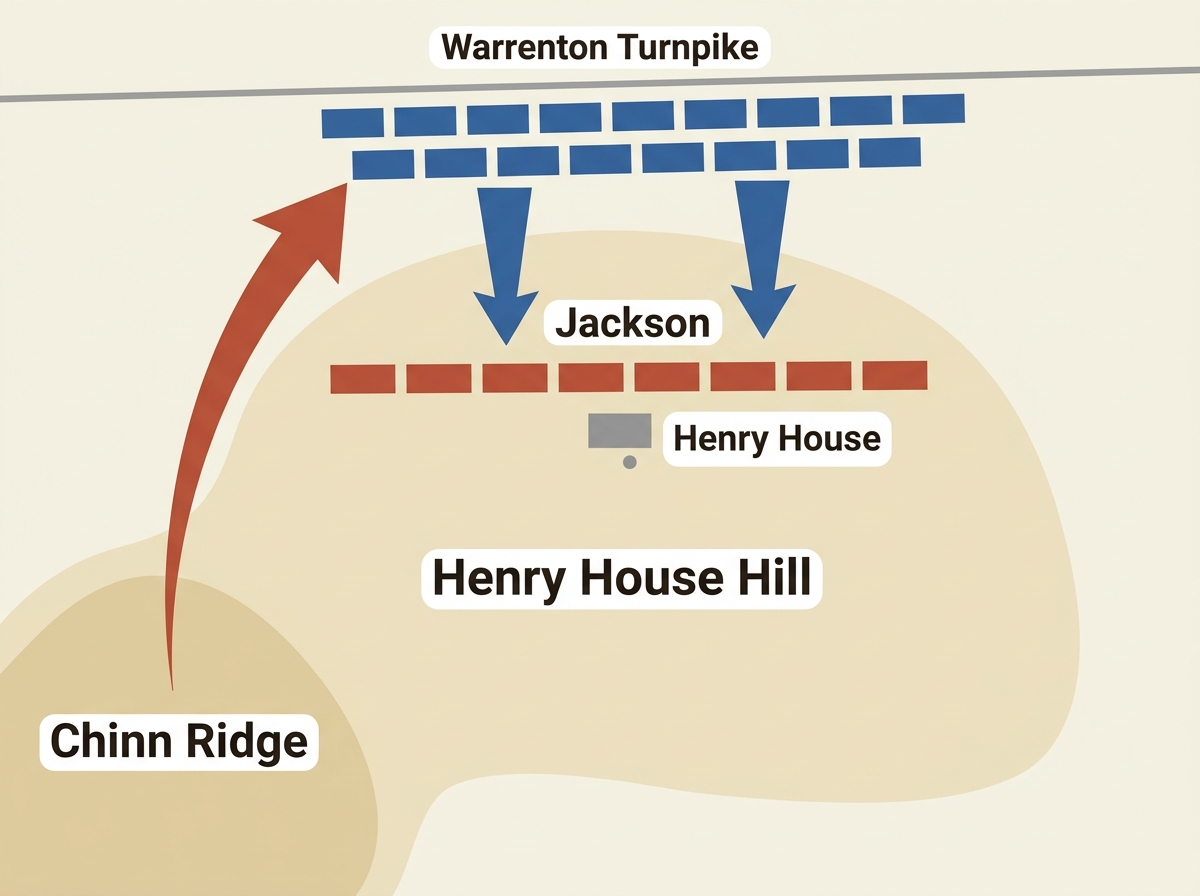
Nobody actually knows what Bee meant. The popular reading is pure praise: look how Jackson stands firm, rally on him, be like that. But there is a real and unresolved second reading. One Confederate officer, Major Chase Whiting (South), reported afterward that Jackson had refused to bring his brigade forward to support Bee's men while they were being slaughtered, and that Bee spoke the words in fury, not admiration: Jackson just stands there like a stone wall doing nothing while we are cut to pieces. We will never know which it was, because Bee was mortally wounded minutes after he spoke and died the next day, July 22, without ever explaining himself. The praise version became the legend; the rebuke version has serious historians behind it. Either way, the name stuck. From that hill on, he was Stonewall Jackson.
Henry House Hill
There was a house on the crest of that hill, and there was a person inside it.
Judith Carter Henry was around 85 years old, a bedridden widow, and the hill the two armies were now tearing apart already bore her family's name. It was her hill, the one she had lived on for the better part of a lifetime, long before either army had ever heard of it. When the fighting closed in, her family tried to carry her out of the house to safety. The old woman begged to be taken back to her own bed, and they did. Union artillery, convinced Confederate sharpshooters were firing from the house, turned its guns on it. A shell came through the bedroom wall and tore off one of her feet, with other wounds, and she died that same day in the bed she had refused to leave.
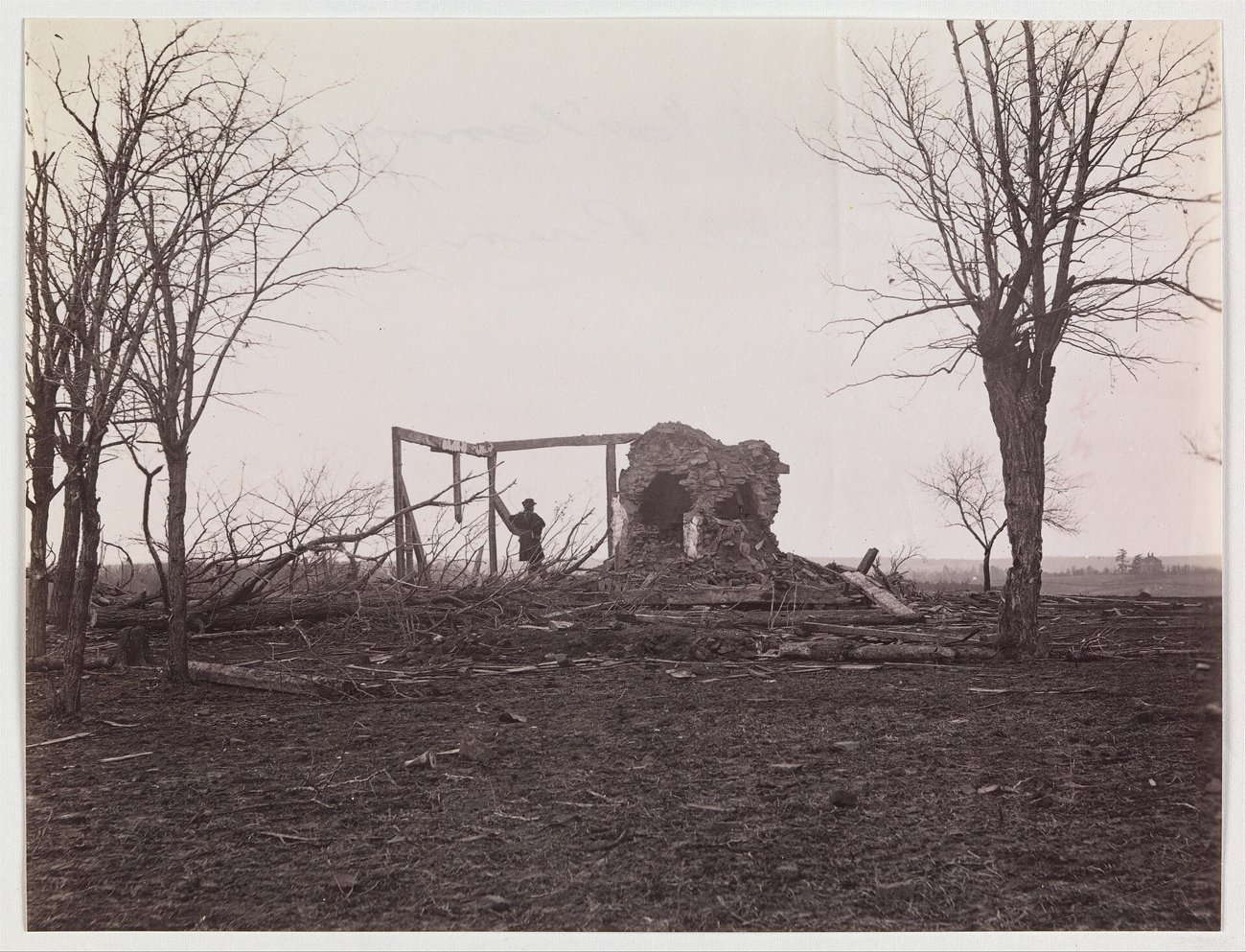
The first major battle of a war that would go on to kill three quarters of a million people took its first civilian life in an old widow's bedroom. Not a soldier, not a combatant, not anyone who had chosen a side, but an elderly woman who asked only to be carried back to her own bed and was killed in it by a shell fired at a house she happened to live in. The whole country would learn the name Henry House Hill. Almost no one would remember it was named for her. Judith Henry is considered the first civilian killed in the American Civil War, and the hill that made her famous is the hill that killed her.
Henry House Hill
For hours the two armies tore at each other across the plateau, and the worst of it gathered around the guns. Union artillery captains James Ricketts (North) and Charles Griffin (North) pushed their batteries (a battery being a cluster of cannon, here about 11 guns between them) forward onto the hill, into close, confused, point-blank fighting. Then a line of soldiers in blue came up out of the smoke toward the Union guns. They were Confederates, the 33rd Virginia, but early in the war uniform colors were not yet standardized, and plenty of Southern units still wore blue, the same shade as the U.S. Army. Griffin saw them, suspected the worst, and wanted to fire. He was overruled. Major William F. Barry (North), McDowell's chief of artillery, was certain the approaching men were friendly Union troops and ordered Griffin to hold his fire. They were not friendly. At a few dozen yards the 33rd Virginia leveled their muskets and shattered the gun crews, and the batteries were overrun. The guns changed hands again and again after that, in brutal close fighting, but that one held order, do not fire, they are ours, given to men dressed identically to the enemy, was the hinge.
What finally broke the day came off the railroad. The last of Johnston's brigades from the Shenandoah Valley, the men the trains had shuttled in, were still reaching the field through the afternoon, and they arrived on the exposed Union flank at the worst possible moment for McDowell. Brigadier General Edmund Kirby Smith's (South) brigade got there by rail around 3:30 to 4:00 p.m.; Kirby Smith was almost instantly shot down, wounded badly in the neck and shoulder, and command passed to Colonel Arnold Elzey (South), who drove the brigade in a charge that smashed into the right end of the Union line on Chinn Ridge, just west of Henry House Hill. At the same moment, Colonel Jubal Early's (South) brigade struck the same flank from another angle. Fresh Confederate troops, delivered by railroad to the exact spot where they would do the most damage, slammed into a Union army that was running out of strength.
And as they came on, the Confederates made a sound.
a high, broken, screaming cry, rising out of the smoke and coming straight at you
Through the afternoon's counterattacks the rebel infantry raised a battle cry that the men who heard it never forgot: the rebel yell, somewhere between a scream and a howl. First Bull Run is generally credited as its first appearance in a major battle. The order that supposedly set it off, a command from Jackson to "yell like furies," comes only from post-war accounts and does not appear in Jackson's own official reports, so we can describe the yell but not vouch for the order. Whatever started it, the effect on exhausted Union troops already bending under the flank attack was real. The tide on Henry House Hill had turned.