A battle that has gone one way for six hours can change in twenty minutes, and that is what happened to the Union army on the afternoon of July 21. One moment Brigadier General Irvin McDowell's (North) men were fighting a hard, even battle on Henry House Hill; the next, with fresh Confederates pouring onto their flank and that unearthly yell rising out of the smoke, they were an army no longer. Around 4:00 p.m. the Union line gave way, and the retreat began.
The Great Skedaddle
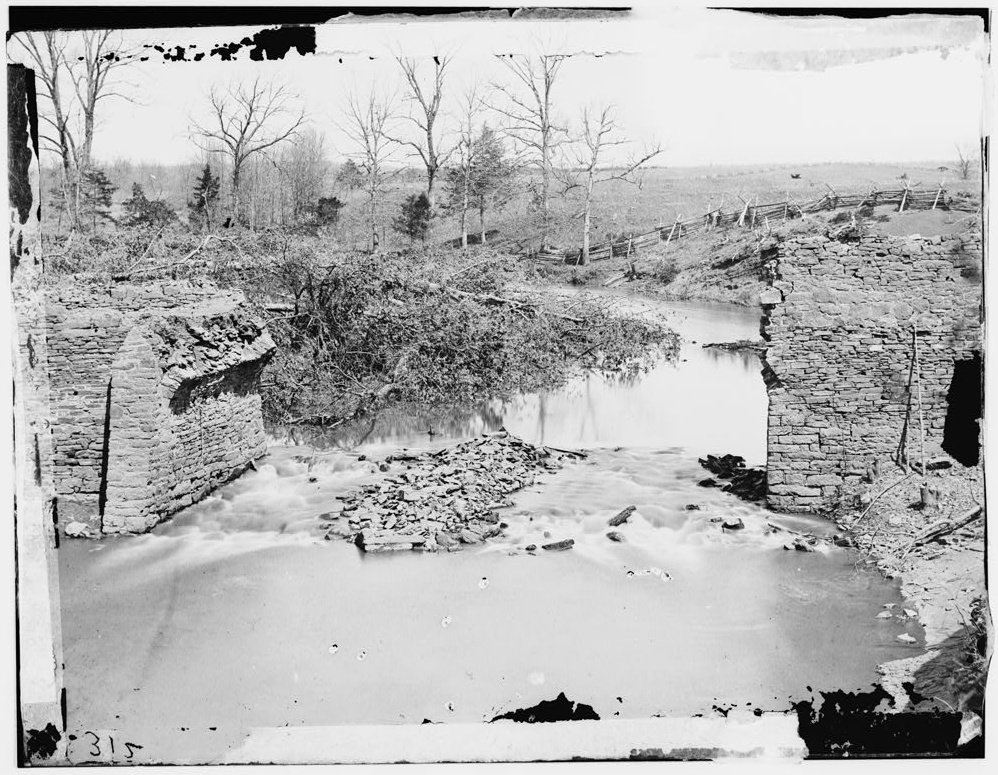
It did not start as a panic. An exhausted army that has fought all day and is finally pushed too far will often pull back in reasonable order at first, and McDowell tried to organize a withdrawal behind a rear guard, a small force left in place to slow the enemy while the rest of the army gets away. What turned an orderly retreat into a stampede was an accident on a bridge. As the Union troops fell back toward their base at Centreville, they had to cross Cub Run Creek on a single bridge, and a Confederate artillery shell overturned a wagon right on the span. The road jammed. With the only easy way out suddenly blocked and rebels behind them, the tired retreat dissolved into a terrified mob, men throwing away rifles, packs, anything that slowed them down, all running the same direction at once. The Southern press named it the Great Skedaddle.
Those roads back toward Washington were not empty. They were clogged with the carriages of the picnickers, the senators and congressmen and their families who had ridden out to watch a victory. Now the fleeing army and the fleeing spectators collided on the same narrow roads, and the panic fed on itself.
The four senators came back into the story here. They did not all flee. Senator Ben Wade of Ohio (North) snatched up a discarded rifle, planted himself across the road, and threatened to shoot any soldier who kept running, a United States senator trying to stop a routed army by himself, until a still-intact regiment came up and restored a little order. Senator Zachariah Chandler of Michigan (North) tried much the same thing, throwing himself across the road to block the retreat. Senator Henry Wilson of Massachusetts (North) had been handing out sandwiches when a Confederate shell smashed his buggy to splinters; he finished the day escaping toward Washington on the back of a stray mule. Senator James Grimes of Iowa (North) barely dodged capture and swore he would never go near a battlefield again. The crowd that had treated a battle like a horse race got the most realistic possible education in what war actually was, and a few of them stood in the road and tried to turn it around with their bare hands.
The Great Skedaddle
One of the spectators did not make it back at all. Representative Alfred Ely (North), the New York congressman who had come out to look in on a regiment he had helped recruit, got swept up in the collapse and was captured by advancing Confederate troops. Brought before rebel officers, he announced himself: "the Honorable Alfred Ely, Representative in Congress from New York." They took him to Richmond and held him in Libby Prison, a converted tobacco warehouse where captured Union officers were kept. Ely had the strange distinction of being the only member of the United States Congress to reach Richmond that day, not in triumph, the way Greeley's headline had promised, but as a prisoner of war. He was finally freed in a prisoner exchange, the negotiated system by which each side traded captured men for its own, on Christmas Day, 1861.
Off the fieldPrisons: Libby, Andersonville, and the capturedThe Great Skedaddle
The Confederates had won a stunning victory, and they almost entirely failed to cash it in. The road to Washington was, for a few hours, wide open, a fleeing, disintegrating enemy and a captured capital practically begging to be taken. Jefferson Davis arrived on the field and urged a pursuit. It did not happen. The winning army was nearly as wrecked by victory as the losing army was by defeat. These were green Confederate troops too, exhausted, scattered, their units tangled, their officers as inexperienced as McDowell's. An attempt to push brigades forward to intercept the retreat ran into McDowell's rear guard and stalled out. The South had broken the Union army and then discovered it was in no condition to chase it. The same rawness that doomed McDowell's plan saved his army from total destruction.
The reckoning
Then came the counting. The standard tally puts the day's casualties at roughly 4,878 men killed, wounded, captured, or missing, about 2,896 on the Union side and 1,982 on the Confederate (and the scholarly figures vary, running somewhere in the range of 4,700 to 4,900 total, because the sources disagree on how to count the missing and the captured). To a public that had packed picnic baskets, the numbers were a hammer blow. Around 847 Americans were killed in this single afternoon, roughly half of all the U.S. battle deaths in the entire Mexican-American War, the country's last big war, which had taken two years to accumulate them. One Sunday in Virginia had killed about half as many Americans as two years of war in Mexico.
Today will be known as BLACK MONDAY. We are utterly and disgracefully routed, beaten, whipped by secessionists.
That was the New York diarist George Templeton Strong, whose journal is one of the great records of Northern feeling during the war, writing the morning after. The reaction split along the two sides. The North was sobered into seriousness: the very next day Lincoln signed legislation authorizing 500,000 three-year volunteers, three years rather than ninety days, the federal government finally admitting in law what the battlefield had just proven. Congress went looking for someone to blame, and within months it created the Joint Committee on the Conduct of the War, a standing body of senators and congressmen chaired by Ben Wade, the same man who had stood in the road with a rifle, that would investigate, second-guess, and hound the Union's generals for the rest of the war. McDowell himself was relieved within days, and George B. McClellan (North), fresh off small victories in western Virginia, was summoned to Washington to build and train a real army out of the wreckage, the Army of the Potomac, which would become the main Union army in the East and fight the war's biggest battles for the next four years. The South swung the other way, into a dangerous elation; the easy victory bred a confidence that some historians think did the Confederacy long-term harm, teaching it to expect wins that would not keep coming.
One last figure is worth following off the field. A farmer named Wilmer McLean owned land near Manassas; Beauregard had used his house as a headquarters, and during the fighting a Union cannonball came down through McLean's kitchen. So McLean moved his family well away from the armies, about 120 miles (190 km) south, to a quiet crossroads called Appomattox Court House. The war followed him there. Four years later, in the spring of 1865, Robert E. Lee surrendered the Confederacy to Ulysses S. Grant in Wilmer McLean's parlor. The war that began in his front yard at Bull Run ended in his front room.