Major General Philip Sheridan (North) was not on the field when his army fell apart. He had spent the night of October 18 at Winchester, a town down the Valley Pike to the north, returning from a meeting in Washington. The Valley Pike (the Valley Turnpike) was the great north-south road that ran the length of the Shenandoah, the spine of the whole campaign, and on this day it would be the road of both the rout running north and the rescue riding south.
Around six in the morning he heard distant artillery and dismissed it as nothing, a reconnaissance, the kind of probing fire that means little. By around nine he had set out south down the Pike on his horse, a powerful black gelding named Rienzi. Less than two miles south of Winchester the truth came up the road to meet him: not a probe but a flood of his own men, broken and fleeing north, the wreckage of a routed army streaming past him in the wrong direction.
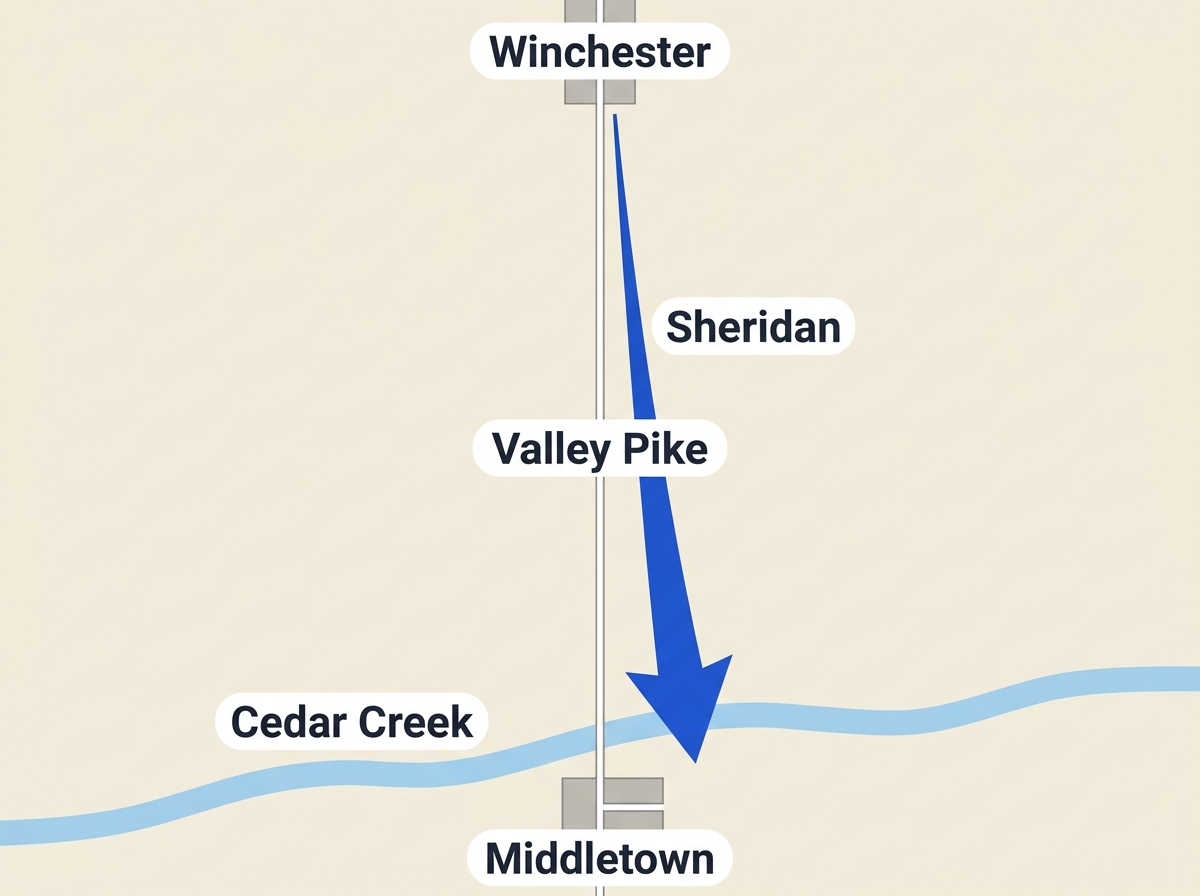
What he did next is the reason everyone remembers Cedar Creek. Sheridan put spurs to Rienzi and galloped the rest of the way to the field, roughly a dozen miles, riding against the current of his own retreat, turning fugitives around as he went, gathering his broken army off the road by the force of his arrival. A rally is exactly this: stopping a fleeing army and re-forming it into a fighting line, and it is one of the hardest things a commander can do, because panic spreads faster than orders. One soldier said the effect of seeing him come down the Pike was like “an electric shock.” He reached the field near Middletown, at the center of the battlefield, around half past ten, and began rebuilding the army that had spent the morning coming apart.
The Legend and Its True Core
Cedar Creek is wrapped in a legend, and the honest way to tell it is to keep the true core and label the embroidery. The ride really happened, and it really turned the battle. But most of what people “know” about it comes from a poem. Within weeks the poet Thomas Buchanan Read wrote “Sheridan’s Ride” (1864), whose refrain counts down the miles, “and Sheridan twenty miles away,” then fifteen, then ten, then five, building to its galloping finish: “Here is the steed that saved the day, / By carrying Sheridan into the fight, / From Winchester, twenty miles away!” The poem made the ride immortal. It also stretched it: the real distance from Winchester to the field was about twelve miles, not twenty. And the poem put words in Sheridan’s mouth: its rousing “Turn, boys, turn! We’re going back!” is Read’s invention, not anything Sheridan is recorded as saying. What Sheridan actually shouted to his men as he rode is reported in several conflicting versions, none of them cleanly verbatim, but the gist is solid: he told his men they were not retreating, that they would sleep in their own camps that night, and that they were going to turn around and attack. That is the true core. The poem is the legend that grew on top of it.
The legend, though, did real work in the world. Read’s poem was printed on page one of the influential editor Horace Greeley’s New York Tribune on Election Day, November 8, 1864, and the timing was not innocent.