Early (South) split his army into columns and sent them through the dark for a pre-dawn convergence on the camps. Major General John Brown Gordon’s (South) flanking column set out first, around eight on the evening of the 18th, threading a narrow trail along the North Fork of the Shenandoah River around the very base of Massanutten. The other two columns moved out around one in the morning. By about half past three, in fog and silence, all three were in position against the sleeping Union line.
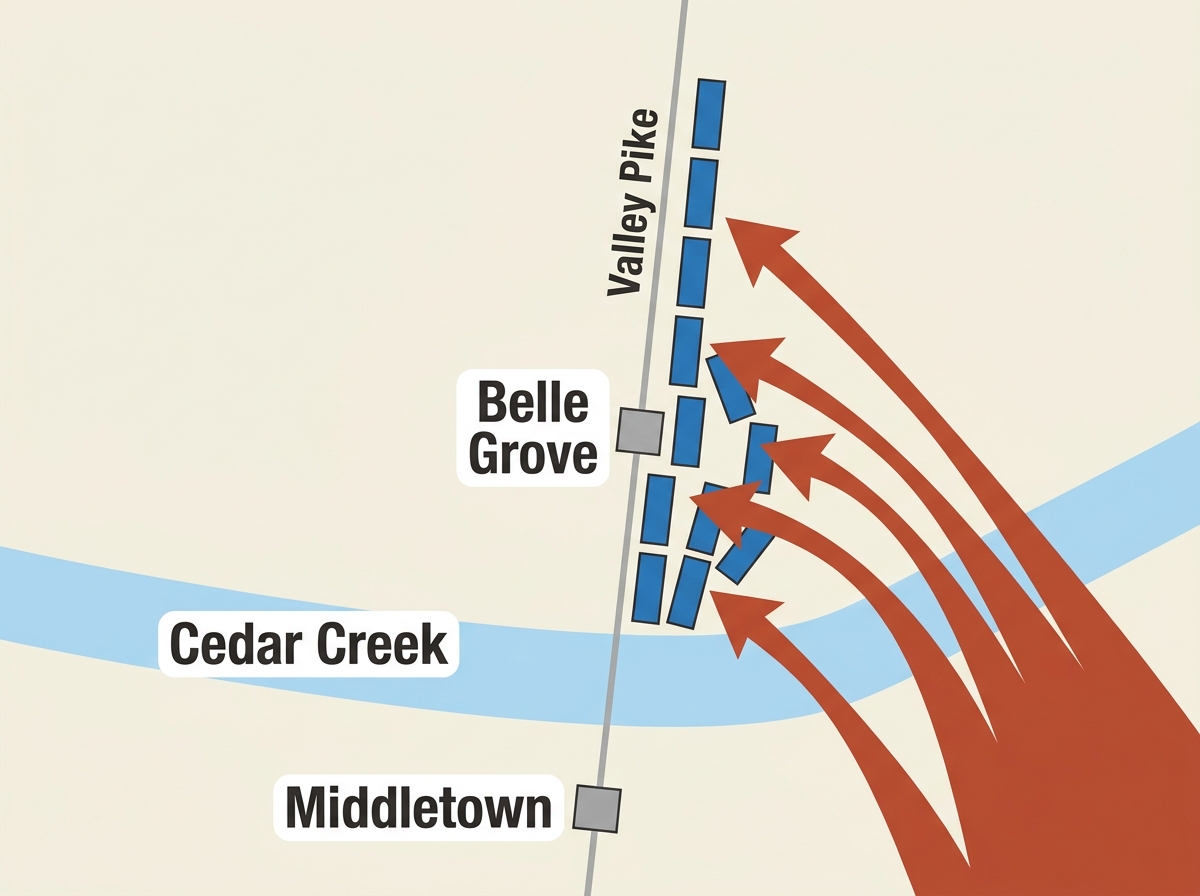
It came at about five o’clock, and it came like the end of the world. Major General Joseph Kershaw’s (South) division struck first, smashing into the camps of Colonel Joseph Thoburn’s (North) division, part of Brigadier General George Crook’s (North) Army of West Virginia, one of the three corps in Sheridan’s single army, the one holding that exposed left flank. (A corps is one of the big building blocks of a Civil War army, several divisions and many thousands of men under one general; this army had three infantry corps plus its cavalry, and despite its grand name Crook’s “Army of West Virginia” was just one of them.) Most of Thoburn’s men were still asleep in their tents. There was no warning, no line, no time, just Confederate infantry coming out of the fog into a camp of men in their blankets. Fifteen minutes later Gordon’s column hit the next division over. Around five-thirty the Confederate artillery opened on Brigadier General William Emory’s (North) XIX Corps.
What followed was a rout, not an orderly retreat but a collapse, an army coming apart and running. Two whole Union corps, Crook’s Army of West Virginia and Emory’s XIX Corps, were driven in panic back through their own camps to the north. Thoburn was mortally wounded in the wreckage of the dawn. By around half past seven Kershaw and the Confederates were shoving two divisions of the VI Corps to the northwest as well. Major General Horatio Wright (North), who was running the army that morning because Sheridan was away, could do little but fight a delaying withdrawal, trading ground for time as his army fell apart around him.
By about ten in the morning, Early had done the seemingly impossible. He had attacked an army half again the size of his own, roughly 31,000 Union men against his own 21,000, caught it in its sleep, and beaten it. He held the field. He held the captured camps. He had taken more than 1,300 prisoners and 24 cannon. A general who had been chased up the Valley three times in a month had, in five hours, apparently won a stunning victory and reversed the entire campaign.
The Battle That Stopped for Breakfast
And then he stopped, and the stopping is the great argument of this battle. The most famous version of why is the cruelest: they call it “the battle that stopped for breakfast.” Early’s hungry, ragged men, fresh from watching their own Valley burned to ash, came over the captured Union line into rich, intact camps full of food, shoes, and clothing, and broke ranks to loot it instead of finishing the fight. If that is what happened, then the same Burning meant to starve this army may have helped save the men it was used against, by tempting them off the attack at the decisive moment. It is the battle’s most repeated story. But it is a leading interpretation, not a proven cause: Early himself also blamed Union cavalry, armed with repeating rifles (the kind that fired several shots before reloading while an ordinary rifle managed one), hovering on his flanks, and historians dispute how much was plunder, how much was sheer exhaustion, and how much was Early’s own caution. The harshest verdict came from inside his own headquarters: Gordon (South), who had devised and led the flank march that opened the battle, wrote after the war that the “fatal halting … converted the brilliant victory of the morning into disastrous defeat in the evening.” It is a damning line, but Gordon and Early feuded bitterly for the rest of their lives over who lost Cedar Creek, and the memoir is a brief for the prosecution. However it happened, the result is not in dispute. The Confederate attack lost its edge in the middle of the morning, and when it lurched forward again it stalled for good by about one o’clock. The pause gave one absent Union general just enough time to ride into the story.