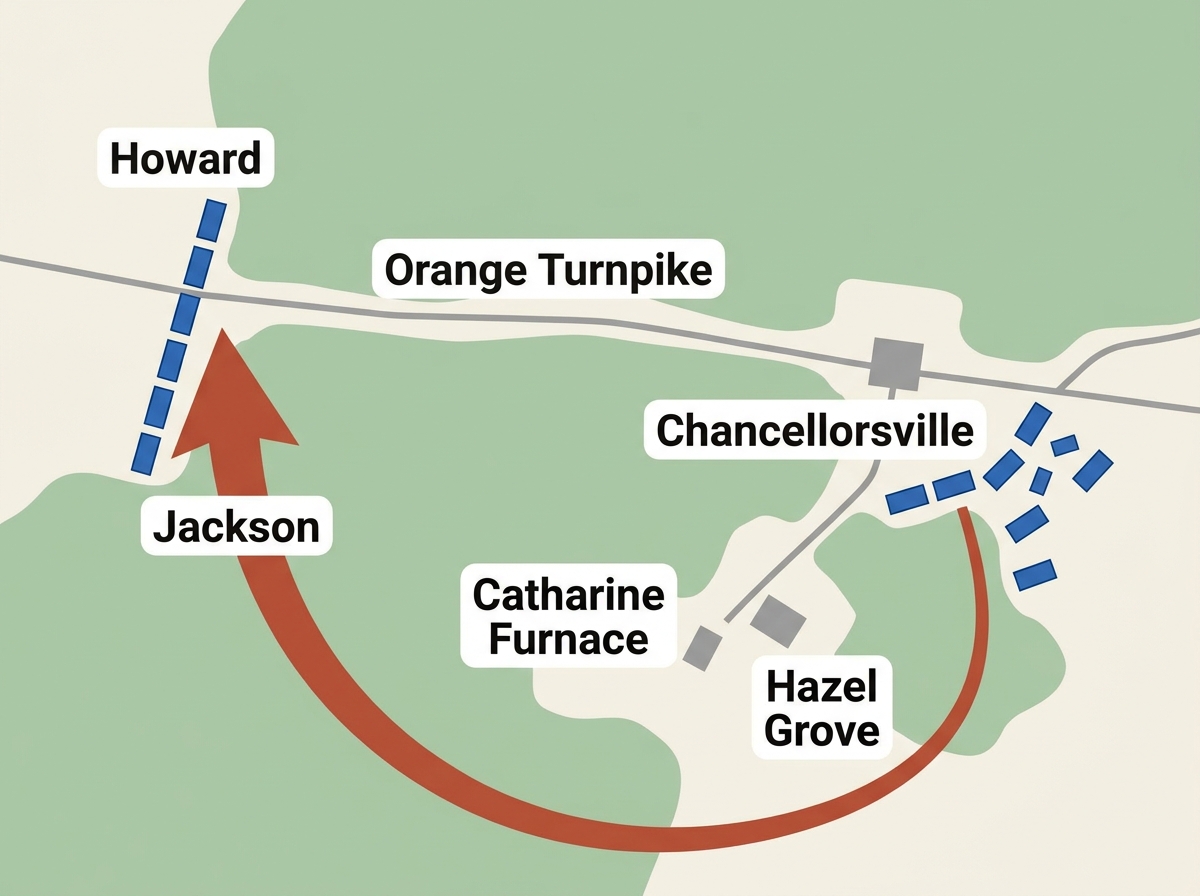
At around seven or eight in the morning on May 2, Lieutenant General Thomas "Stonewall" Jackson put his Second Corps on the road, and for most of the day the most dangerous column in the Confederacy more or less disappeared. Twenty-eight to thirty thousand men, with their guns and wagons, threaded south and then west along Wellford’s hidden road, past Catharine Furnace, through woods thick enough to hide an army from an enemy a few miles away. It was slow, exposed work. A march like that has no good answer if it is caught strung out on a forest track, and for hours it was strung out on a forest track. The one force that should have caught it, Union cavalry ranging ahead to scout the woods, was hundreds of miles south on Stoneman’s raid. Hooker had sent his eyes away, and now a Confederate army was crossing his front and almost no one was watching the ground.
It was very nearly caught anyway. Major General Daniel Sickles (North), whose III Corps held high ground at a place called Hazel Grove, spotted the column moving across his front and sent troops to probe at Catharine Furnace. For a moment the whole plan teetered. But the 23rd Georgia (South), thrown out as a rear guard, fought a delaying action that bought Jackson the time he needed, and the moment passed. Worse, Major General Joseph Hooker (North) read the moving column exactly backward. A long gray line trailing south and west out of his front looked, to a commander who had already convinced himself Lee was beaten, like a Confederate army in retreat. Hooker chose to believe Lee was running. Lee was not running. Lee was reaching around his neck.
A Corps Facing the Wrong Way
What was waiting at the end of that march was the XI Corps under Major General Oliver O. Howard (North), and it was waiting the wrong way. Howard’s men held the far western end of the Union line, the flank that hung in the air, and they were facing south, toward where the trouble was supposed to come from, with their right end open to the west and unprotected. They were not entrenched. As the long spring evening came on, around 5:30, they were cooking supper, stacking arms, settling in. They had been warned that something was moving out beyond their flank, and the warnings had been waved off up the chain as the nervousness of green troops (new soldiers who jump at shadows). Most of the corps was made up of German-American regiments, immigrant soldiers the rest of the army half-dismissed as the "Dutch," and no one with the authority to bend the line back and face west had taken their reports seriously.
The first thing many of them saw was the wildlife. According to accounts, deer and rabbits and turkeys came bolting out of the western woods ahead of the line, driven from cover by the advance of an army the men had been told was not there. Then the trees themselves seemed to come apart, and out of them came Jackson’s corps at a dead run, the high keening rebel yell carrying ahead of a battle line a mile wide, hitting the open end of Howard’s corps from exactly the direction no one was facing.
The division of Brigadier General Robert Rodes (South) led the assault and, in the words that have followed it ever since, rolled completely over the XI Corps. A line of unentrenched men, facing the wrong way, with their suppers half-cooked, was simply overrun from the side, where almost no one could even turn a weapon to meet the enemy. The corps came apart. Some units, Major General Carl Schurz’s (North) division among them, managed a stand in the chaos and made the Confederates pay for ground. Most of it dissolved into a stampede back toward the Chancellorsville crossroads. In a matter of minutes the XI Corps lost around 2,500 men, killed, wounded, and captured, and the Union right ceased to exist as a fighting line.
Jackson’s men drove forward through the wreckage, pushing roughly a mile and a quarter toward Chancellorsville before the dark and their own disorder (the inevitable tangle of a victorious assault in thick woods at night) finally brought them to a halt. The flank march had worked exactly as drawn on the cracker box. Lee had now cut his army into three pieces in front of a force twice his size: Early at Fredericksburg, Lee’s own sliver in front of Hooker, and Jackson’s corps swinging in from the west. The gamble had paid the biggest dividend of the war.
Jackson’s flank attack is the single most famous maneuver of the Civil War. The twelve-mile march should never have gone undetected, and went undetected because the ground hid it, the Union cavalry was gone, and the Union commander misread what was left in plain sight. It shattered an entire Union corps in under an hour.