By the gray, foggy morning of May 25, 1862, Major General Nathaniel Banks (North) had perhaps 5,000 to 6,500 exhausted soldiers strung out in a thin line on the hills just south and southwest of Winchester. (His command on paper was far larger, with figures as high as 22,500 thrown around, but that was the entire sprawling department he was responsible for, a department being an administrative command zone covering a whole region, not the worn-down force actually present for this fight. The men who would do the bleeding numbered only a few thousand.) Banks reportedly understood that holding the town was hopeless. He was not fighting to win. He was fighting to buy time for his 550 supply wagons to escape north toward the Potomac before Jackson’s army arrived to take them.
Banks was not a soldier by training. He was a Massachusetts politician, a former Speaker of the U.S. House of Representatives and governor of his state, handed a general’s stars at the war’s start for his political weight rather than his battlefield skill. That is part of why Jackson, a career soldier, could run rings around him.
Facing him, Jackson had something like 16,000 men coming up out of the fog.
May 25
Jackson attacked at first light, his men moving forward through a dense morning fog that hid them until they were close. He split the assault. Major General Richard Ewell’s (South) division (a division being a formation midway between a brigade and a full army, several thousand men) came in on the Union left, east of town, pushing up the Front Royal Pike (the road running southeast out of Winchester toward Front Royal) toward the Union brigade dug in on the heights at Camp Hill, on the southeast edge of town. Jackson himself drove up the center and right along the Valley Turnpike, toward the key piece of ground: Bowers Hill, a rise southwest of town where Colonel George Gordon’s (North) brigade anchored the Union right flank (the flank being the exposed end of a battle line, the place every general most fears having turned). Whoever held Bowers Hill held Banks’s whole position.
For a while it was a slugging match. Ewell’s push on the Union left made only limited headway. On Bowers Hill, Confederate cannon and Union cannon hammered each other at close range along the Turnpike, an artillery duel with neither side budging. Banks’s tired men, for all their exhaustion, were holding.
May 25
So Jackson reached for the move that would end the battle. He turned to Brigadier General Charles Winder (South) and, when Winder suggested hitting the Union right flank up on Bowers Hill, Jackson answered simply: "I will send you up Taylor."
Under cover of the same morning fog, around 7:00 to 7:30 a.m., Brigadier General Richard Taylor (South) swung his roughly 2,000 Louisianans wide to the west, out around the end of the Union line, until they were positioned to come up the slope of Bowers Hill and roll up the Union right from the side. Taylor was the son of former U.S. President Zachary Taylor and brother-in-law of Confederate President Jefferson Davis, which made him about the most pedigreed man on either side of the Valley, and he did not rush. As his men moved into place, Federal artillery found them and opened fire; some of the men flinched and ducked for cover. Then, rather than hurry, Taylor rode out in front of his whole brigade and led them up the hill, in his words, "in a steady walk": no running, no premature firing, just a disciplined line climbing into the guns. A Confederate staff officer named Henry Kyd Douglas, who watched it happen and later wrote the memoir "I Rode with Stonewall," remembered it as one of the most beautiful charges he ever saw, a line of glistening bayonets bright in the morning sun, its formation straight and compact.
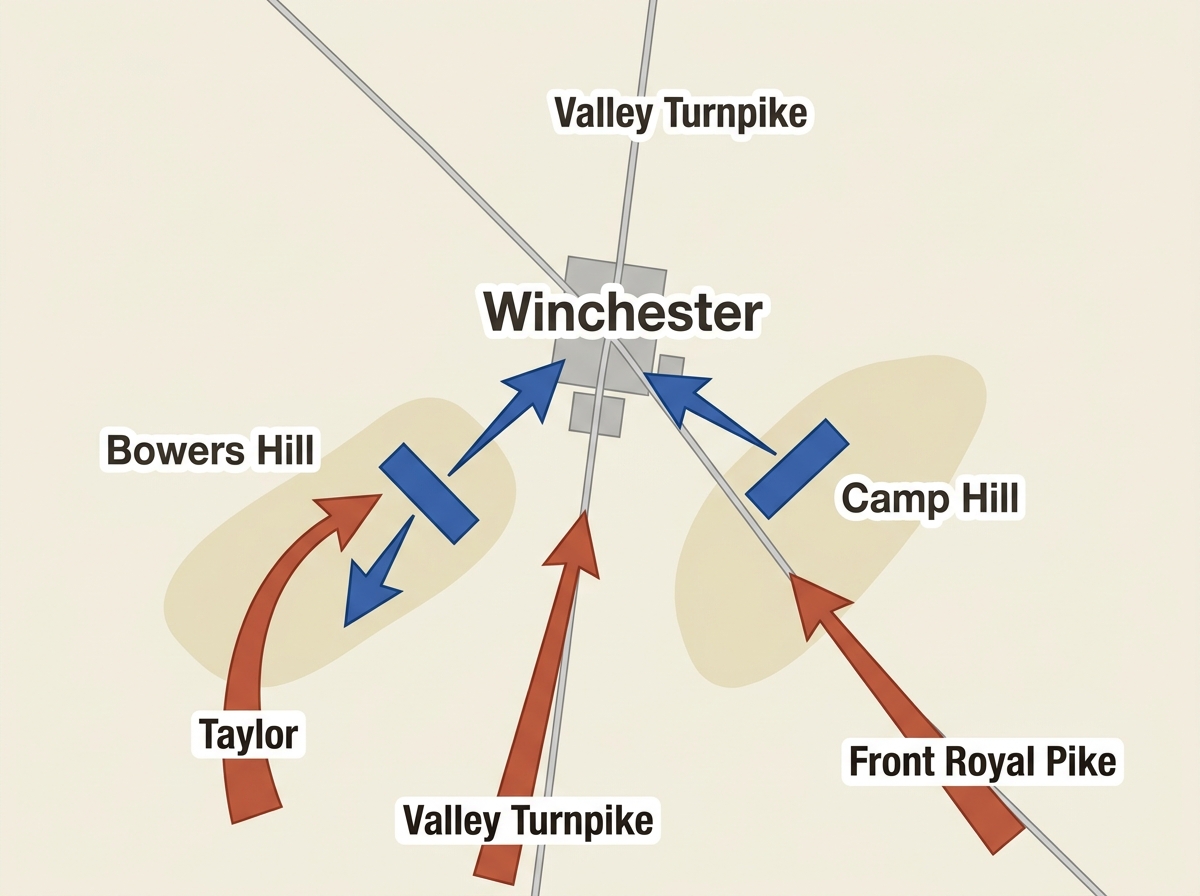
The Louisianans walked through Federal musket fire and canister (canister being an artillery round that turns a cannon into a giant shotgun, spraying iron balls into massed men), closed the holes blown in their line, and crashed into the Union right. The 27th Indiana and 29th Pennsylvania regiments broke. The 2nd Massachusetts had to fall back. Gordon’s brigade came apart on Bowers Hill, and once the right flank went, the whole Union line went with it. A line that has been rolled up from the end cannot fight two directions at once: men facing the enemy in front suddenly take fire down the length of their own line from the side, and there is no good answer but to run. Within minutes Banks’s entire position disintegrated. One Confederate sergeant, John H. Worsham, remembered Taylor’s charge as "the grandest I saw during the war… every man was in his proper place." The men who carried it off were soldiers of a slaveholding republic, and the victory was a victory for that cause as much as it was a feat of arms.
May 25
What was left of Banks’s army poured back north through the streets of Winchester in disorder. For the Union soldiers it was a nightmare with no exit, a column of beaten, frightened men funneling through narrow streets that had turned into a gauntlet, the road north their only hope and the whole town between them and it. Winchester was the worst possible town to retreat through, because it was fiercely pro-Confederate. As the Federals streamed past, the town’s residents lined the streets in jubilant excitement, ringing church bells and cheering Jackson’s men into the town they felt they had just been liberated from. (By some accounts, civilians also fired on the retreating Union soldiers from windows and doorways; this is reported rather than firmly established, and the better-documented scene is the cheering crowd, not the shooting.) When Banks tried to rally his men, one Federal soldier is supposed to have called back that he was "trying to get to it as fast as I can," trying, that is, to reach the road north and keep running.
The numbers tell the rest. Of Banks’s roughly 2,019 casualties for the day, 1,714, about 85 percent, were captured or missing. An army that loses that many men as prisoners has not retreated in good order. It has broken, which is what a rout is: a military word for a total collapse, the moment soldiers stop being an army and become a running crowd. Against that, Jackson’s whole army lost only about 400 men, killed and wounded, around five Union losses for every Confederate one.
Jackson ordered a hard pursuit, hoping to turn the rout into the destruction of Banks’s army. With the prize in front of him, his luck ran out. His infantry was worn down from the dawn fight and the week of marching that came before it, and the cavalry that should have run Banks down was nowhere to be found. Brigadier General Turner Ashby’s (South) troopers, the very horsemen Jackson needed to close the trap, had scattered along the retreat route to plunder the captured Union wagons, the same abandoned haul that was about to make Banks a household joke. The soldiers who were supposed to chase the beaten army were busy helping themselves to its baggage. Watching his chance slip north, Jackson is said to have lamented: "Never was there such a chance for cavalry. Oh, that my cavalry was in place." The pursuit lost its coordination and sputtered out around Stephenson’s Depot, a few miles up the Turnpike, and Banks’s beaten army streamed away north toward Martinsburg and the Potomac beyond.
He had routed an army. He had not destroyed one, and the very plunder that would make Banks famous was what let Banks get away.