In the spring of 1862, the Confederacy was in trouble. A huge United States army under Major General George B. McClellan (North) had landed on the Virginia coast and was grinding its way up the Virginia Peninsula (a finger of land between the York and James rivers, pointing straight at the Confederate capital) toward Richmond, and there did not seem to be enough Southern soldiers to stop it. So the Confederates went looking for a way to make the North flinch, and they found it about a hundred miles to the west, in a long green valley called the Shenandoah, a corridor of farmland running through western Virginia that pointed, like a loaded rifle, straight at Washington, D.C.
The man they handed that rifle to was Major General Thomas J. "Stonewall" Jackson (South), a secretive, deeply religious former college professor who had earned his nickname the previous summer by holding his brigade (a brigade being a block of several regiments, themselves blocks of several hundred men each, so a few thousand soldiers in all) steady "like a stone wall" while the line around him broke. Over the next six weeks Jackson would run one of the most studied campaigns in military history through that valley. The army he commanded fought for a country, the Confederacy, that had been created for one overriding purpose: to keep millions of human beings enslaved. Every brilliant march in this story was a march in defense of slavery.
Jackson’s campaign
The ground Jackson was defending, the Shenandoah Valley, is a corridor of farmland roughly 150 miles (240 km) long running southwest to northeast through western Virginia, walled in by mountains on both sides. Two things made it priceless. First, it was a granary, a great storehouse of grain: its farms produced something like a fifth of Virginia’s entire wheat crop, plus cattle and other food the Confederate armies and the city of Richmond needed to keep eating. Lose the Valley and you starve the war.
Second, and more dangerous, was its geography. Because the Valley ran southwest to northeast, "down" the Valley (toward its lower, northern end) meant moving toward the Potomac River, and just beyond the Potomac sat Washington itself. An army marching north through the Shenandoah was an army walking toward the back door of the Union capital. That fact terrified Washington, and Jackson’s whole job was to make it terrifying. Running up the middle of the Valley was the Valley Turnpike (a turnpike being a maintained toll road, in this case the region’s main paved-stone highway), and the Turnpike ran straight through Winchester, the town at the Valley’s northern entrance, the hinge that controlled who came in and who went out.
Jackson’s orders came down from General Joseph E. Johnston (South), who commanded the main Confederate army standing between McClellan and Richmond. The instruction was not to win some grand victory. It was simpler and sneakier: tie down the Union forces in the Valley, keep them busy, and above all keep them from being sent east to reinforce McClellan’s drive on Richmond. In particular, Jackson was to keep one Union army, under Major General Nathaniel P. Banks (North), pinned in the Valley, and to keep a second, larger Union corps (a corps being an army-within-an-army, here roughly 30,000 to 40,000 men) under Major General Irvin McDowell (North), waiting near Fredericksburg, too nervous to march south. McDowell’s corps had been promised to McClellan as the reinforcement for the final push on Richmond; keeping those men frozen in place meant they could never reach the one battle that mattered. If Jackson could keep those tens of thousands of soldiers looking over their shoulders at him, they could not be looking at Richmond.
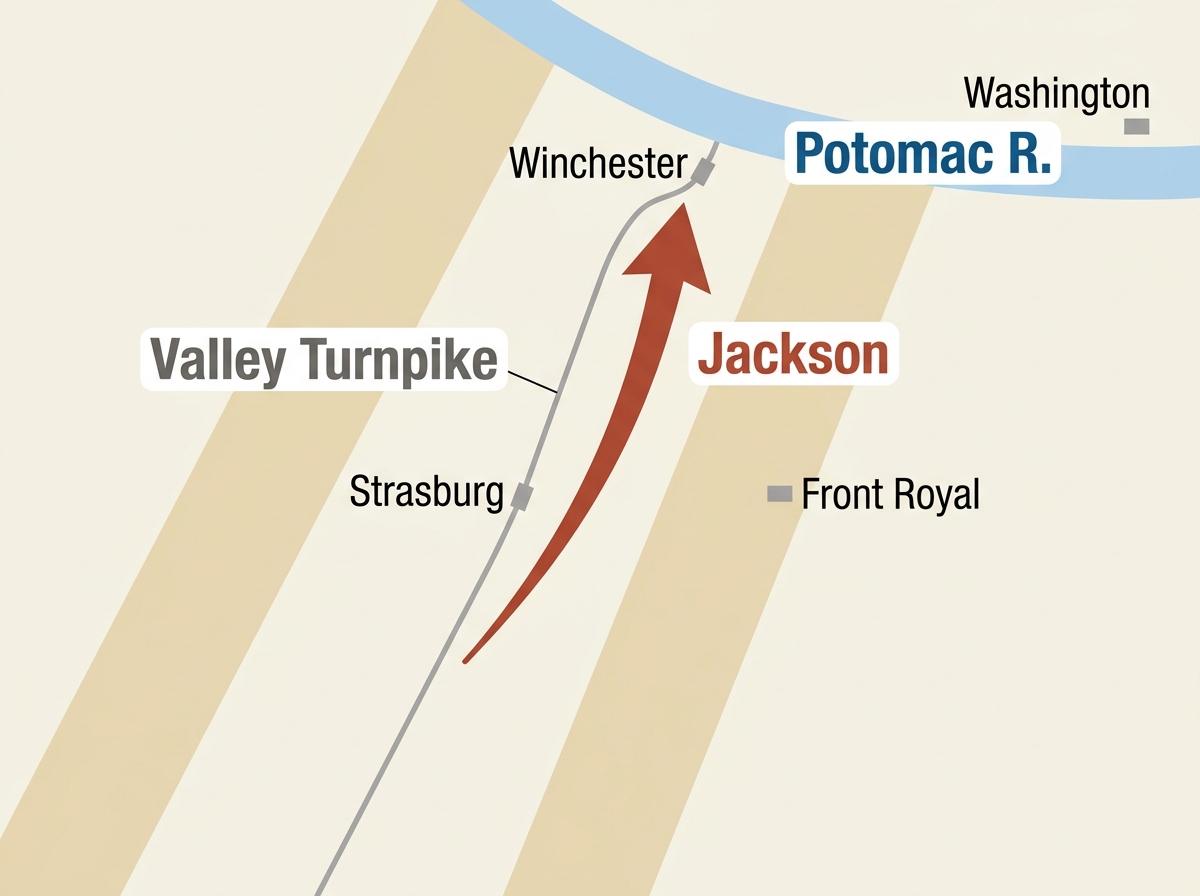
Jackson’s campaign
To do that with a small army, Jackson did the one thing nobody expected: he made his infantry move like horsemen. His soldiers earned the nickname "foot cavalry," foot soldiers who covered ground the way mounted cavalry was supposed to. The numbers behind the nickname are genuinely hard to believe. Across the full campaign, Jackson’s men marched 646 miles in 48 days, an average of better than 13 miles a day, day after day, for a month and a half. In the week leading up to Winchester they covered about 140 miles in seven days, roughly 20 miles a day. Later in the campaign the famous Stonewall Brigade would march 42 miles in a single day, through rain and mud, with nothing to eat.
Jackson got this out of men by sheer iron discipline, and the worst of it was the not-knowing. He drove hard starts, allowed few breaks, and had no patience at all for stragglers, but he also told his own generals nothing, so the column marched into days it had not been warned about, toward towns it had not been named, on empty stomachs, under one standing order: keep moving. The men hated it and the enemy could not counter it. Nobody can block a move they cannot see coming.
Through April and May, Jackson used that speed to wrong-foot the Union forces one after another. He had opened the campaign back on March 23 at Kernstown by attacking what he thought was a small Union rear guard and running into a full division instead, the only battle he would lose all spring. And yet even that loss worked for him: his sheer aggression so rattled Washington that Lincoln pulled troops back to guard the Valley, troops that might otherwise have gone to McClellan. Then at the Battle of McDowell (May 8) Jackson beat back a Union force in the western mountains, keeping two Union armies from joining up against him. And on May 23 he played his sharpest card yet at the small town of Front Royal. Jackson and Major General Richard S. Ewell (South) fell on the little Union garrison there and shattered it, capturing most of its men and inflicting around 773 casualties while losing only about 36 of their own. Front Royal mattered far beyond its size: it sat on the flank of Banks’s army and on the rail line feeding it, which meant Jackson was now suddenly beside and behind Banks, threatening to cut off his line of retreat.
Banks got the message that his Front Royal garrison was gone and did the only sensible thing: on May 24 he ordered his army to fall back north up the Valley Turnpike from Strasburg, racing for the safety of Winchester before Jackson could get across his path. It was not a clean retreat. Confederate cavalry and infantry harried his columns all day at Middletown and at Newtown (Stephens City), and in the running fight Jackson’s men overran piles of abandoned Union supplies. Banks’s own soldiers could watch their wagons going up in the dust and smoke behind them as they ran, the first of the hauls that would soon make their general a Confederate punchline. By the evening of May 24, Banks had gotten what was left of his army into Winchester. Jackson was right behind him.