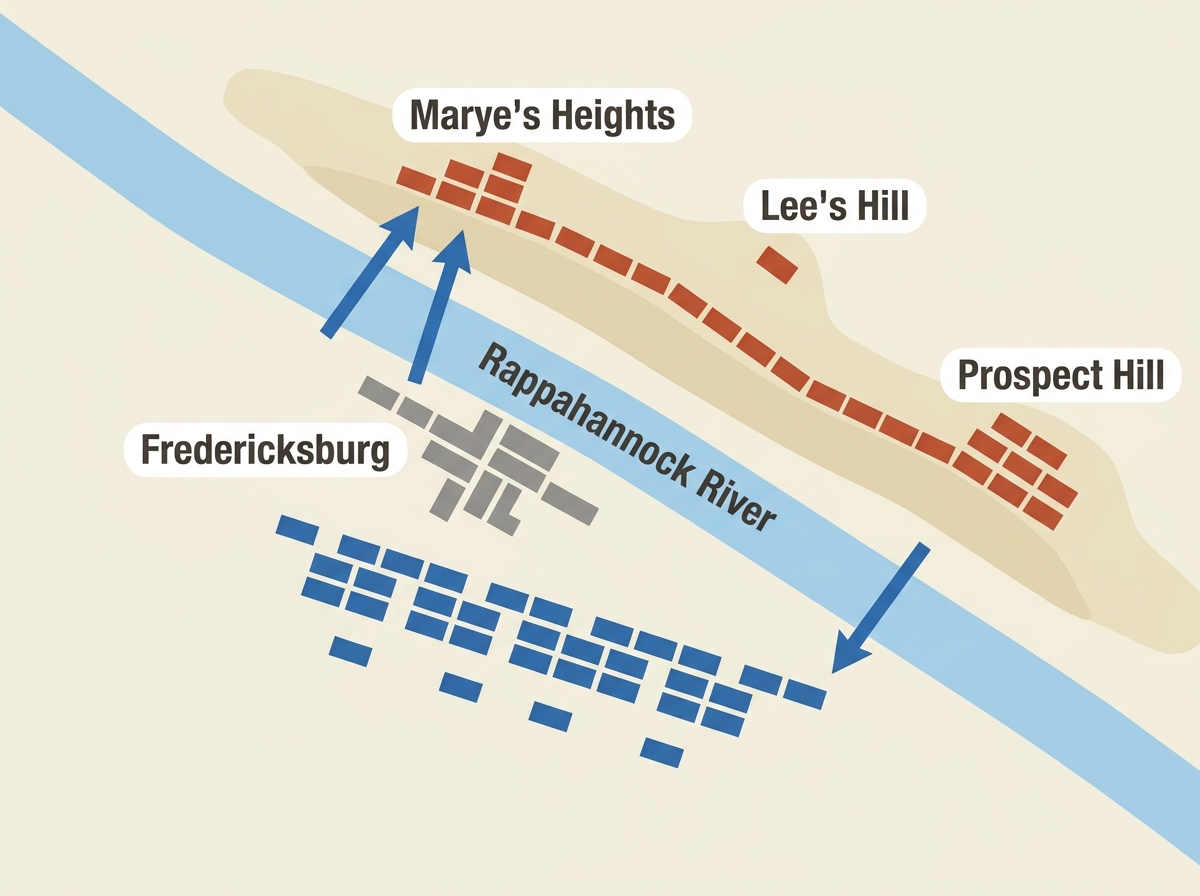
To get at the Confederate army, Burnside first had to get across the river, and the river was now a shooting gallery.
Before dawn on December 11, Union engineers walked out onto the cold water and began laying the upper bridges, the ones opposite the town itself. They never got the chance to finish. From the cellars, windows, and rubble of Fredericksburg’s waterfront, Mississippi riflemen under Brigadier General William Barksdale (South) opened fire and shot the engineers off the boats. Every time a work party went back out, the sharpshooters cut it down again. The bridge could not be built while those men held the far bank.
So Burnside tried to blast them out. Union artillery, massed on the high east bank known as Stafford Heights, opened on the town and poured shells into it, by one account more than five thousand rounds. The bombardment wrecked houses and started fires and did almost nothing to the riflemen, who were sheltered in stone cellars the shells could not reach. The town burned and the snipers kept shooting.
A Hundred and Thirty-Five Men in Rowboats
What finally worked was the oldest answer there is: send men straight at them. In the afternoon, parties of Union infantry, roughly a hundred and thirty-five men of the 7th Michigan and 19th Massachusetts under Colonel Norman J. Hall (North), climbed down into the pontoon boats themselves. These were not landing craft. They were flat-bottomed bridge boats, low and slow and built to be tied together, and the men had to row them by hand straight across open water with Barksdale’s riflemen sighting on them from the far bank the whole way. There was nowhere to get down, nothing to hide behind, no way to shoot back and row at the same time, just a hundred and thirty-five men sitting up in plain view, pulling at the oars while bullets came off the water around them and the man at the next oar dropped. They reached the far bank with the boats still afloat, scrambled up the muddy slope into the streets, and went straight at Barksdale’s men, building by building. What followed was close, ugly, room-by-room fighting through a town, one of the first large-scale instances of urban house-to-house combat in American history: men kicking in doors, firing down stairwells, clearing a house and then the next one. The Mississippians were finally pushed back, the engineers finished the bridges, and the army began to cross on December 11 and 12. Downstream, where there was no town to hide snipers, three more bridges went in with little trouble, and the part of the army that would attack south of the town crossed almost unopposed.
The Sack of the Town
Once Union troops were loose in Fredericksburg, they wrecked it. Men dragged pianos and mirrors and parlor furniture out into the muddy streets and smashed them for sport; one soldier was seen wearing a stolen bonnet, another emptying a feather mattress into the road so he could keep the ticking. It was a soldiers’ rampage through a captured town, and Lee, watching from the heights, likened them to Vandals (the ancient tribe that sacked Rome). The civilian death toll stayed small, only about four townspeople killed, because most residents had already fled before the bombardment. But the town itself was gutted. The men who did this had just crossed a river under aimed fire to reach it, and the worst day of all was still ahead of them.