After the bruising at Beaver Dam Creek, Brigadier General Fitz John Porter (North) pulled his V Corps back to ground he could actually defend, and he chose it well. His line ran behind Boatswain’s Swamp (also called Boatswain’s Creek), a boggy ravine that curved in a long semicircle, roughly 1.5 to 2 miles (2.5 to 3 km) end to end, around the plateau where a farmhouse called the Watt House stood, a few miles into the Virginia Peninsula northeast of Richmond. Any Confederate who wanted Porter had to cross open ground, slither down into the muck of the swamp, and then climb a steep hillside, about 50 feet (15 m) of rise, straight into massed gunfire.
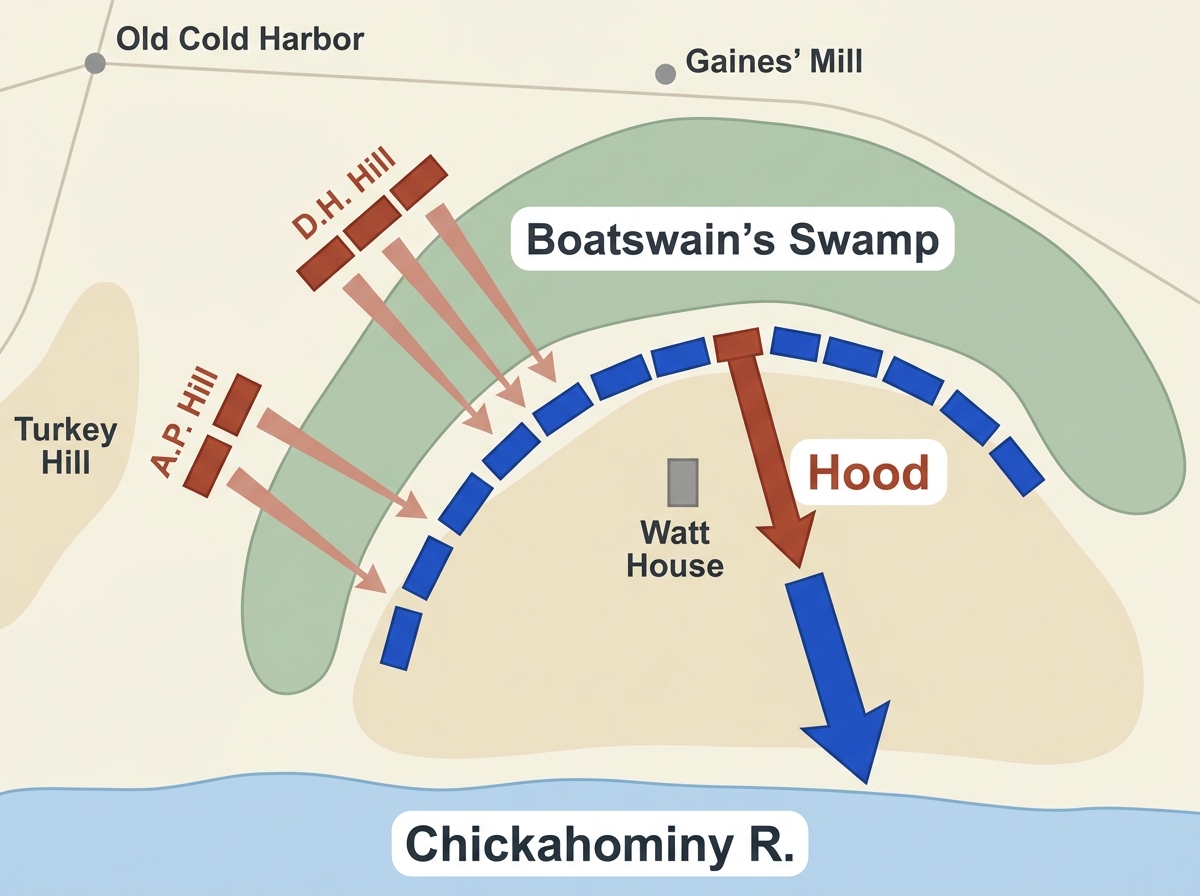
And the gunfire was massed. Porter stacked his defense in three tiers: a first line down at the creek bottom with sharpshooters (expert marksmen with long-range rifles) firing from behind felled trees, a second line halfway up the slope, and a third line of rifle pits along the plateau’s crest. On top of the plateau he arrayed 96 cannon, with still more artillery batteries (groups of cannon) firing in support from across the Chickahominy to the south. Morell’s division held his southern (left) flank, on Turkey Hill; Sykes’s division held the northern (right) flank; McCall’s division waited in reserve along the crest. It was, in short, a wall, and Robert E. Lee was about to run his army into it.
Lee did not know the wall was there. Boatswain’s Swamp did not appear on Confederate maps at all. Lee’s whole scheme assumed his troops would come around and hit Porter’s flank; instead, because the swamp pushed Porter’s line out farther than anyone on the Confederate side realized, his men kept marching straight into the front of a fortified position that, on paper, should not have existed.
June 27 | Hours of charging uphill into the guns
What happened next was Lee’s army losing the same battle three different ways, an hour at a time, because every division went in alone instead of all of them landing together. First the plan, then the momentum, then the men who carried it.
Around noon, the division of Major General Daniel Harvey “D.H.” Hill (South), no relation to A.P. Hill, reached the crossroads of Old Cold Harbor to the north and went looking for the open end of Porter’s line, the flank Lee’s maps promised him. It was not there. Instead of curling around Porter’s edge, D.H. Hill’s men ran straight into the solid front of his line, the first hard evidence that the map was wrong, that Boatswain’s Swamp had pushed the Union position somewhere no Confederate chart had it. From that moment, every assault Lee threw forward was aimed at a wall nobody on his side had known was there.
Around 2:30 p.m., Major General A.P. Hill (South), knowing by now the ground was worse than planned, sent his roughly 12,000-man division (grandly nicknamed the Light Division, A.P. Hill’s own name for it: “light” meaning fast, not small; at 12,000 men it was anything but) straight at Boatswain’s Swamp in the first major assault of the day, rather than wait for the rest of the army to come up alongside. His brigades crossed the open ground, went down into the swamp, started up the hill, and were torn apart. In about two hours, A.P. Hill’s division lost more than 2,000 men and gained essentially nothing, and bought Lee nothing either, because no one was attacking with him.
Around 3:30 p.m., the division of Major General Richard S. Ewell (South) fed into the same fight, three brigades in ferocious, doomed charges. Ewell had his horse shot out from under him and kept directing the fight on foot, walking among his own soldiers as they died around him in rows, for ground they could not hold. A Union soldier later described the volume of fire by saying the air “was too full of lead for standing room.” The picture was accurate: men were charging uphill into a hailstorm, one division at a time, and dying for nothing each separate division could keep.
Porter felt the pressure mounting. Around 5 p.m. he wired McClellan that he was “pressed hard, very hard.” McClellan, directing the whole battle by telegraph from his headquarters south of the river, never once appeared on the field in person. He finally moved help across. A full division under Major General Henry Slocum (North), on loan from the VI Corps, crossed the Chickahominy and fed its brigades straight into Porter’s line, where it was chewed up almost as badly as the men it came to save. Behind Slocum, McClellan also ordered two brigades from the II Corps under Major General Edwin Sumner (North), the Irish Brigade and one other, but they had a long way to come and arrived roughly three hours later, effectively during the final collapse, far too late to matter.
The one blow that might have ended it early never came. Thomas J. “Stonewall” Jackson finally reached Old Cold Harbor and found, as one officer put it, the Yankees in line facing him rather than the open flank Lee had promised him. He had been led down the wrong road, costing an hour-long countermarch (turning the whole column around to retrace its steps) and then dogged by burned bridges, roadblocks, and sharpshooters. Then, through a tangle of miscommunication, he sat and waited for orders while the battle roared a short distance away and did nothing. His Confederate artillery chief, Colonel Edward Porter Alexander (South), said it flatly after the war: “Had Jackson attacked when he first arrived, or during A.P. Hill’s attack, we would have had an easy victory.” Instead, the South paid for Porter’s wall in full, one division at a time, all afternoon.