In the last days of June 1862, the Confederate capital could hear the United States Army coming. Major General George B. McClellan (North), commanding the Army of the Potomac, had spent the spring creeping up the Virginia Peninsula (the long neck of land between the James and York Rivers, southeast of Richmond), and by late May his men were close enough to see the church spires of Richmond, roughly 5 to 6 miles (8 to 10 km) off. He had well over 100,000 men; some counts put the army at 105,000 or more. The Confederacy had a capital about to fall.
The man who decided not to let it fall had only just taken the job. At the Battle of Seven Pines (also called Fair Oaks) on May 31 and June 1, the Confederate commander, General Joseph E. Johnston (South), was badly wounded, and President Jefferson Davis handed the army to General Robert E. Lee. Lee renamed it the Army of Northern Virginia and did the math: he could not win a siege against a bigger, better-supplied army parked outside his capital. Sitting still meant losing slowly. So he chose the opposite of sitting still. Within weeks of taking command, he attacked.
And the thing he was fighting to save was not just Richmond’s warehouses or its railroads. The fight for Richmond was, at bottom, a fight over a slaveholding republic: a country of roughly 4 million enslaved people whose forced labor was the South’s economy, and whose continued bondage was the reason the Confederate states had walked out of the Union in the first place. Take Richmond in the summer of 1862 and the rebellion might end before it became something larger. Save it, and slavery’s republic got to keep fighting. That was the prize on the table outside the city. Lee had been a general for less than a month, and was about to throw the largest army the South had ever fielded straight at the larger army in front of it to hold onto it.
The Seven Days | Mechanicsville and the plan to crush Porter
On June 26, Lee opened what history would call the Seven Days Battles, a week of near-continuous fighting from June 25 to July 1, with an assault at Beaver Dam Creek, near the village of Mechanicsville, just northeast of Richmond. It did not go well. The division of Major General A.P. Hill (South) charged across the creek and was shot to pieces for no ground gained, somewhere around 1,000 to 1,500 men down. As a tactic, Mechanicsville was a failure.
As psychology, it worked, on the wrong man. McClellan, watching the Confederates suddenly turn aggressive, began that very day to plan a “change of base”: army slang for picking up his whole supply line and shifting it somewhere safer, in his case from the York River side over to the James River to the south, where U.S. Navy gunboats could cover him. The man with the bigger army started planning his retreat the day the smaller army attacked him.
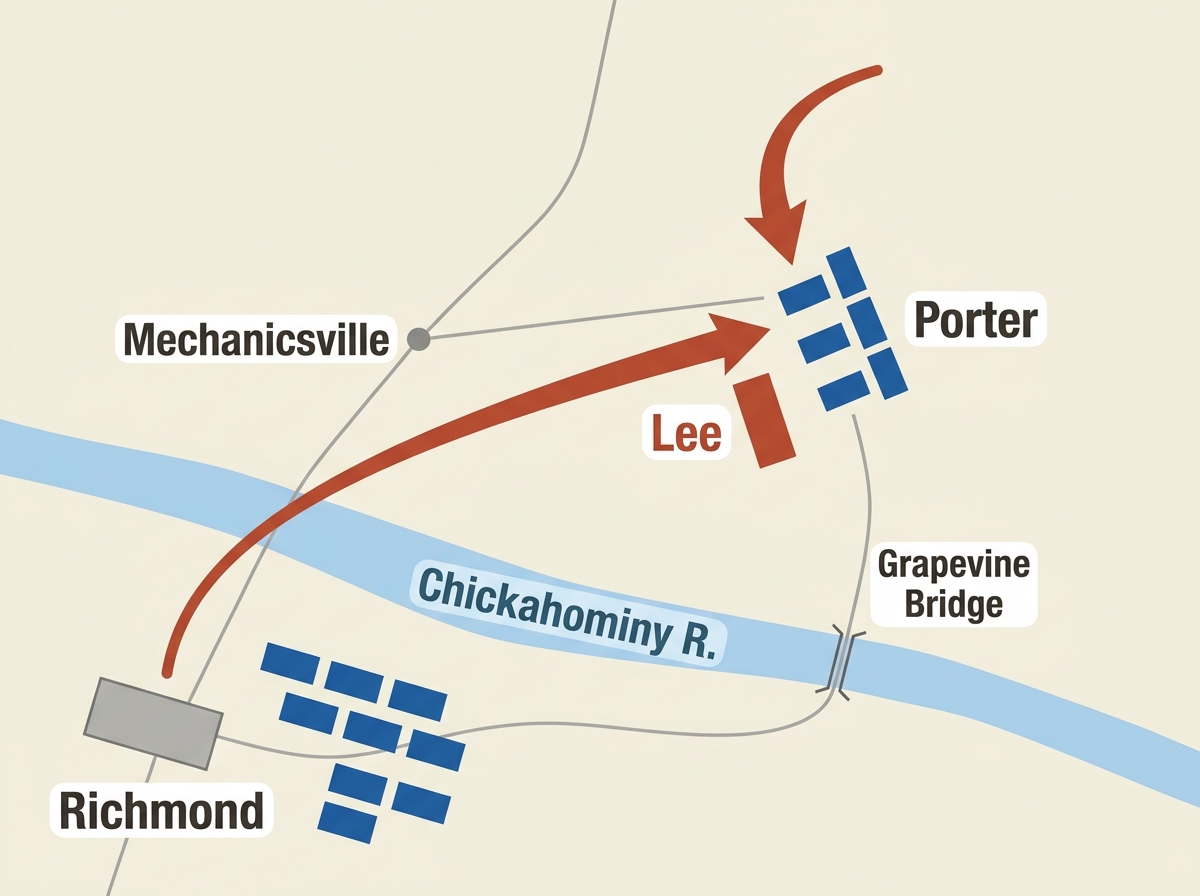
That plan hardened fast. In the pre-dawn hours of June 27, before a single shot was fired at Gaines’ Mill, McClellan had already decided to fall back to the James. He sent out orders to start the army’s supply trains south, and he gave Porter a specific, telling job: hold the north bank as a rearguard, then bring his corps back across the river over the Grapevine Bridge once the Confederate attack developed. Porter was not being asked to win the coming battle. He was being asked to buy time for a retreat his commander had already chosen. The fight at Gaines’ Mill, when it came, did not break McClellan’s nerve and trigger his withdrawal: the withdrawal was the plan, and the battle was the price of covering it.
Lee’s actual plan was sharper than Mechanicsville made it look. McClellan’s army was split awkwardly by the Chickahominy River, a slow, swampy stream that wandered east of Richmond. Most of McClellan’s force sat south of the river; one piece sat exposed on the north bank, his Fifth Corps (written “V Corps,” numbered units being just how the army named the big pieces of itself) under Brigadier General Fitz John Porter (North), a steady career officer McClellan trusted with his most vulnerable flank. (A corps was the army’s largest building block, on the order of 20,000 to 35,000 men.) Lee meant to leave only a thin screen of troops south of the river, under Major General John Magruder (South), who had already bluffed McClellan once on the Peninsula by marching the same men in circles to look like more, to fool McClellan’s main body, then throw the bulk of his army across the Chickahominy and destroy Porter’s isolated corps before McClellan figured out that the force in front of his capital was mostly theater. Crush Porter, threaten McClellan’s supply line, and the whole invasion might unravel.
The plan had one moving part that refused to move on schedule. To turn Porter’s right flank (the exposed northern end of his line, the side you hit to roll a position up from its edge) Lee was counting on Major General Thomas J. “Stonewall” Jackson (South), marching in from the Shenandoah Valley to the west, a long farming corridor about 100 miles (160 km) west of Richmond where Jackson had spent the spring running circles around Union armies. Jackson was the most feared marcher in either army. And he was late. He had left the day before reportedly six hours behind schedule, his men worn down from a brutal Valley campaign, slowed by burned bridges, mud, enemy skirmishers, and a supply train that kept failing. His tardiness was already bending Lee’s plan out of shape before Gaines’ Mill even began.
Eastern TheatreFirst Winchester: Jackson’s Valley campaign, the spring of running circles