By the morning of July 1, 1862, Colonel Henry J. Hunt (North) had built a wall of iron on a hilltop in Virginia, and the army that had been running all week had finally stopped. Up on the crest of Malvern Hill, gun stood above gun, rank behind rank, all of them looking down one long, bare, gently sloping field, and the army backing up the hill had decided that here, at last, it would turn around and fight. (Throughout this story, North = the Union, the United States fighting to hold the country together; South = the Confederacy, the breakaway slaveholding republic. Officers on a side carry a (North) or (South) tag the first time they appear in each section.)
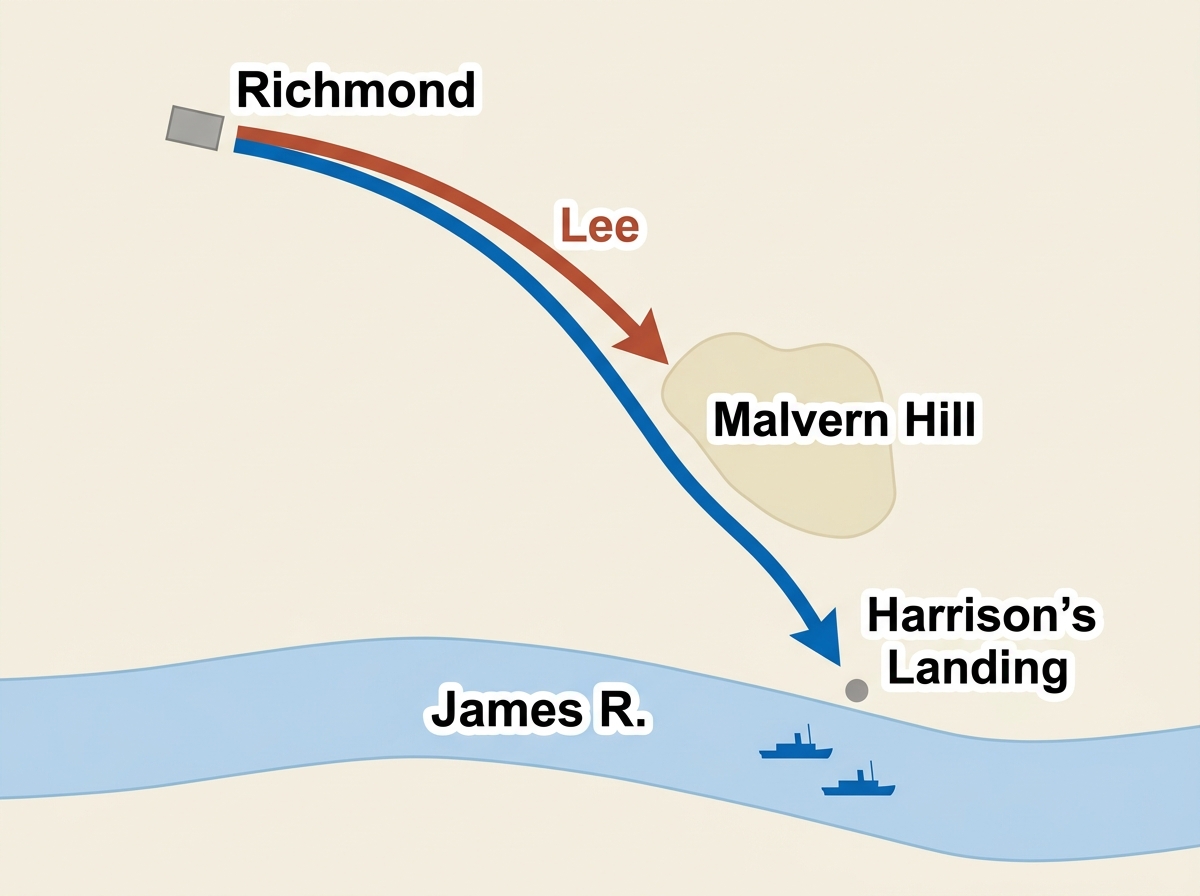
To understand why everyone had come to this hill, you have to back up a week. For seven days, Robert E. Lee had been hitting George B. McClellan (North), and for seven days McClellan had spent every day backing away. The great Union army (the United States’ main fighting force in the East) had come up the Virginia Peninsula (the finger of land between the York and James rivers) to take the Confederate capital at Richmond, and now it was in full retreat, marching south toward the one thing that felt safe: the James River, where the United States Navy’s gunboats (river warships carrying heavy cannon) waited to cover them. The navy’s guns could pound any Confederate pursuit from the water, shielding the army’s rear. The army was running, and the thing it was running from was the survival of a slaveholding republic. Richmond was the capital of a new country founded to keep four million people enslaved, and an entire campaign had been built to capture it and end the rebellion in a stroke. Now that campaign was collapsing backward toward the river, and Lee smelled a chance to finish it for good.
The Seven Days’ end
The fighting that brought everyone here was called the Seven Days Battles (June 25 to July 1, 1862), and it was Lee’s offensive: six engagements in a row, launched to drive McClellan away from Richmond and save the Confederate capital. Mechanicsville, Gaines’s Mill, Savage’s Station, Glendale, the names piled up, all of them clashes Lee forced that week, and after Gaines’s Mill on June 27, McClellan made his decision. He would not fight his way into Richmond. He would withdraw his whole army (officially the Army of the Potomac, the Union’s main eastern force) south across the Peninsula and put his back against the James, where the gunboats could shield him. Lee chased the whole way, swinging at the retreating column, trying to cut it apart before it reached the water. At Glendale, on June 30, he nearly did, and missed.
Eastern TheatreGaines’s Mill: the victory that decided McClellan to retreatBy July 1, the Union rearguard (the troops assigned to cover a retreat so the rest of the army can pull back safely) had backed up onto Malvern Hill, and for the first time in the whole week, the entire Army of the Potomac stood united on one field. It was a good place to make a stand. Malvern Hill is a broad, flat-topped plateau, only about 100 feet above the country around it, but its strength was never really its height. Its strength was what it let you see and shoot. The north face, the side the Confederates would have to come up, was open, gently sloping farm field, with almost no cover for hundreds of yards, in places more than a mile. Any attacker had to walk uphill across that bare ground in full view the entire way. The James River lay just 1 to 2.5 miles (1.6 to 4 km) to the south, securing the Union rear. Boggy creeks, ravines, and dense woods guarded the flanks (the exposed sides of the army’s line). It was, in plain terms, a natural fortress, and the men in blue knew it.
What turned a strong position into a death trap was Hunt, the man already standing on the crest with his guns, the army’s chief of artillery (the officer in charge of the cannon). Artillery in this war meant cannon grouped into batteries, a battery being a cluster of roughly six guns that worked and moved together. Hunt’s job that day was to mass those batteries (to concentrate them so their combined fire overlapped on the same ground): to gather them side by side and tier on tier along the crest, gun above gun, all looking down the open northern slope. There is real confusion in the records about exactly how many cannon he had, since different counts measure different things, the forward line versus the reserve versus every piece on and behind the hill, but the totals run up toward 250 guns altogether, stacked across the high ground. Hunt also wedged a battery of heavy 32-pounder howitzers (short, big-bored cannon that lob a heavy shell) onto the right flank. Behind the hill, in close support, sat the army’s Artillery Reserve (a dedicated pool of fresh gun batteries held back to roll forward and replace any that ran low on ammunition). Down on the James, three Union gunboats, including the USS Galena, added their fire from the river. Hunt had built a wall of iron on the high ground, and he aimed all of it at the empty field below.
Lee had spent a week trying to destroy this army on the run. Now it had stopped running and turned to face him from the best ground it had found yet.