A gap, a turning point, and the cavalry that broke the line
The main assault finally went in late in the morning, Major General Horatio G. Wright’s (North) VI Corps and Brigadier General William H. Emory’s (North) XIX Corps attacking together, side by side, east of Winchester. The first Confederate line they hit belonged to Major General Stephen Dodson Ramseur (South), whose division took the first shock of the whole assault and bent without breaking, buying Lieutenant General Jubal A. Early (South) the minutes he needed to feed the rest of his army into the fight. Almost at once the head-on battle showed why head-on fights are murder.
The two Union corps advanced over uneven ground, and as they pushed forward a gap (a hole in the line where two formations drift apart) tore open between them. A gap in a battle line is a doorway, and the Confederates went straight through it. Major General Robert E. Rodes (South), one of Lee’s finest division commanders, and Major General John B. Gordon (South), another of Early’s division commanders, drove a counterattack into the seam, and the Union center buckled and fell back in disorder. For a stretch of that afternoon, the battle Sheridan was supposed to win comfortably was coming apart in the middle.
It was saved by a man who died saving it. Brigadier General David A. Russell (North), a division commander in Wright’s corps, brought up his reserves to plug the gap, and as he ordered the counterattack that would close the doorway, a bursting shell killed him. His men drove on anyway and restored the line. Sources call that the turning point of the fight, the moment the Union center stopped collapsing and started holding. In the same churn of fighting, on the other side of the gap, Rodes was killed leading his counterattack, struck down reportedly while urging his men on, in the early afternoon. Two generals dead in the same patch of ground inside an hour, one closing the gap and one trying to keep it open. That was the texture of this battle: close, and expensive at the very top.
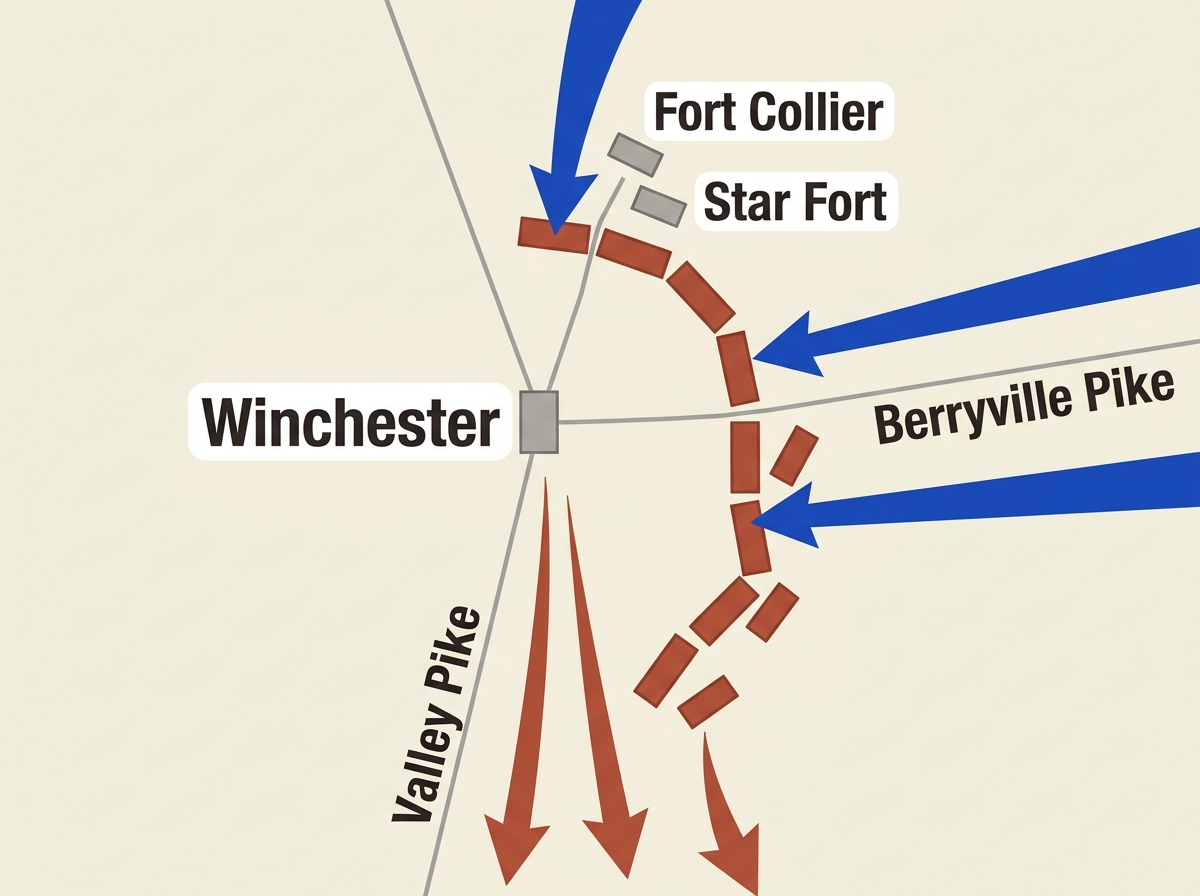
Then came the blow that ended it, and it came from the right. All through the fight Major General Philip H. Sheridan (North) had been keeping pieces in reserve, and around three in the afternoon he turned them loose against Early’s left flank, the northern end of the Confederate line, the open shoulder of an army where getting around it means no longer pushing the enemy back but rolling him up sideways. Brigadier General George Crook’s Army of West Virginia (North), the reserve corps Sheridan had been holding, went in against Gordon’s left. At the same moment Sheridan’s massed cavalry came sweeping down onto that same open flank from the north and northeast, driving straight into the end of Early’s line. The cavalry on the right was decisive because it was the mobile force massed exactly where the Confederate army had no flank to spare, and it hit while Crook’s infantry hit too. Infantry pressing from the east, cavalry and more infantry caving in the north: a hammer and an anvil, with Early’s army the thing between them. Late in the afternoon Brigadier General George A. Custer (North) led a massed cavalry charge straight at the Confederate forts north of town, the works around Fort Collier and Star Fort, and Early’s line, pressed in front and turned on the flank and overrun on the north, came apart.
It came apart, too, at the top. By the time the day was done the fight had killed two Confederate generals, Rodes and Brigadier General Archibald C. Godwin (South), also cut down by a bursting shell, and one Union general, Russell, and wounded several more on each side. That was an unusually heavy harvest of senior officers for a single day, and a measure of how hard the men had to be driven and how close the thing had been.