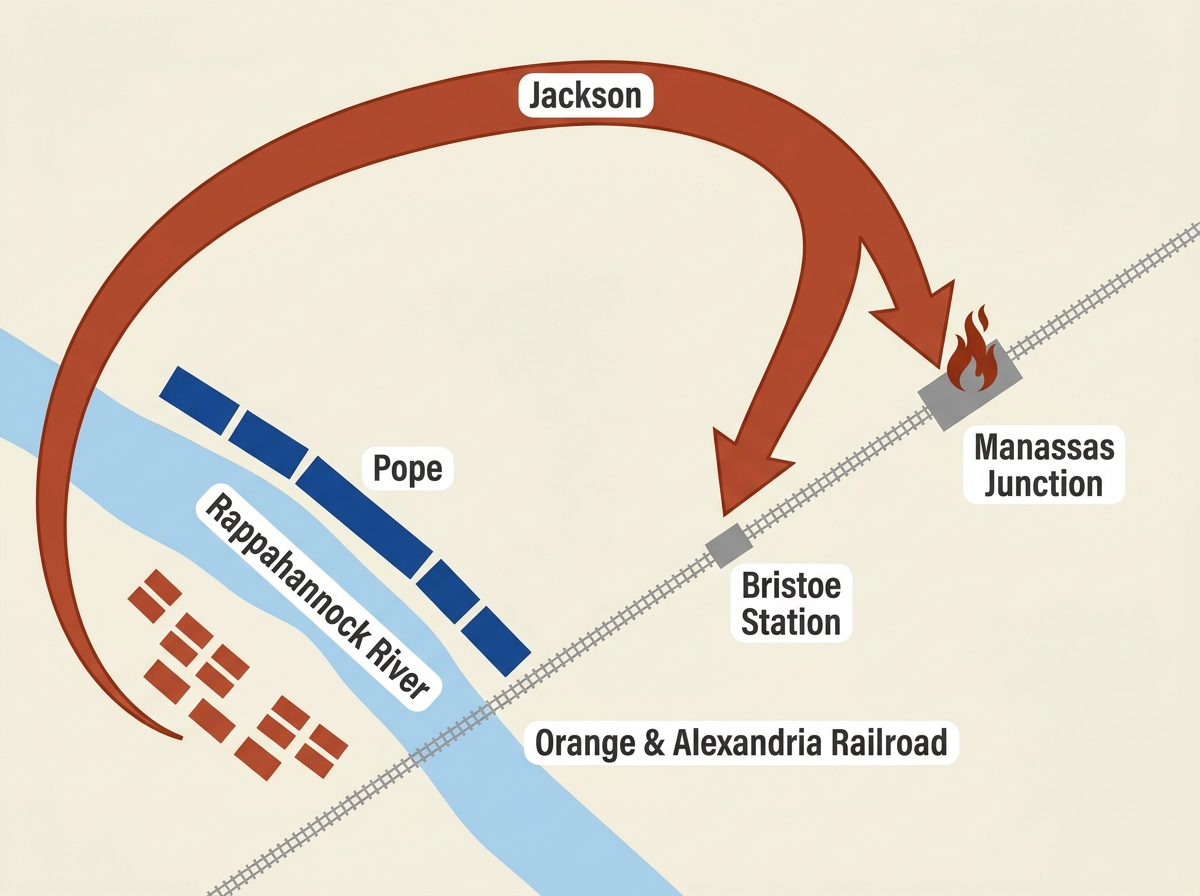
Just over a year before the events in this section, two armies of green amateurs had blundered into each other along a winding Virginia creek called Bull Run, and the first big battle of the Civil War ended with the United States Army running for Washington and a Confederate brigadier earning the nickname Stonewall. That was July 1861 (First Bull Run / First Manassas). Second Bull Run was fought on the same ground, the same creek, the same hills, in places the same fields, and a great many of the men who fought it were standing where they, or men just like them, had already bled the summer before.
What the whole war was for does not change here, though the battle itself will not stop to say it. The Confederate States, the eleven Southern states that had broken away from the United States, were fighting to preserve and extend slavery, the system that held millions of human beings as property and on which the Southern economy was built. The United States was fighting, at first, to put the Union back together. By the late summer of 1862 the war was turning into something larger: a war to end slavery. Second Bull Run sits on that hinge, because the outcome of these three days reached all the way into a document President Abraham Lincoln was, at that very moment, keeping locked in a drawer.
A quick word on how an army of this era was built, because the words for its parts will come up constantly. From the bottom: a regiment is a few hundred to a thousand men (the 5th New York you will meet later had about 500). A few regiments make a brigade (a few thousand). A few brigades make a division (roughly ten thousand). And a few divisions make a corps (tens of thousands), sometimes also called a wing when an army is split into big chunks. The rank ladder tracks the same way: a brigadier general typically leads a brigade; a major general sits above him over a division or corps; and a full general, Robert E. Lee’s rank, stands at the very top. Keep that nesting in mind and every troop movement below has a scale.
“I come to you from the West, where we have always seen the backs of our enemies… I desire you to dismiss from your minds certain phrases… [like] ‘lines of retreat.’”
Major General John Pope (North), on taking command of the Army of Virginia
Back to the Old Ground
In the early summer of 1862 the Union seemed to be winning the war in the East. Major General George B. McClellan (North) had landed a huge army on the peninsula southeast of Richmond and crept to within sight of the Confederate capital’s church spires. Then it fell apart. In a brutal week of fighting at the end of June known as the Seven Days Battles, the Confederates under General Robert E. Lee drove McClellan back from the gates of Richmond, and the threat to the capital eased. Lincoln, casting around for a way to keep pressure on Virginia, scraped together scattered Union commands into a new Army of Virginia and handed it to Pope, with orders to protect Washington and the Shenandoah Valley (the long farming valley running down the western side of Virginia) and to pull Confederate strength away from McClellan.
Pope arrived from the western theater (the war’s fighting out toward the Mississippi, far from Virginia) with a reputation for winning and a talent for saying the wrong thing. He greeted his new eastern army with a boastful order announcing that out West he had only ever seen the backs of his enemies, and that words like “lines of retreat” could be dismissed from their minds. The men did not love being lectured by a stranger about courage, and Lee, watching from the south, did not love Pope at all. Lee made the decision that would define the campaign: with McClellan no longer an immediate threat, he would shift his forces north and destroy Pope before turning back to McClellan. Through late August the two armies sparred along the Rappahannock River, feeling for an opening. A new, untested Union army under a general nobody trusted yet faced a confident Confederate army under a commander at the height of his powers, with the ground between them already a graveyard. Lee was about to make his opening.