Lee’s plan was audacious to the point of recklessness. Facing Pope (North) across the Rappahannock, Lee split his army in two, always a gamble, because either half could be destroyed alone, and sent half of it on one of the most famous marches of the war.
On August 25, Lee turned loose Major General Thomas J. “Stonewall” Jackson (South) with his wing of the army and a single instruction: get into Pope’s rear. Jackson set off on a wide, looping flank march around Pope’s right (the far end of his line, the unprotected side where an army least wants to be hit), swinging west and north through Thoroughfare Gap, a pass through the Bull Run Mountains. His men covered something on the order of 50 to 55 miles in roughly two days, on foot, in August, marching so hard and so fast that Jackson’s foot soldiers had long since earned the nickname “foot cavalry.” Pope had no idea where they had gone.
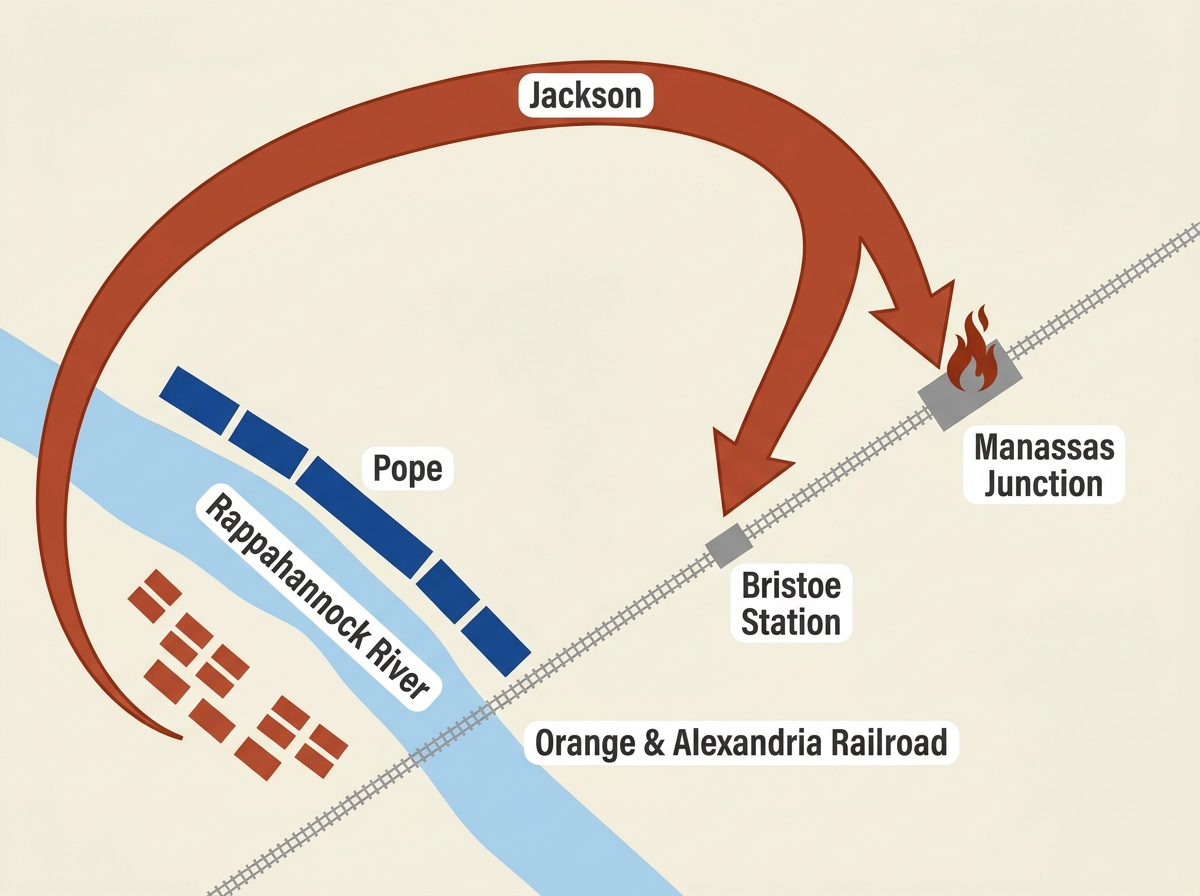
On August 26, Jackson’s wing came down out of the hills and struck the Orange & Alexandria Railroad at Bristoe Station, a few miles southwest of the prize. The railroad was Pope’s lifeline, the single rail line carrying his food, ammunition, and supplies up from the south. Jackson cut it. Then, before dawn on August 27, he took the prize itself: Manassas Junction, the great rail crossing where Pope had built a vast supply depot in his rear.
A Day of Wild Feasting
Jackson’s men were ravenous, having outmarched their own supply wagons, and what they found at Manassas Junction was a Union army’s entire larder: warehouses and rail cars stuffed with food, whiskey, boots, clothing, and ammunition, far more than hungry, half-shod Confederate veterans had seen in months. There followed what one account calls a day of wild feasting: lean men in rags gorging on lobster salad and corned beef, stuffing their pockets and packs, drinking what they could before Jackson had the whiskey casks poured out. Then, because they could not possibly carry it all away, they burned what was left, setting fire to the rest of the United States Army’s supplies and watching the depot go up in a column of smoke rising over Pope’s own rear.
For one day, the have-nots ate the haves’ dinner, and then torched the table.
This was the move that forced the entire battle. With his supply line cut and his depot in flames behind him, Pope had no choice: he abandoned his Rappahannock line and turned his whole army around to hunt down the raider who had gotten into his rear, exactly what Lee wanted. Jackson, his work done, slipped away from the burning junction on the night of August 27 to 28 and pulled his wing back onto a hidden defensive line behind the embankments of an unfinished railroad grade, an abandoned, never-completed rail line below a wooded rise called Stony Ridge. The cuts and fills of that half-built railroad made ready-dug earthworks, a fortification handed to Jackson for free. The ground he chose to make his stand on was the old First Manassas battlefield. He had marched fifty miles to fight on the same hills as the year before. Now his half of the army was alone, dug in, with Pope’s much larger force converging on it and Lee’s other half, Longstreet’s wing, still a day’s march away beyond Thoroughfare Gap. The whole campaign hung on a race: if Pope found Jackson before that second wing arrived, he could crush him.