On the morning of the third day, August 30, Pope (North) sealed his own fate. Overnight, part of the Confederate line had pulled back to straighten itself, and Pope, still convinced the enemy was withdrawing, read the movement as proof that Jackson was finally running. He ordered a pursuit. He sent Union troops, including the corps of Major General Fitz John Porter (North), forward against what he believed was a beaten, retreating foe.
They marched into Jackson’s unbroken line and were shattered against it. The wall was still there. The men Pope sent to chase a fleeing enemy found instead the same embankment that had held all the day before, lined with Confederate infantry who cut them down. While Pope’s attention was fixed forward on Jackson, the real blow was loading on his flank.
Four O’Clock on the Union Left
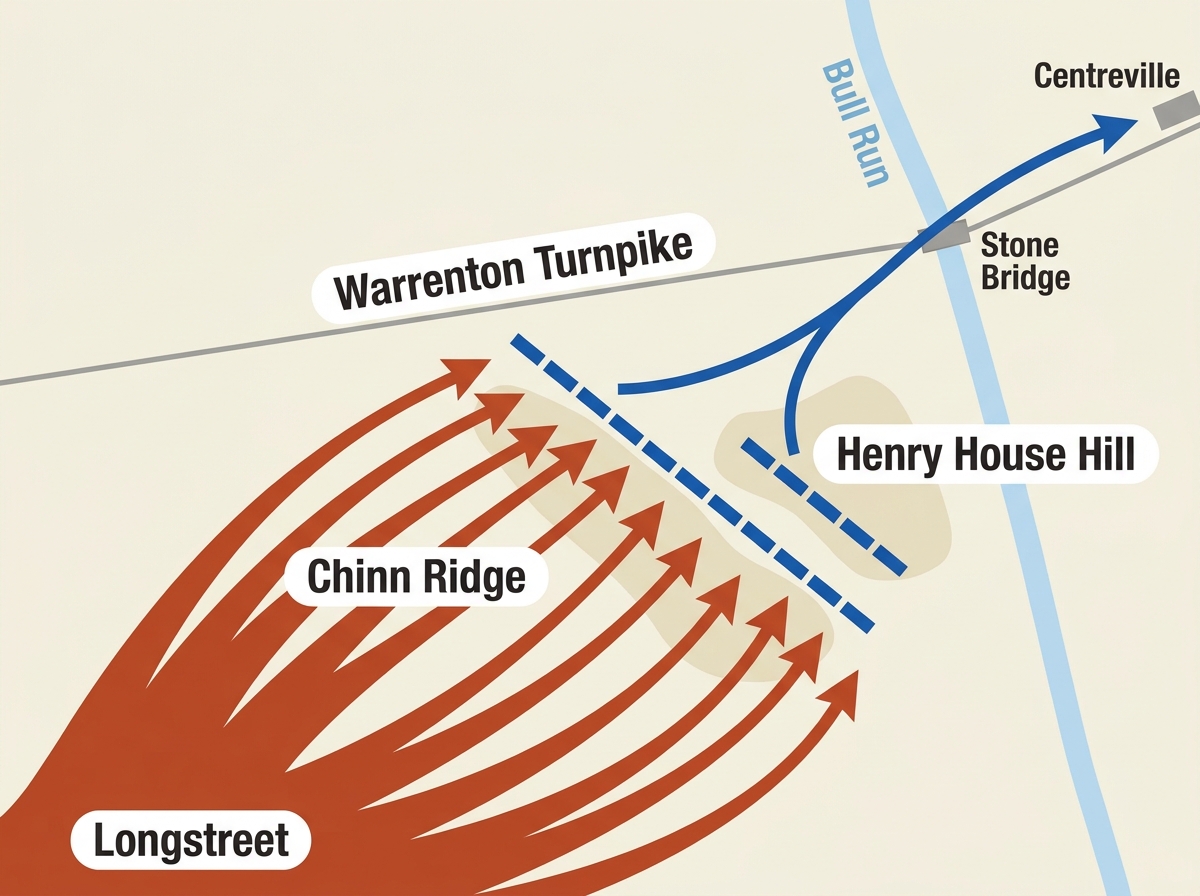
At about four o’clock in the afternoon, Major General James Longstreet (South) let it go. He launched what was, by most reckonings, the largest simultaneous mass assault of the entire war, somewhere between 25,000 and 28,000 men, five divisions, advancing together on a front about a mile and a half wide, straight into the exposed Union left. Major General John Bell Hood’s division (South) spearheaded it, driving forward south of the turnpike. There was almost nothing in front of it. Pope had committed his army to attacking Jackson and left his flank in the air, unanchored, protected by nothing, and now an avalanche of Confederate infantry came down on it.
One regiment shows what that meant for the men in the path of it. The 5th New York Infantry, Duryée’s Zouaves (North), in their bright, conspicuous uniforms, stood in the way of Hood’s charge with about 500 men. In roughly ten minutes, nearly 300 of them were killed or wounded. It is recorded as the single greatest loss of life suffered by any infantry regiment in any one battle in the entire war, half a regiment gone in the time it takes to boil an egg. That is what Longstreet’s avalanche did where it landed.
The Stands That Saved the Army
The Union army began to come apart, but it did not collapse the way it had a year before, and the difference came down to a few thousand men who stood and died to buy time. On Chinn Ridge, high ground south of the turnpike, a thin Union rearguard (the troops left behind to fight off pursuers and cover a retreat) threw itself into Longstreet’s path. The math there was savage: because Major General Irvin McDowell (North) had shifted Brigadier General John Reynolds’s division (North) away from the ridge, roughly 2,200 Union soldiers were left facing what one account calls “ten times their number,” possibly the worst tactical decision of the day. Those outnumbered men, and then another stand on Henry House Hill, the very hill where Stonewall Jackson had earned his nickname in 1861, held just long enough. They bought the minutes that kept the Union army from being surrounded and destroyed.
After dark, Pope’s beaten army withdrew east across Bull Run, funneling over the Stone Bridge and the nearby fords, back to Centreville and then on toward the defenses of Washington. Unlike the panicked rout of First Bull Run, this retreat held together, an organized rearguard keeping it from becoming a stampede. It was a defeat, badly so, but not a catastrophe of fleeing men. The army survived to fight again. It would have to, very soon.