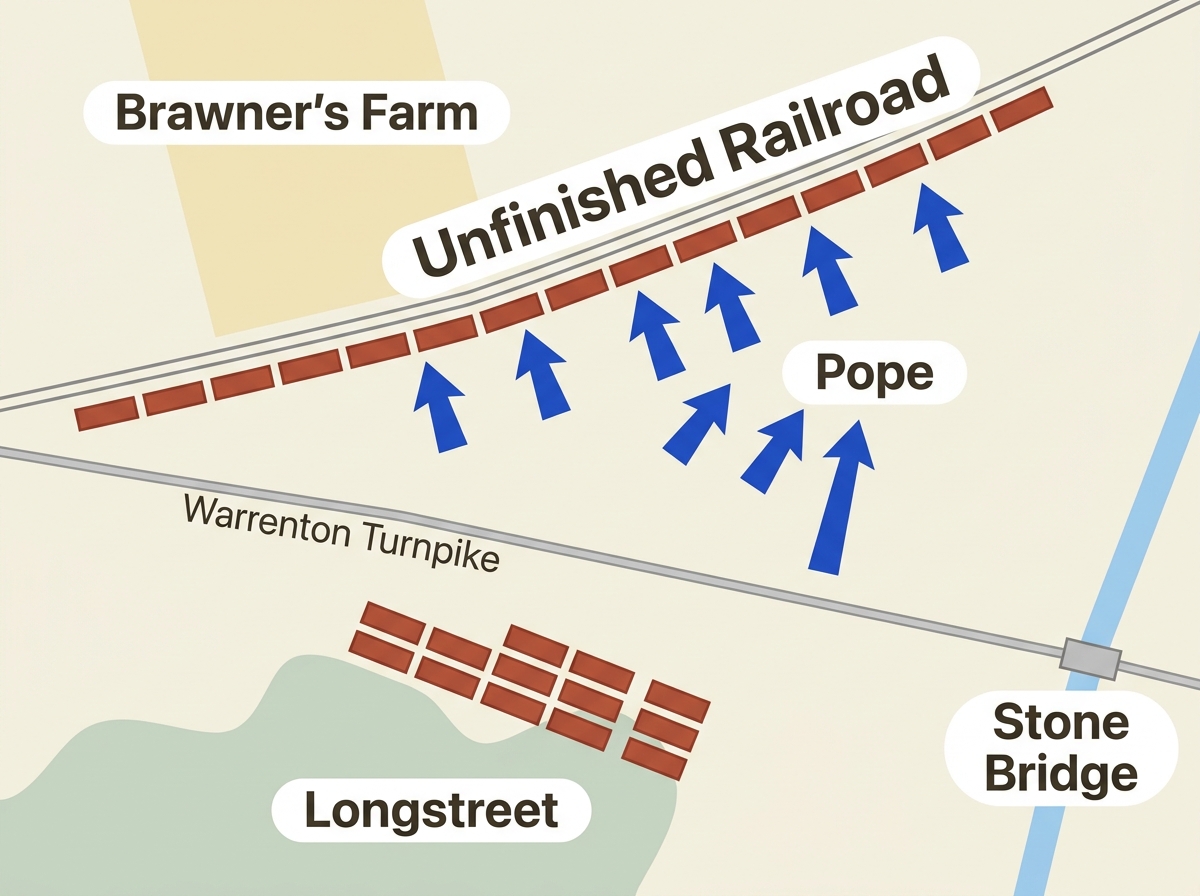
Pope (North) came on hard, and he came on confused. He knew Jackson was somewhere near the old Manassas battlefield, but he badly misread the situation. He convinced himself that Jackson was retreating, trying to escape, and that if he moved fast enough he could trap and “bag” the whole Confederate wing before it slipped away. Jackson was doing nothing of the kind. He was standing his ground, roughly 20,000 men packed into a line (a long row of soldiers, shoulder to shoulder) about 3,000 yards long behind the embankment of that unfinished railroad. He wanted to be found. He wanted Pope to come and break himself on the wall.
It opened the evening of August 28. To pin Pope’s attention and announce his position, Jackson ambushed a Union column marching past on the Warrenton Turnpike (the main east-west road), and the clash centered on Brigadier General John Gibbon’s brigade (North) in the open fields of Brawner’s Farm, near the hamlet of Groveton. What followed was not maneuver but a stand-up, toe-to-toe firefight at close range, two lines of men blazing away at each other across a few hundred feet of farmland for better than two hours, until darkness ended it in a bloody draw. The cost of those two hours tells you what kind of fighting this was: at Brawner’s Farm, one of every three men engaged was shot. Gibbon’s brigade, soon to be famous as the Iron Brigade, was gutted. And Jackson got exactly what he wanted: Pope was now fixated on him, certain he had cornered his prey.
One Division at a Time
The next day, Pope did what he had promised to do. He threw his army at the wall, and he threw it in the worst possible way. The Union attacks went in piecemeal: one division would charge the railroad line, get shot to pieces, and fall back, then a fresh division behind it would charge the same spot and get shot to pieces in turn. Hitting a defended line one chunk at a time is how an attacker loses, because it lets the defender slide men along his line to meet each blow as it comes, instead of being swamped by all of them at once. So Jackson shifted troops to each threatened point and held.
The North kept feeding men into the same line, one division after another, and the line kept handing the men back broken.
It came close. In places the line nearly gave: on Jackson’s left, where Major General A.P. Hill’s division (South) took the worst of the assaults, some of Hill’s men ran clean out of cartridges and hurled rocks at the Union soldiers climbing the embankment. Behind the line, Union guns on Dogan Ridge broke up Confederate counterattacks again and again. It was a long, grinding, murderous day, and the wall held.
Thirty Thousand Men, Unseen
Around noon, the trap closed without Pope ever seeing it. Major General James Longstreet (South), commanding Lee’s other wing, the half of the army that had been a day behind, came marching through Thoroughfare Gap and onto the field. Quietly, without fanfare, Longstreet deployed his entire corps on Jackson’s right, extending the Confederate line south, across the Warrenton Turnpike, into ground from which it could strike the exposed flank of Pope’s army. Lee’s two halves were reunited on the battlefield, and Pope did not realize Longstreet was on the field at all.
How do you not notice thirty thousand men lining up beside you? The answer is the fog of war. A Civil War general had no view from above, no aircraft, no radio, just his own eyes and whatever his scouts and cavalry rode back to tell him, and his vision on the ground was blocked by woods and ridges. Longstreet’s wing filed into position screened by the trees and high ground south of the turnpike. Pope had, in fact, been warned. His cavalry chief, Brigadier General John Buford (North), sent up a report at 8:15 that morning that seventeen regiments of infantry had passed through Gainesville, to the west, which was Longstreet’s whole column arriving. But Major General Irvin McDowell (North), to whom the dispatch was handed, stuffed it in his pocket and forgot about it until seven that evening. Later, Brigadier General John Reynolds (North) personally rode into Longstreet’s men south of the turnpike and reported the enemy there in force, and Pope waved it off as mistaken identity, insisting Reynolds had simply bumped into friendly troops. By the day’s end Pope had brushed aside something like four separate warnings that a second Confederate wing was on his flank. He was not blind so much as unwilling to see: his fixed conviction that the enemy was beaten and fleeing turned every warning into noise. The trap was set, and he could not see it because he had already decided what was true.