The thing the Union was attacking on the morning of June 15 was called the Dimmock Line, and by evening the most important fact about it would be who built it and who took it. The Dimmock Line was a fortified ring around Petersburg, a roughly ten-mile arc of 55 numbered artillery batteries (each battery a fixed gun emplacement, an earthwork strongpoint mounting cannon) connected by dug-in infantry trenches, curving east, south, and west around the city, both ends anchored on the Appomattox River so it could not be flanked at the water. On paper it was formidable. On June 15 it was held by Wise’s 2,200 men spread along its whole length, far too few to defend it.
The Dimmock Line was built by enslaved labor. Over a thousand enslaved people brought from North Carolina, and 264 more from Virginia’s Eastern Shore, had been forced to dig it, to throw up the dirt walls that now shielded the capital of the men who claimed to own them.
The Corps That Struck First
The Union force that came at it that morning was Brigadier General William F. “Baldy” Smith’s (North) XVIII Corps, drawn not from the Army of the Potomac but from Major General Benjamin F. Butler’s (North) Army of the James, which was already operating near Petersburg at Bermuda Hundred. That is why Smith’s men were the ones in position to strike first. A corps is the largest building block of a Civil War army; here it numbered some 16,000 men. It helps to fix the whole ladder once, because the next sections lean on it: an army is built of several corps, a corps of several divisions, a division of several brigades, a brigade of several regiments, and a regiment runs from a few hundred up to about a thousand men. Smith’s corps crossed the Appomattox toward the thinly held eastern face of the line, and the approach began in confusion: the transport vessels landed his divisions almost at random at the crossing sites, scrambling his organization before the fighting even started.
Spearheading the advance was the division of Brigadier General Edward W. Hinks (North). Hinks commanded the United States Colored Troops of the corps: roughly 3,700 Black soldiers, many of them formerly enslaved, most of them green, going into their first major combat. Men who a year or two earlier had been held as property, some of them possibly enslaved within a few miles of where they now stood, were marching to attack the works that enslaved hands had been forced to build.
They had to fight their way even to reach the line. Pushing in along the Jordan Point Road, Hinks’s men ran into a Confederate cavalry roadblock at Baylor’s farm, east of the Dimmock works. The USCT went at it, launched two attacks, and captured a cannon, but the fight chewed up the morning and held the advance back until early afternoon, and every hour lost there was an hour nearer dark. Then Smith spent hours more on a careful reconnaissance of the works ahead, and the daylight bled away.
The Wall Comes Down
The assault finally went in around seven that evening, and when it came it broke the line. The Union attack swept over the earthworks on a three-and-a-half-mile front, and Hinks’s USCT division carried a long stretch of the eastern Dimmock works, Batteries 6 through 11, in roughly two hours of fighting: nearly a mile of the enemy’s fortifications, taken at the point of the bayonet by the men the Confederacy had insisted could never be soldiers. By around nine o’clock the eastern works were in Union hands, and there was almost nothing left between Smith’s corps and the city itself.
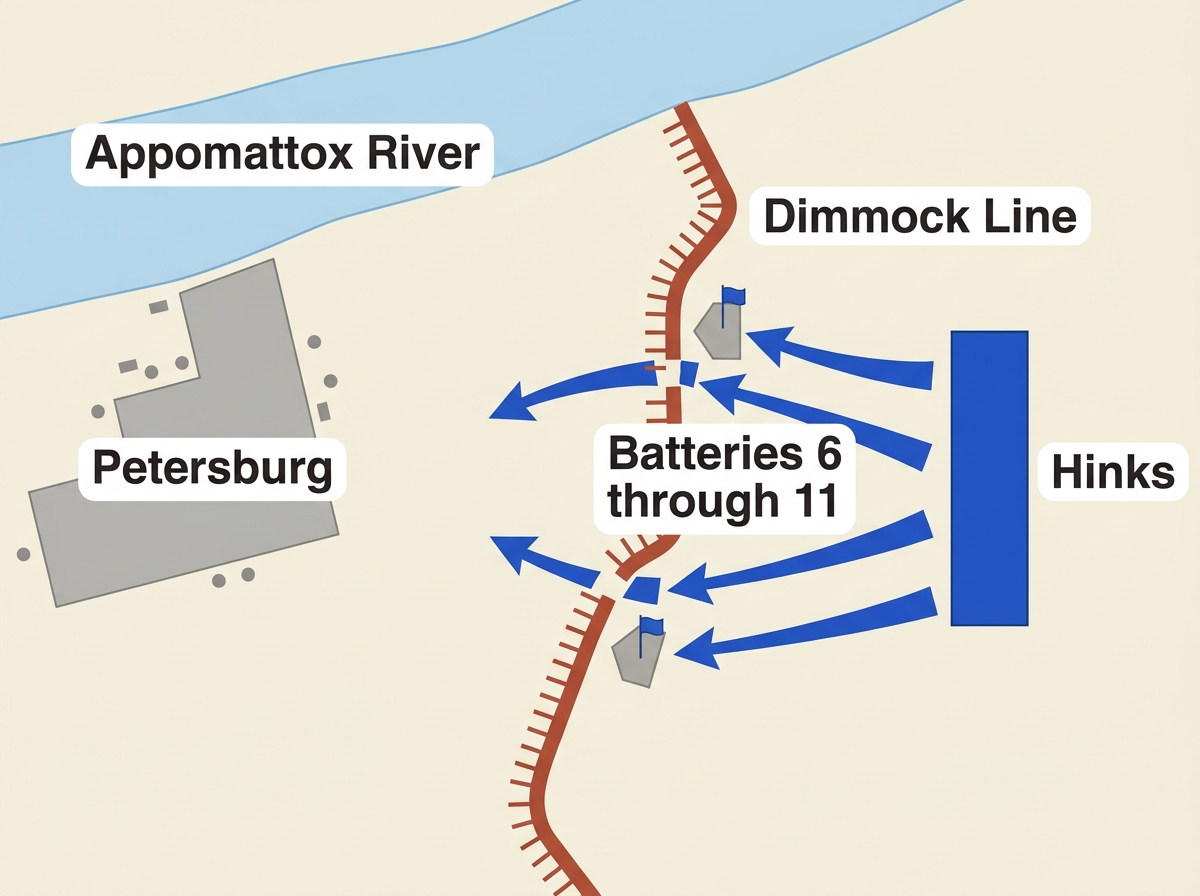
It was the whole argument of the war compressed into a single afternoon. Men who had been enslaved stormed over the fortifications that enslaved people had been forced to build, and took the guns off the wall that was meant to protect the men who had owned them. The railroad was the object. Slavery was the reason. And the proof of the reason was right there on the parapet, in blue, on June 15.
Their own officers knew what they had watched. Colonel Joseph B. Kiddoo (North) of the 22nd USCT reported that his troops had behaved in a way that gave him, in his words, the fullest confidence in their fighting qualities, the white officer corps registering in real time, and against its own prejudice, what the freedmen had proved.
“behaved in such a manner as to give me great satisfaction and the fullest confidence in the fighting qualities of colored troops.”
Colonel Joseph B. Kiddoo (North), 22nd USCT
Off the fieldThe U.S. Colored Troops: the men the Confederacy said could never be soldiers