By the middle of June 1864, Ulysses S. Grant had been hammering Robert E. Lee head-on for six straight weeks, and the arithmetic had gotten gruesome. From the Wilderness through Spotsylvania to Cold Harbor, the long, grinding Overland Campaign, the two armies had bled each other in one frontal collision after another. At Cold Harbor on June 3 Grant had thrown his men against entrenched Confederates and lost thousands in minutes for nothing. Entrenchments (dug-in defensive lines, dirt thrown up into ramparts a charging man has to cross) had made attacking suicidal, and Lee was very good at digging. So Grant stopped charging the capital. He decided to cut its throat instead.
Eastern TheatreCold Harbor: the slaughter that ended the frontal-charge campaignThe throat was a town called Petersburg, Virginia, sitting on the south bank of the Appomattox River about 24 miles (39 km) south of Richmond. Petersburg mattered for one reason: it was a railroad junction, the point where the rail lines that fed the Confederate capital converged, five of them by the usual count. Richmond could not be fed or armed except through Petersburg. Take Petersburg, and Richmond starves; starve Richmond, and Lee’s Army of Northern Virginia, the thing keeping the Confederacy alive, has nowhere to stand. So after a year of trying to beat Lee’s army in the open field, Grant went around it and reached for its supply line. The railroad was the object of the maneuver, not the reason behind it. The Confederacy had broken eleven states out of the United States to do one thing: preserve and extend slavery, the holding of roughly four million Black people as property. Richmond was the capital of that slaveholding republic, Petersburg was its last shield, and the question underneath the whole maneuver was whether the slave society survived. By the end of the first day that question would be standing in the assault line, in human form, carrying a rifle.
Stealing a March on Lee
The march Grant pulled to get there is one of the great feats of the war, and the whole battle hangs on it. To steal a march is to disengage from an enemy and move your army so quietly and so fast that he does not know you are gone until it is too late to stop you. That is what Grant did. He pulled the Army of the Potomac, the main Union army in the East, out of its lines in front of Lee at Cold Harbor without Lee noticing, marched it southeast, and ferried it across the James River, the wide river to the northeast of Petersburg. The James was far too wide to wade or bridge casually, so Grant’s engineers laid a pontoon bridge (a roadway floated on a string of anchored boats) 2,200 feet long across the river at Windmill Point, one of the engineering marvels of the war, and ran an entire army over it.
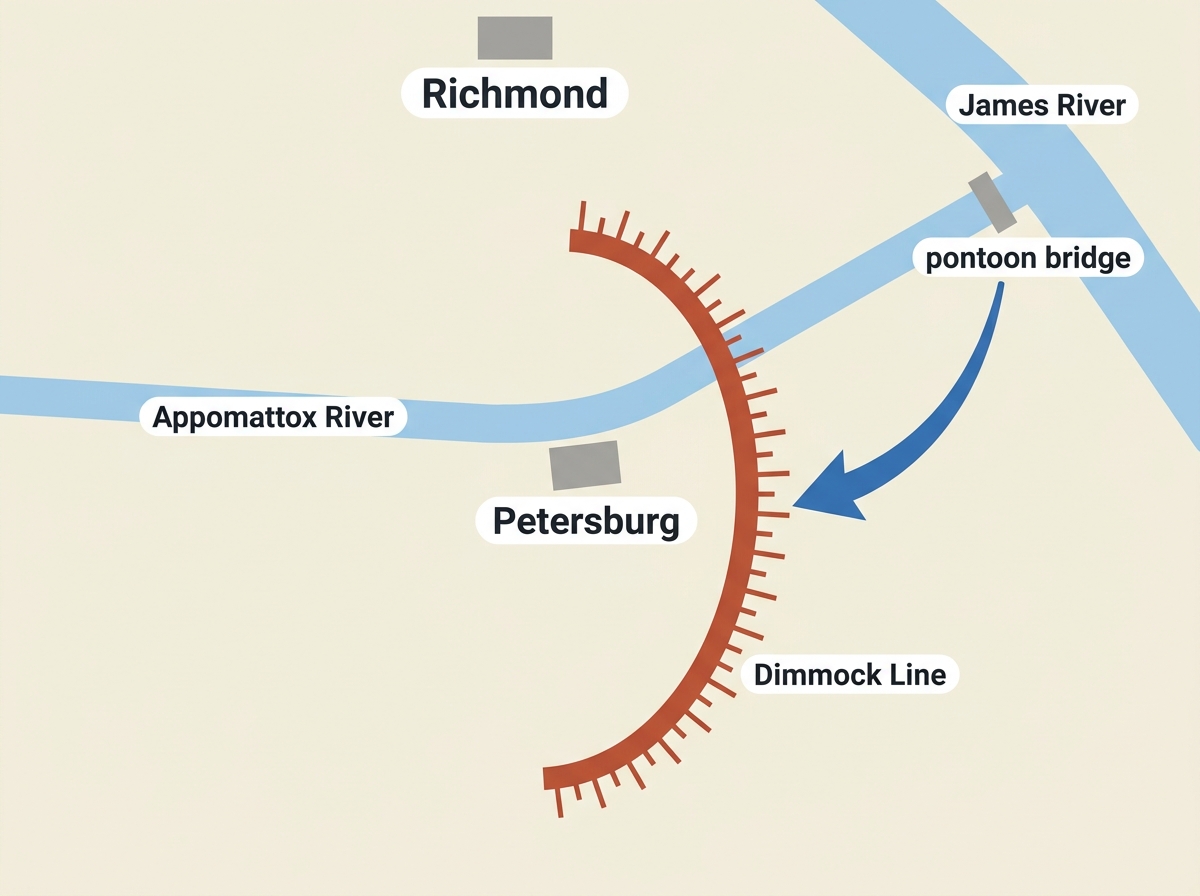
What it bought was a head start. For about two days, Lee did not know where Grant’s army was. He thought it might still be in front of him, or moving on Richmond directly. He did not believe it had slipped across the James and was reaching for Petersburg from the east, until it was almost too late. The battle that follows turns on a single question: could the Union exploit that head start and seize a nearly undefended city before Lee figured out where everybody had gone and came running?