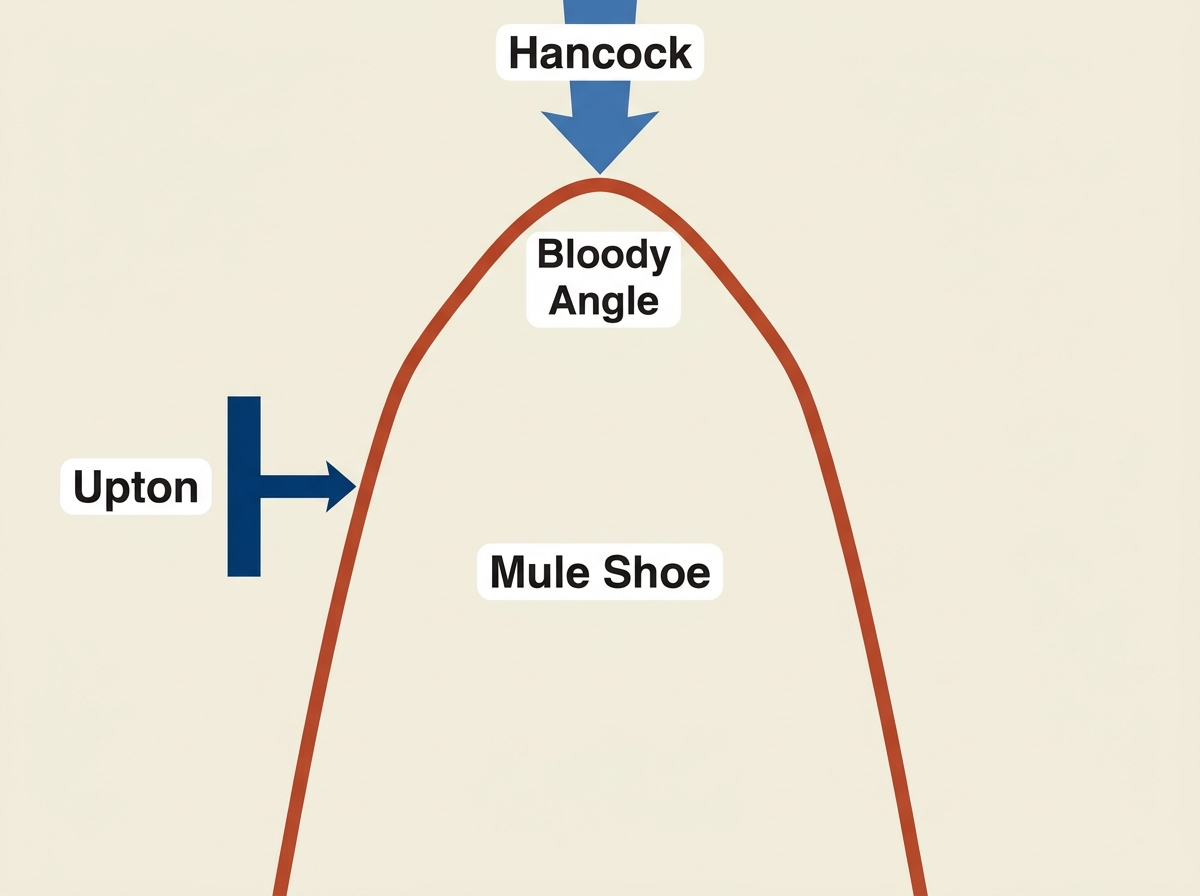
Here is the problem Lee’s engineers could not solve. When Lieutenant General Richard Ewell (South) and his Second Corps dug their part of the line on the night of May 8, the best defensible ground, a patch of higher elevation they needed in order to see and shoot, did not sit in a tidy straight line. It bulged out northward, ahead of everything on either side of it. To hold that high ground, the trench had to follow it, which meant the line poked out into a great horseshoe-shaped loop, jutting more than half a mile out in front of the main works and enclosing something like 250 acres of farmland. The soldiers looked at the curve of it on the ground and named it the "Mule Shoe."
A bulge like that in a fortified line has a formal name, a salient (a part of a defensive line that juts out toward the enemy), and it is a known death-trap, for a reason you can see by drawing it. A straight line of works can only be shot at from the front. A salient sticks out, so an enemy can wrap around it and fire into it from the front and both sides at once, three directions of bullets converging on the men inside (gunners call that converging side-fire enfilade, and it is exactly as bad as it sounds). Lee knew the Mule Shoe was weak. His artillerists knew it. They accepted it anyway, because the alternative was surrendering the high ground, and to make up for the danger they crammed the salient with around thirty cannon and built the trenches stout. The apex, the tip of the horseshoe, the part that stuck out farthest and was exposed on the most sides, was the worst spot of all. Within a few days it would have a new name: the Bloody Angle.
Upton’s Column
The Union spent May 10 testing the line, and one test very nearly changed the war.
In the early evening, around six, a young colonel named Emory Upton (North) tried something new against the west face of the salient. The standard way to assault works was to advance in a broad line, stop, trade volleys to soften the defenders, then charge, which gave the men behind the rampart plenty of time to shoot you to pieces on the way in. Upton threw that out. He took twelve hand-picked regiments, roughly five thousand men, and stacked them in a tight, deep column, four battle lines packed close one behind the other, like a battering ram of human beings, and sent them sprinting across about 150 yards of open ground with one inflexible order: do not stop to fire. Do not shoot, do not pause, just run and hit the trench before the defenders can reload after their first volley.
It worked beautifully. Upton’s column took the first volley, absorbed it, and crashed straight into the works, breaking clean through the line and capturing a stretch of trench and a battery of guns. For a few minutes there was a real hole in Lee’s army. And then nothing came to fill it. The supporting attack that was supposed to pour through behind Upton, a division under Brigadier General Gershom Mott (North), wilted under Confederate artillery fire and fell back before it arrived. Left alone and unsupported in a captured trench with the enemy closing in from three sides, Upton had to give the ground back; Confederate counterattacks drove his men out of the works they had just bled to take.
But everyone who mattered saw what had happened. A dense, fast column, charging without firing, had cracked a modern entrenched line, something that was supposed to be impossible. Grant was watching, and he drew the obvious conclusion: do it again, but bigger. Do it with a whole corps, aimed straight at the apex. He promoted Upton brigadier general on the spot and started planning the assault for May 12.
Lee Pulls the Guns
And then Lee, by pure accident, took the cannon off the very ground Grant was about to attack. On May 11 Lee guessed wrong: watching the Union army shuffle, he convinced himself Grant was disengaging and sliding off to the southeast again, the now-familiar pattern, and, to be ready to march, he ordered most of the artillery, around twenty-nine guns, pulled out of the Mule Shoe. It was, in effect, stripping the most exposed point in the army of its teeth the night before the biggest assault of the campaign landed on it. The error compounded itself by the clock. Late that night Major General Edward "Allegheny" Johnson (South), whose division held the apex, grew nervous and asked for his guns back. The order to return them went out, but it crawled, and the artillery did not start rolling back toward the salient until roughly half past three in the morning on May 12. Major General Winfield S. Hancock’s (North) assault would land about half an hour later, with the cannon literally on the road, headed the wrong way. The Confederate artillerist Edward Porter Alexander (South) would later judge the decision to pull those guns the single worst Confederate mistake of the whole campaign, and he was right.
Fight It Out on This Line
Around half past eight on the morning of May 11, with the army stalled and the casualty lists already appalling, Grant wrote a dispatch to the army’s chief of staff in Washington, Major General Henry Halleck (North). Buried in the routine business about sending the wagons back to Belle Plain for fresh provisions and ammunition was the line that would define the entire campaign in the Northern press: that he meant to fight it out on this line if it took all summer. It was the opposite of every message Washington had gotten from this army after a hard fight. He was not coming home.
Yellow Tavern, and the Death of Stuart
That same May 11, six miles (10 km) north of Richmond, the cavalry raid bore its bitter fruit. The roughly twelve thousand troopers of Major General Philip H. Sheridan (North) ran into Stuart’s roughly forty-five hundred at a place called Yellow Tavern. In the swirling fight, Major General J.E.B. Stuart (South), Lee’s dashing cavalry chief, the army’s eyes for three years, was shot at close range by a dismounted Union trooper, Private John Huff (North). He was carried into Richmond and died there the next day, May 12, even as the Mule Shoe was filling with bodies a few hours’ ride to the north. Major General Fitzhugh Lee (South), Robert E. Lee’s nephew, took over the cavalry. In the same handful of days, each army lost a beloved senior commander, Sedgwick for the Union and Stuart for the Confederacy, to a single well-aimed shot.