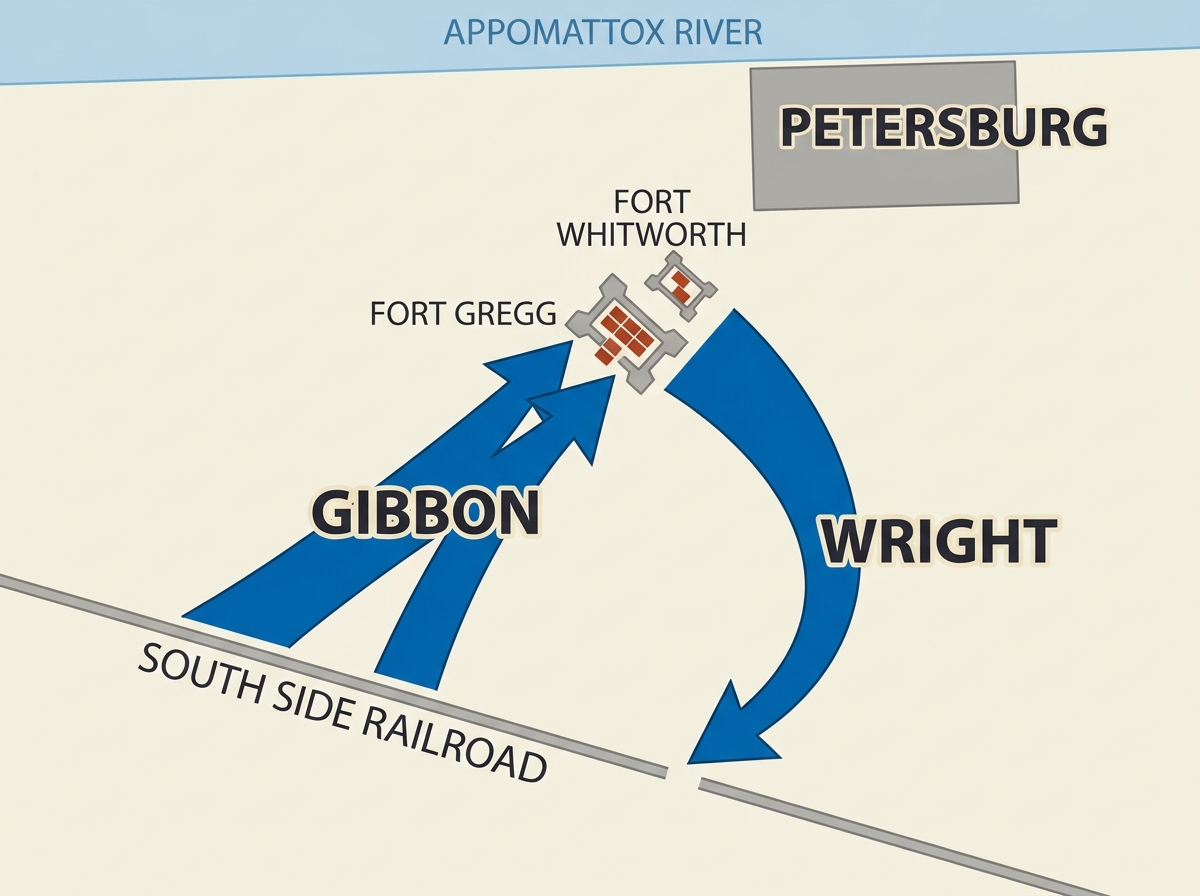
The breakthrough had torn the line open, but it had not yet taken Petersburg. Between the gap and the town stood two small earthen forts, Fort Gregg and Fort Whitworth, and behind them Lee was scrambling to throw together a last inner line to cover the streets while the army got away. If the forts fell quickly, Union troops would be in Petersburg by afternoon and might cut off the retreat entirely. So the handful of men inside them were asked to buy time with their lives.
Fort Gregg was held by something like 300 to 350 men, many of them Mississippians, with a couple of guns. Coming at them was the Twenty-Fourth Corps of the Army of the James, under Major General John Gibbon (North), thousands strong, with United States Colored Troops in the supporting lines. Gibbon’s brigades crossed the open ground and hit the fort in waves. The defenders fired into them at point-blank range, the attackers fell back, re-formed, and came again, and the fighting at the parapet turned to clubbed muskets and bayonets and fists.
It has been remembered since as a kind of Confederate Alamo. Gibbon’s men came on around one o’clock in the afternoon, and the garrison held for close to two hours against odds that could only end one way. When the fort was finally carried, around a quarter to three, most of the defenders were dead, wounded, or taken. But the hours they bought were the point. They gave Lee the daylight he needed to pull his shattered army back behind the inner works and ready the roads west. Petersburg would not fall that evening after all.
Out beyond the western flank, the Sixth Corps had not stopped at the trenches. Wright’s men wheeled and drove on to the South Side Railroad, the last line into Petersburg from the west, and tore it up. With that, the final artery feeding Lee’s army and the capital was cut. There was nothing left to hold for.