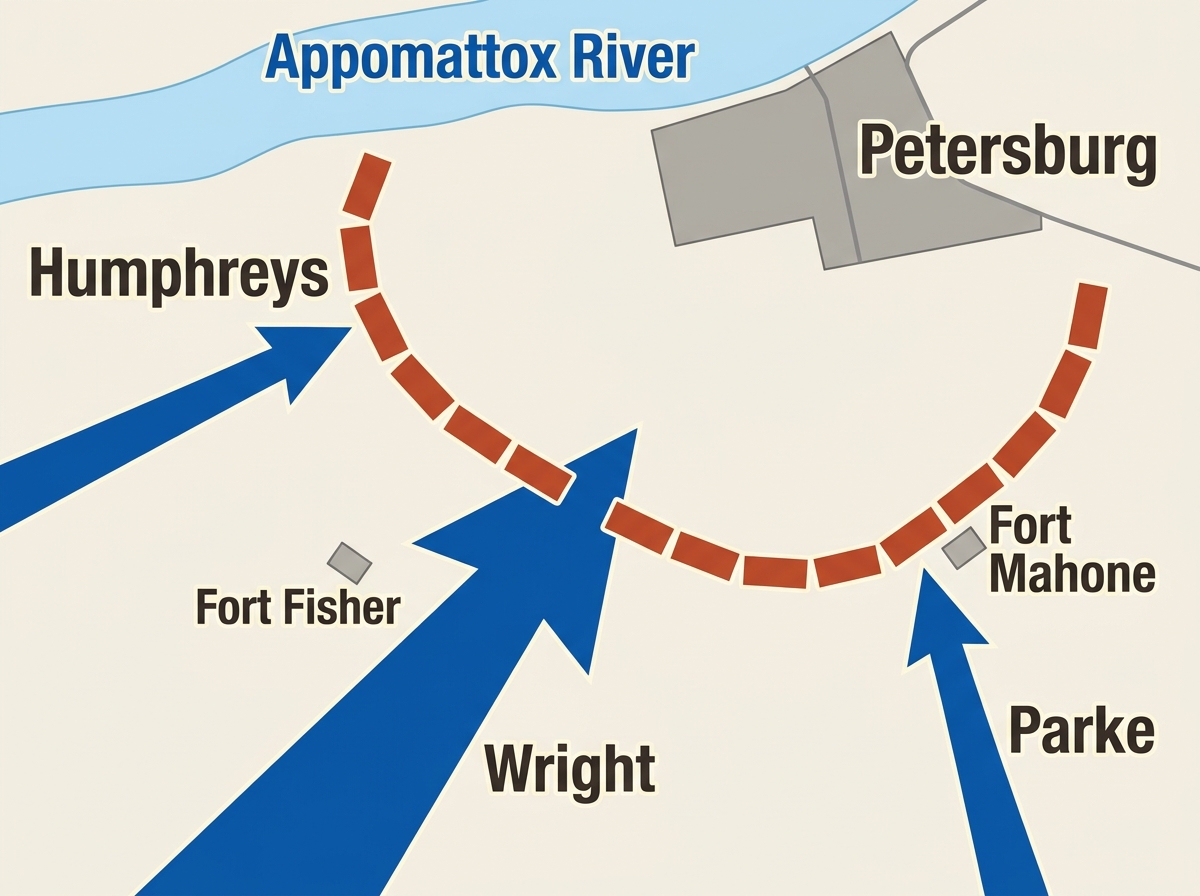
It was still dark on Sunday, April 2, 1865, when the signal gun fired from Fort Fisher, one of the Union works in the line. At about 4:40 in the morning, the men of the Sixth Corps rose out of the gloom and went forward in a single great wedge, thousands of them packed shoulder to shoulder, aimed at one point in the Confederate trenches southwest of town.
The corps was led by Major General Horatio G. Wright (North), and the leading division belonged to Brigadier General George W. Getty (North), with the Vermont Brigade out in front. They crossed the open ground in the dark under a scattering fire, reached the works, tore through the sharpened stakes the defenders had planted, and climbed over. The thin gray line holding that stretch had no depth and no reserve. It came apart almost at once. One Union account said the resistance was swept away "like chaff before a tornado." By a little after five o’clock the trenches were broken wide open and the defenders were running.
The lines that broke belonged to the corps of Lieutenant General A. P. Hill (South), one of Lee’s most trusted commanders. Hill had been on sick leave and had only just returned to duty. When the firing told him his front had given way, he rode out with a single staff officer to find his men and rally them. Instead he rode into the chaos of the collapse and met two Union soldiers of the 138th Pennsylvania, Corporal John W. Mauk and Private Daniel Wolford, who had pushed forward through the broken line. Hill demanded their surrender; they leveled their rifles and fired, and he was killed instantly. When word reached Lee, he is said to have answered quietly that Hill was at rest now, and they who were left were the ones to be pitied.
Word of the disaster went to Lee at his headquarters at the Turnbull house, west of town. He could see for himself what it meant. The Sixth Corps had cut clean through the heart of his line and was rolling up the trenches in both directions, and behind it more Union corps were pouring through the gap. There was no patching this. The siege that had held for nine months had broken in twenty minutes.