Hill nearly breaks, Longstreet saves him, and the woods repeat a year-old horror
The second day opened with the Union nearly winning the whole thing before breakfast. Around five in the morning, Major General Winfield S. Hancock (North) and Brigadier General George W. Getty (North) attacked straight down the Plank Road and slammed into the exhausted, disorganized corps of Lieutenant General Ambrose Powell (“A.P.”) Hill (South) from the night before. Hill’s line came apart. His men fell back in confusion, and for a few minutes Lee’s entire right wing, the southern end of his line along the Plank Road, teetered on the edge of total collapse.
What held it together first was a single open field and twelve guns. At the Widow Tapp farm, a small clearing just behind Hill’s crumbling line, twelve Confederate cannon under one artillery colonel stood out in the open and fired canister (a can packed with musket balls that turns a cannon into a giant shotgun) straight down the Plank Road, buying minutes against Hancock’s advance.
And then, around six in the morning, the rescue arrived. The First Corps of Lieutenant General James Longstreet (South), Lee’s most trusted lieutenant, the man he called his “Old War Horse,” came up at the end of a hard night march; his corps had started the battle some 10 miles (16 km) away. At the head of the column was the Texas Brigade. Lee, seeing his line saved at the last instant, rode forward to lead the counterattack in person, waving his hat and shouting that the Texans always carried any position they were sent against. His own soldiers would not have it. They refused to advance until he went back to safety, some grabbing the reins of his horse, Traveller, and Longstreet talked him into a safer spot behind the line. (This is the famous “Lee to the rear” episode, the traditional name for the moment; the soldiers halting his horse is the verified part.) The counterattack then went in: two of Longstreet’s divisions drove the Union line back through the woods. The Texas Brigade was wrecked doing it, by one account only about 250 of some 800 men coming through unhurt. Brigadier General James S. Wadsworth (North) was mortally wounded as the Confederate advance pushed his command back. Between the two roads, the IX Corps of Major General Ambrose E. Burnside (North), reporting straight to Grant rather than to Meade, fed in piecemeal through the same blinding woods, too slowly to tip the morning.
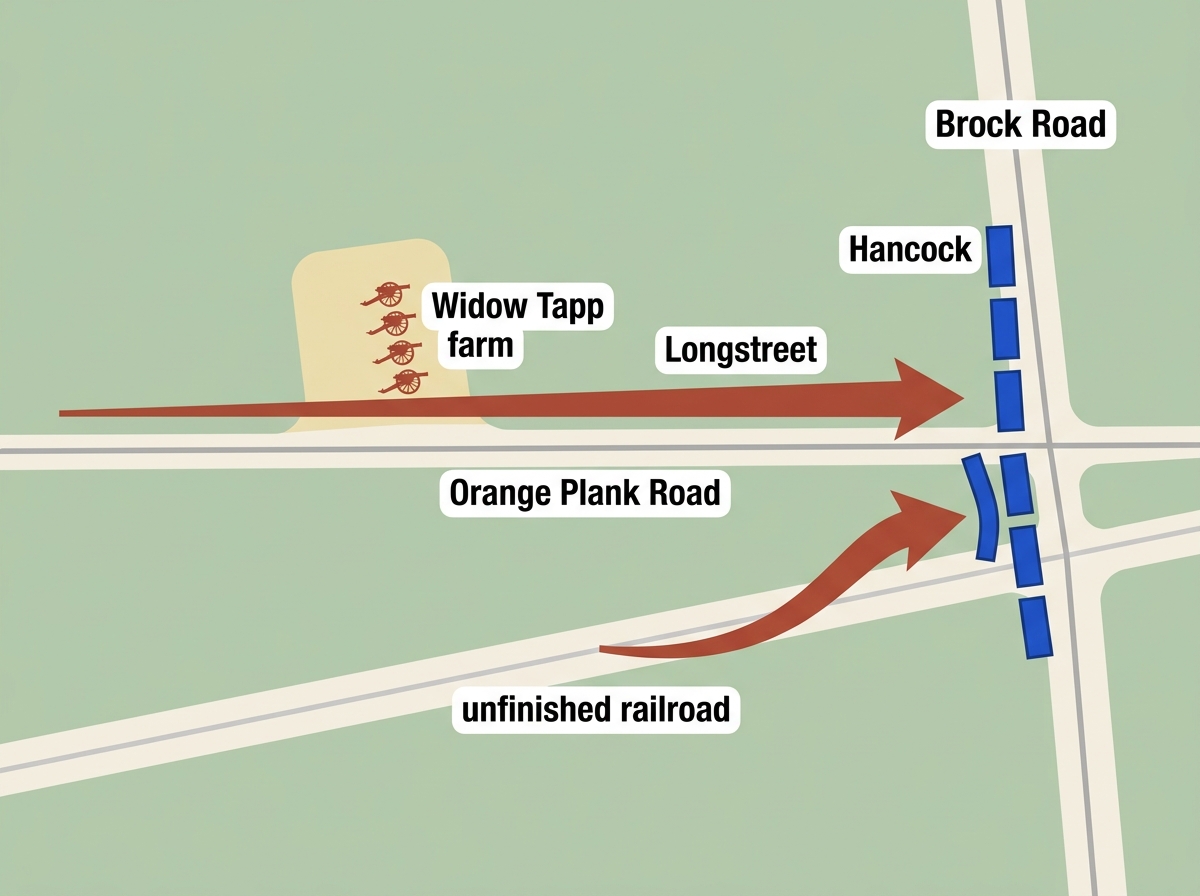
Then Lee’s army found the door nobody had thought to lock. Around ten in the morning, Lee’s chief engineer, Major General Martin L. Smith (South), came back from scouting the brush with a report that changed the day. South of the Plank Road, hidden in the trees, ran an unfinished railroad bed, a long graded cut where a railroad had been started and never built. It was open. It was unguarded. And it pointed like an arrow straight around the flank of Hancock’s line. (A flank is the exposed end of a battle line, the side rather than the front; get around a flank and you can fire down the whole length of the enemy’s line instead of butting into the front of it.) Hancock’s men were facing west, braced for the next blow to come at their front, and this graded ditch led to the one place they were not looking, their open southern end.
Around eleven, a staff officer led four brigades quietly up that hidden railroad bed, formed them in the trees, and turned them loose into Hancock’s unguarded left. The surprise was total. An order meant to guard that flank had miscarried somewhere in the chain, so there was nothing waiting. The Union line came apart from the end, collapsing sideways, one unit folding into the next, the whole formation peeling up the way a strong wind lifts the corner of a tarp. Hancock fell back to his log breastworks (chest-high barricades of piled timber) along the Brock Road, and later said the attack had rolled up his line, in his own words, like a wet blanket.
Then the woods reached for their year-old echo. Riding forward on the Plank Road to press the broken Union army, Longstreet (South) was shot by his own men. In the smoke and brush, one of his own regiments had become separated from the rest; when it came back toward the road, its own side mistook it for Federals, and two bodies of Confederate troops fired on each other, catching Longstreet’s mounted party in the crossfire. A bullet tore through his throat and into his shoulder. He survived, but he was out of the war for roughly five or six months. In the same volley, Brigadier General Micah Jenkins (South) was struck in the forehead and mortally wounded; he lingered for hours and died without ever regaining his senses. It had happened in the same woods, in the middle of a successful flank attack, almost exactly a year after Thomas “Stonewall” Jackson had been shot down by his own men at Chancellorsville nearby: both corps commanders, both cut down by friendly fire on the brink of victory, in this same tangle of trees. With Longstreet down, the great Confederate attack lost its grip and stalled.
The day still had two blows left. In the late afternoon Lee threw a renewed assault at Hancock’s Brock Road breastworks; a fire broke out in the log works and for one moment Confederate flags went up on the barricade itself, but the works held, and a Union counterattack drove the breach back out within about an hour. Then, as evening came on, the northern road flared one last time: around 5:30 p.m. Brigadier General John B. Gordon (South) struck the far Union right, a flank that had been left hanging in the air. Out of the dusk his attack crumpled the Union line and swept up two captured generals, and for a few minutes it threatened to roll the whole northern end of the army into ruin. But darkness and the woods did to Gordon what they had done to everyone all day: they swallowed his momentum, and the Union line re-formed in the dark before a crumpled flank could become a rout.