At 4:30 in the morning on April 12, 1861, a single mortar shell rose over the dark harbor, arced across the sky, and burst above Fort Sumter. It was a signal, not an attack, a flare made of gunpowder telling every gun in the ring around the fort to open fire. The war that would kill some 700,000 Americans began with one shell fired at an empty patch of sky over a brick fort, and for the next thirty-four hours the guns around Charleston Harbor poured iron into the fort without killing a single soldier.
The signal shell
The first round came from the Fort Johnson mortar battery on James Island. Captain George S. James (South) gave the order; Lieutenant Henry S. Farley (South) pulled the lanyard (the cord that fires a cannon). That shell, by the account most modern historians accept, was the true first shot of the Civil War, though the historical record is genuinely murky here, and some scholars say the identity of the very first man to fire is simply unknown.
What is not murky is the legend that grew up around it. Edmund Ruffin (South) was a 67-year-old Virginia planter and fire-eater (the period's word for the radical pro-slavery agitators who had been demanding secession for years). He had built his entire identity around the coming of this war, had argued for it, ached for it, and finally traveled all the way to Charleston for the express purpose of being present at its opening, an old man standing among the guns to watch the thing he had wished for arrive. After the signal shell he fired a 64-pound round from the Iron Battery out at Cummings Point, and Southern tradition crowned him the man who fired the first shot of the war. It was a myth, and a cultivated one: the anonymous signal mortar had beaten him to it by the clock, robbing the man who had wanted it most of the one distinction he had come for. Four years later, with the Confederacy destroyed and slavery abolished, every belief he had organized his life around in ruins, Ruffin wrote a final entry in his diary denouncing "Yankee rule," and shot himself.
After the signal, the whole ring opened up. All 43 Confederate guns and mortars came to life, firing roughly every two minutes in a slow counterclockwise wheel around the harbor, so that the shelling rolled around Fort Sumter like the hand of a clock made of cannon fire.
The teacher who would not fire his best guns
Anderson (North) did not answer. He held his fire in the dark and let the Confederate guns hammer his walls for hours, waiting for daylight. It was not until about 7:00 a.m. that the garrison fired its first shot in reply, and the man who fired it was Captain Abner Doubleday (North), Anderson's second-in-command. Doubleday sighted a 32-pound cannon on the Iron Battery at Cummings Point and let fly. The ball hit the battery's slanted iron roof, bounced off, and splashed harmlessly into a nearby swamp. The first shot the Union fired in the Civil War skipped off an iron roof like a thrown stone and sank in a marsh, and the war ground on as though it had never been fired.
There was a reason the fort's reply was so feeble. Sumter's heaviest, most effective guns were mounted up top, on the open upper tier, the "barbette," an exposed firing platform along the top wall of the fort. To work those guns, men would have to stand up in the open while iron rained in from every shore of the harbor. Anderson refused to spend his soldiers that way. He ordered fire only from the lower, sheltered casemate guns (the cannon set behind the thick brick of the fort's lower level), which meant his best weapons sat silent the entire battle.
Anderson had spent his career as an artillery teacher, the man who drilled young officers in how to mass cannon fire and bring it down with maximum effect, and his single most gifted student in that art was Beauregard, who was at that moment doing exactly what he had been taught, ringing the harbor with guns and methodically reducing the fort, executing his old instructor's lessons against his old instructor's walls. Anderson, the man who knew better than anyone on either shore how to make these guns kill, was deliberately choosing not to. He left his deadliest cannon cold and crewed only the safe ones below, because firing the good guns meant standing his men up in the open to die, and he would rather lose the fort than lose the men.
So Sumter answered with a fraction of itself. Anderson could safely crew only about 21 guns on the lowest level, and even those threw poorly against the land batteries ringing him. Worse, he was running out of the cloth bags that hold a cannon's powder charge: the garrison had started with only about 700 cartridges, and as they ran low the soldiers tore up blankets and uniforms and sewed the cloth into new ones by hand. By the second day Anderson had cut his fire down to just six guns, six scattered cannon stuffed with powder bags sewn from bedding and clothing, against forty-three.
Fire
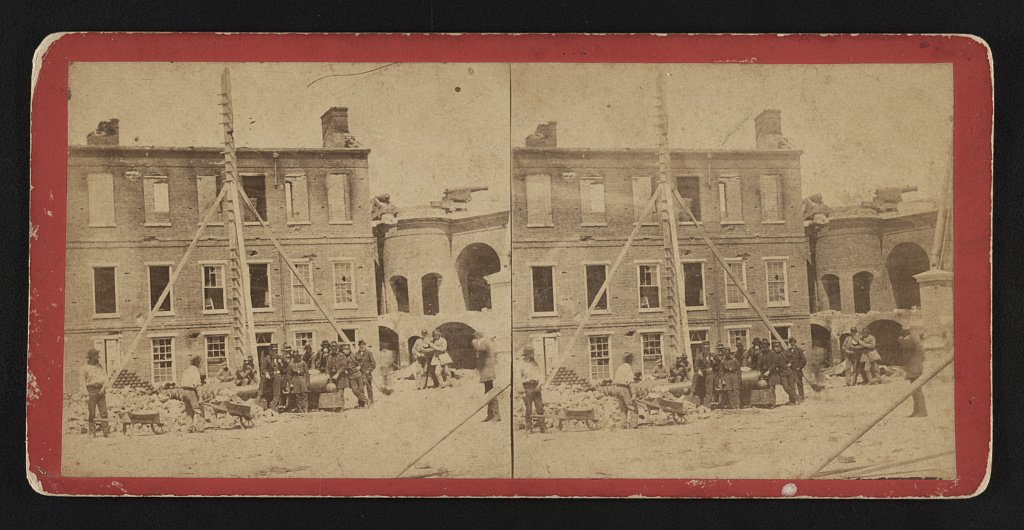
The Confederates were not just trying to knock holes in the brick. They were trying to burn the fort down from inside. They fired heated shot: solid cannonballs heated red-hot in furnaces before firing, designed to lodge in wood and set it ablaze. By the afternoon of April 12, fires were breaking out inside Fort Sumter; a rainstorm around seven that evening damped them down for a while, but when the full bombardment resumed on the 13th, the fires came back for good. By noon on April 13 the wooden barracks were burning, the main gate was burning, and the choking smoke pouring through the lower casemates, the one part of the fort that was supposed to be safe, made them almost impossible to breathe in. The garrison was now fighting a fire and an army at the same time, with bedding and uniforms for ammunition.
Then, around one o'clock on the afternoon of the 13th, a Confederate round shot away the fort's central flagpole, and the U.S. flag came tumbling down. To the men watching from the shore batteries, a flag coming down meant surrender, and one of those watching men decided, entirely on his own, to do something about it.
The one-man truce
The man was Louis T. Wigfall (South), a former U.S. senator from Texas, a famous firebrand, now hanging around Beauregard's headquarters as a volunteer aide. Watching from Morris Island, Wigfall saw the flag fall and went rogue. With no orders from Beauregard or anyone else, he grabbed a small boat and had an enslaved man, one of the enslaved laborers the Confederates used to build and serve the harbor batteries, row him across the open water toward the fort while shells from the still-firing ring came down around the boat. It was a small craft on a harbor full of falling iron, rowed by a man with no say in any of it, toward a fort on fire, and somehow it got there. Wigfall clambered in through a gun opening in the wall, found a startled Anderson, and told him he had defended his flag nobly and that General Beauregard wanted to stop the fight. Anderson, exhausted, his fort burning, his ammunition all but gone, agreed to cease fire around two o'clock.
The trouble was that Wigfall had no authority to offer any of this. He had not actually spoken to Beauregard in some time. So almost immediately a second boat arrived carrying Beauregard's real aides, a proper official delegation, who knew nothing whatsoever about Wigfall's freelance peace mission and were baffled to find one already underway. They had to tell Anderson, to his face, that the man who had just negotiated his surrender had been speaking for nobody. Anderson, who had laid down his flag and stopped his guns on the word of a freelancer, was furious, furious enough to threaten to run the flag back up and resume firing, to undo the surrender and reopen the bombardment over a clerical farce. A battle very nearly restarted because two sets of envoys had not been introduced. It was untangled the only way it could be: Beauregard formally offered the identical terms Wigfall had freelanced, and Anderson, with a burning fort and no powder and nowhere left to go, accepted them for real.