The terms were settled, the fort had fallen, and the strangest battle in American history was almost over without having killed anybody. Thirty-four hours of bombardment, 43 guns, a fort set ablaze and battered half to pieces, and not one man dead on either side from enemy fire. Out beyond the harbor bar, the relief fleet Lincoln had sent sat useless on the swells, close enough to see the smoke and unable to do a thing about it. Anderson (North) asked for one thing in surrender: the right to fire a 100-gun salute to the United States flag before he hauled it down and marched his garrison out. Beauregard (South) granted it. It was supposed to be the dignified, bloodless ending to a bloodless fight. It became the place where the war's first man died.
The fleet that watched from the bar
Lincoln's whole gambit had rested on a relief expedition arriving to feed the fort, and it did arrive. Gustavus Fox's (North) vessels reached the waters off Charleston while the bombardment was still underway, and then sat there, helpless, riding the swells outside the harbor bar (the shallow ridge of sand across the harbor mouth). They could not get in. Heavy seas and the Confederate guns made it suicide to run unarmed supply boats up the channel, and the one warship that might have changed the math, the powerful Powhatan, the fleet's heaviest vessel, was not there. It had been quietly diverted hundreds of miles south to Fort Pickens, Florida, on a cross-cutting order from Secretary of State William Seward (North) that Fox knew nothing about until it was too late. So the fleet that was meant to be the answer to everything sat on the horizon and watched the fort burn. Lincoln's trap had worked: the Confederates fired first, on food, in front of the world. The price of it was that the food never landed and Anderson surrendered with the ships in sight.
The forty-seventh gun
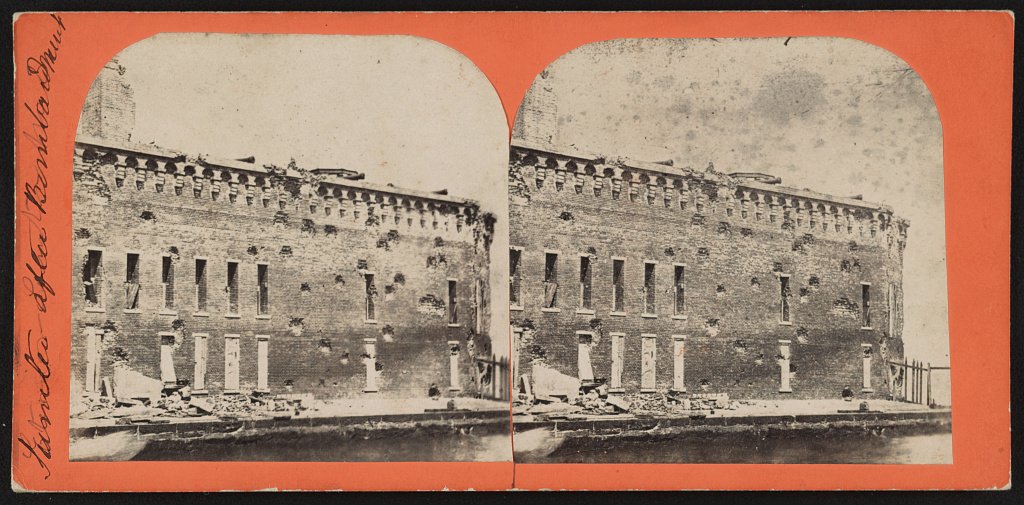
Around two o'clock on the afternoon of April 14, the garrison began the salute, gun by gun, a hundred rounds of honor for the flag. They reached forty-seven. On the forty-seventh gun, a spark in the hot barrel set off the powder charge before the crew was clear, and the gun blew up. The explosion tore off the right arm of Private Daniel Hough (North), an Irish-born artilleryman from County Tipperary, and killed him almost instantly. The blast set off ammunition piled beside the gun, wounding five other men. The salute was stopped at fifty rounds.
Hough is counted as the first man to die in the American Civil War. He had stood through thirty-four hours of enemy bombardment without a scratch. The Confederates, firing 43 guns at his fort for a day and a half, never managed to kill him. What killed him was an accident, during a ceremony, after the shooting had stopped, in a war whose enemies had so far killed exactly no one. The first death of a war that would take roughly 700,000 lives was a misfire at a flag salute. (One of the wounded, Private Edward Galloway (North), died of his injuries a few days later in a Charleston hospital, becoming the second.) Hough was buried in the fort's parade ground within about two hours; where his remains lie today, nobody knows for certain.
Out with the flag flying
With the salute cut short and the dead buried, Anderson marched his garrison out of the wrecked fort with the flag flying and drums beating, weapons in hand, exactly as the terms allowed. He carried the Fort Sumter flag north with him, where it would become a rallying symbol for the Union. The men boarded a Confederate steamer, transferred overnight to one of the relief-fleet ships that had arrived too late to help, and on April 15 sailed out of Charleston Harbor for New York. The bloodless battle was over. The avalanche it set off was not.
Seventy-five thousand men
On April 15, the very day Anderson's garrison sailed away, Lincoln issued a proclamation calling for 75,000 volunteers to put down the rebellion. The North answered in a flood; Ohio alone, by one count, could have filled the entire quota within sixteen days. But the same call that rallied the North split the country wider open. Lincoln was asking the states to supply troops to help force the seceded states back into the Union, and for four states of the Upper South, being asked to send soldiers against their fellow Southerners was the line they would not cross.
By the Upper South, the war meant the slave states that had so far stayed in the Union (Virginia, Arkansas, Tennessee, and North Carolina), the ones that had watched the secession winter from the fence and not jumped. Lincoln's call for troops knocked them off it. Virginia is the one that mattered most: the largest, richest, and most populous Southern state, the one whose capital would become the Confederate capital and whose soil would soak up more of the war than any other. Virginia seceded on April 17, two days after the proclamation, and in doing so handed the Confederacy its heartland and its great commanding general-to-be. The others followed in a cascade: Arkansas, which had actually voted against secession back in March, reversed itself and left on May 6; Tennessee's legislature voted out on May 7; North Carolina followed on May 20. Four more stars went onto the Confederate flag because of a request for troops, swelling the Confederacy from seven states to eleven by that June. The fort had been a symbol; the call to retake the country's forts turned half a region into an army.
The rallying ran in both directions, but not as two equal mirror images. The fall of Sumter galvanized the North to fight for the Union, and it galvanized the white South to fight for what it called independence. Those were not matched goods. Anderson's flag became a Northern icon; Charleston celebrated a bloodless victory. But the "independence" the South was rushing to defend was independence to preserve the slave republic its constitution had just spelled out in plain words, the freedom of four million enslaved people held against it. Both sides went to war with the same fervor; only one of them was fighting to keep human beings as property. The war they were rushing into would last four years and cost more American lives than every other American war combined.
Four years to the day
There is one last symmetry. Fort Sumter and Charleston Harbor stayed in Confederate hands for nearly the entire war, falling only in February 1865 as the Confederacy collapsed. On April 14, 1865, four years to the day after he hauled it down, Robert Anderson (North), now an aging major general in failing health, returned to the ruined fort and raised the very same United States flag, the literal flag he had carried away in 1861. The man who lost Fort Sumter on the first day of the war came back to raise its flag on nearly the last. That same night, in a theater in Washington, Abraham Lincoln was shot. The flag went up over the harbor where it all began on the same day the man who had held the country together took the bullet that killed him.
Off the fieldThe assassination: the night the flag went back up at Sumter