The new president in Washington inherited the standoff like a lit fuse, the one his predecessor had let burn all winter. Abraham Lincoln was inaugurated on March 4, 1861, and almost the first problem on his desk was Fort Sumter: a starving garrison on a brick island, six weeks of food left, an enemy government demanding the place, and no good options. He could send a war fleet to force supplies in and look like the aggressor who started a war. He could pull Anderson (North) out and look like he had surrendered the Union's authority on day one. Or he could find a third move. He found one, and it was clever enough that people have argued about it ever since.
Send food, and say so
Lincoln's third move was to send food. Not a war fleet, not troops, not weapons, just provisions. On April 4 he ordered a relief expedition under Gustavus Fox (North), a naval officer he had tapped to plan the resupply, and on April 6 he did the part that mattered: he formally notified Governor Pickens (South) that a supply-only expedition was on its way, carrying provisions and nothing else, no soldiers and no guns.
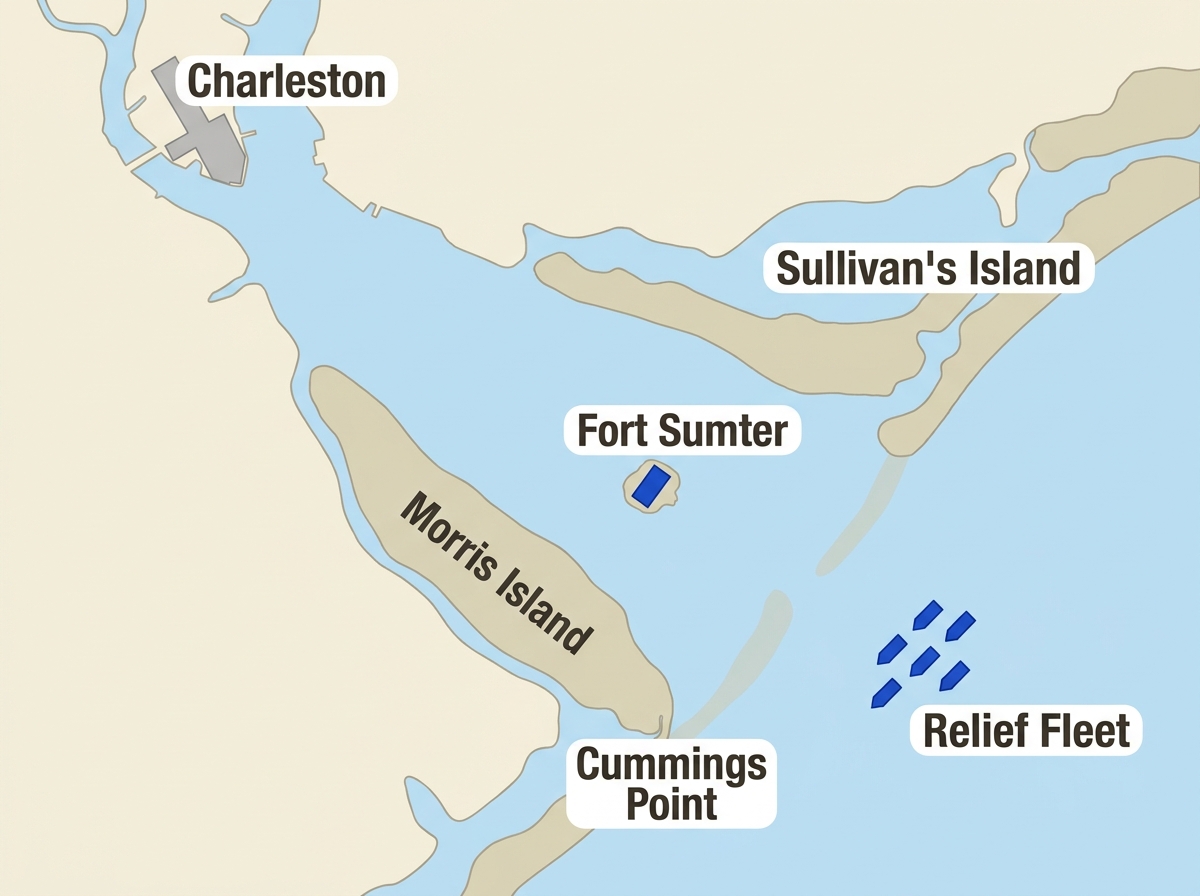
That notice was the whole trick. By announcing in advance that he was sending only food to feed hungry men, Lincoln handed the Confederate government an impossible choice. They could let the supply ships through, and in doing so quietly admit that the United States still had the right to hold and provision a fort in their harbor. Or they could open fire on unarmed boats bringing bread to starving soldiers, and take the blame, in front of the whole world, for firing the first shot of a war. Lincoln understood that the fort had almost no military value. Its value was as a symbol and as a trap: whoever shot first would own the war. He arranged it so that if a shot came, it would come from the other side.
The hornet's nest
In the Confederate capital at Montgomery, Alabama, Jefferson Davis and his cabinet saw the trap and stepped into it anyway. On April 9, Davis and his cabinet decided to act: demand the fort's evacuation, and if Anderson refused, take it by force.
One man in the room begged them not to. Robert Toombs (South), the Confederacy's secretary of state, was the lone dissenter, and by the accounts that survive he warned Davis in the plainest terms that firing on the fort would be a catastrophe. As his colleagues remembered it afterward, he told Davis it was unnecessary, it put the South in the wrong, and it would be fatal: it would strike a hornet's nest, rouse the quiet North into a swarm, and lose the Confederacy every friend it had above the Mason-Dixon line (the surveyed border between Pennsylvania and Maryland that Americans used as the informal dividing line between North and South). Those words come down to us from memoirs and diaries written later, not from a transcript, so treat them as a faithful summary of what Toombs argued rather than a record of his exact phrasing. The cabinet overruled him. On April 10, the Confederate secretary of war telegraphed Beauregard with the order: demand that Anderson get out, and if he refused, reduce the fort.
The ultimatum
On April 11, Beauregard (South) sent three of his aides rowing out to Fort Sumter to deliver the demand in writing. They handed Anderson (North) a formal letter ordering him to evacuate, written with a courtliness that gives the whole exchange its peculiar dignity: Beauregard noted "the flag which you have upheld so long and with so much fortitude" before asking him to haul it down. The terms were generous. Anderson and his men could march out with their weapons and salute their flag as they went.
Anderson refused, but he refused like a man who knew his old student would read every word. His formal written reply declined the demand: it was, he wrote, "a demand with which I regret that my sense of honor, and of my obligations to my Government, prevent my compliance." Then, as the aides were leaving, he said something that gave the game away. "I shall await the first shot," he told them, "and if you do not batter us to pieces, we shall be starved out in a few days." The aides carried that remark straight back to Beauregard, and it changed things, because it suggested the fort might fall on its own, with no need to fire a gun at all.
So Beauregard tried once more to avoid it. With Davis's blessing, his aides came back in the small hours, at one o'clock in the morning on April 12, with a new offer: name the day you will evacuate, promise not to fire on us in the meantime, and we will hold our fire and let starvation finish what guns would otherwise start. Anderson answered conditionally. He would evacuate by noon on April 15 unless he received new orders from his government, or fresh supplies, before then. To the Confederates that condition was fatal: it meant the relief fleet known to be approaching could resupply the fort and cancel the whole agreement. They judged it not good enough.
So at 3:20 in the morning, two of Beauregard's aides handed Anderson a final note. "Sir," it read, "by authority of Brigadier General Beauregard, commanding the Provisional Forces of the Confederate States, we have the honor to notify you that he will open fire of his batteries on Fort Sumter in one hour from this time." One hour. Anderson, ever the gentleman, walked the men who had just promised to bombard him down to their boat. His reported parting words to them were the words of a teacher saying goodbye, not a commander: "If we never meet in this world again, God grant that we may meet in the next."
Nobody wanted to pull the lanyard
Even with the orders given, there was a flinch at the very last moment. Roger Pryor (South), a fire-breathing former Virginia congressman who had spent weeks loudly urging South Carolinians to strike a blow, was offered the honor of firing the war's first shot. He could not do it. "I could not fire the first gun of the war," he said, and got into a boat and rowed away before the bombardment began. The man who had done as much as anyone to talk the South into war could not bring himself to be the one who started it.