In the dark of December 26, 1860, a U.S. Army major loaded eighty-five soldiers into boats and rowed them across Charleston Harbor without telling anyone: not his own government in Washington, not the furious state that surrounded him. Six days earlier, South Carolina had become the first state to walk out of the United States (the Union, as the country was called), declaring itself no longer part of it (the formal name for that walkout was "secession," from a Latin word meaning "to go apart"). It had been blunt about why. Its own declaration of secession, issued four days before the boats pushed off, named "an increasing hostility on the part of the non-slaveholding States to the institution of Slavery." The state was leaving the Union to keep its slaves. The major, Robert Anderson (North), commanded the small federal garrison (the troops manning a fort) guarding the harbor, and he had decided he could not defend the post he was standing in. So he abandoned it in the night and moved his men to a better one. The Civil War starts with that quiet boat ride, not with a shot but with a relocation.
The midnight move
Anderson's old post was Fort Moultrie, on Sullivan's Island along the north shore of the harbor mouth. On paper it was a fort. In reality it was a deathtrap. Moultrie sat low on the sand with the town and the dunes rising right behind it, which meant any hostile force could simply walk up on the landward side and shoot down into it. A fort you can attack from the rear on foot is not a fort you can hold with eighty-five men. So in the dark, Anderson did two things. He spiked Moultrie's guns, hammering iron spikes into the touch-holes so the cannon could not be fired, and burned their wooden carriages, so that nothing he left behind could be turned around and used against him. Then he ferried his garrison out to the one position in the whole harbor that an undermanned force actually could defend.
That position was Fort Sumter, a five-sided brick fort (a brick pentagon) built on an artificial island in the main ship channel near the harbor mouth, raised out of the water on some 70,000 tons of New England granite dumped on a sandbar starting in 1829. It commanded the entrance to the harbor, it had water on every side, and nobody could march up to its walls. For a garrison that knew it was outnumbered, water was the best wall there was.
South Carolina took the move as a betrayal. The state's governor, Francis Pickens (South), considered it a breach of faith. The outgoing Buchanan administration in Washington had given the state vague assurances not to alter the military balance in the harbor, and overnight Anderson had altered it, then destroyed the guns of the fort he left so there could be no mistaking that the move was permanent. The man who had looked trapped at Moultrie had slipped out to the one fort the locals could not easily get at. From that morning the harbor was a standoff: a federal flag flying over an island fort, and an angry state on every shore around it.
The ship that got turned back
Washington did try to help, once, and it went badly. On January 9, 1861, an unarmed merchant steamer called the Star of the West came nosing into the harbor channel carrying provisions and reinforcements for Anderson's garrison. It never got close. A battery on Morris Island (a battery being a cluster of cannon and the crew that works them) manned by teenage cadets from the South Carolina Military Academy (today called The Citadel) opened fire on the ship as it entered. The Star of the West was hit three times. Its captain, John McGowan (North), turned around, and the relief mission failed before it began.
Anderson watched the whole thing and did nothing. He had not been told the ship was coming, and rather than start a war on a guess, he held his fire while a U.S. vessel was shot at in front of him. Some historians point at those cadet guns and argue this was really the first hostile military shot of the war, three months before the bombardment everyone remembers. The usual verdict is that the war started in April, but the Star of the West shows the line between peace and war had already gone fuzzy by January.
The president who did nothing
If South Carolina was firing on U.S. ships in January, where was the United States government? It was in the hands of a lame-duck president who had decided the crisis was not his to solve. James Buchanan (North), Lincoln's predecessor, spent the whole winter of 1860 to 1861 in a strange paralysis. He insisted that secession was illegal, that no state had the right to walk out, and in the same breath insisted that the Constitution gave him no power to stop a state from walking out. So he protested, and did nothing. He would not reinforce Anderson in any serious way, partly on that constitutional reasoning and partly out of fear that any forceful move would shove the still-wavering slave states out of the Union too.
The result was four wasted months. While Buchanan delayed, the seceded states organized a government, raised troops, and ringed Charleston Harbor with guns at their leisure, unopposed. By the time a new president took office, the fuse had been burning, untouched, since December. Buchanan handed it to Lincoln already alight.
The ring closes
While the Star of the West was steaming home empty, the standoff was turning into a siege. In February 1861, seven seceded states met in Montgomery, Alabama, stitched themselves into a new country, the Confederate States of America, wrote a constitution, and elected Jefferson Davis as their provisional president (their acting head of state, chosen to run the new government while it organized itself). Like South Carolina's secession declaration, the new country did not hide what it was built to protect. Where the old U.S. Constitution had carefully avoided the word, the Confederate constitution wrote slavery in by name, forbidding any law "denying or impairing the right of property in negro slaves" and guaranteeing slavery's spread into any territory the Confederacy might gain. The country forming around Charleston Harbor was, on the page and on purpose, a slaveholders' republic. In March it handed command at Charleston to its very first general, Brigadier General P.G.T. Beauregard (South). The harbor now had a national government behind it, and that government wanted the fort.
So all spring, a ring of guns rose around Fort Sumter. Anderson could only watch his harbor turn into a noose, one gun emplacement at a time: Fort Moultrie back on Sullivan's Island, a battery at Fort Johnson on James Island to the southwest, the Iron Battery out at Cummings Point on the tip of Morris Island, and a floating battery, an armored barge sheathed in railroad iron and boiler plate, towed into position on April 9 and 10. By the time it was finished, 43 guns and mortars (a mortar being a stubby cannon that lobs its shell up and over in a high arc, to drop down inside a fort rather than batter its walls) were trained on a single brick island.
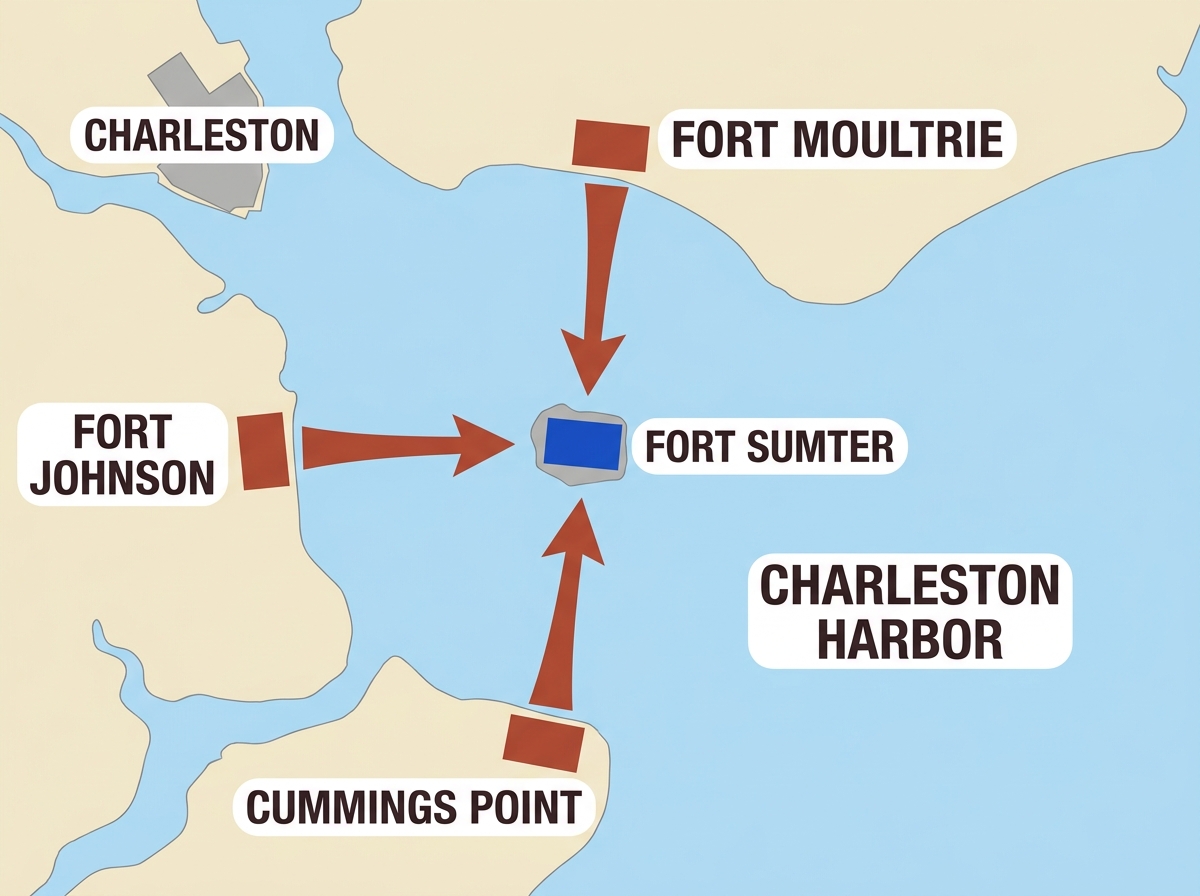
Inside that noose, the garrison was slowly starving. Eighty-five men were sealed on an island they could not leave, and the food was running down. By the time Lincoln took office in March, they had only about six weeks of rations left. (The 85 figure is the one most carefully sourced accounts use; a few summaries say 80, probably depending on whether you count workmen and noncombatants.) The fort bristled with gun ports (the rectangular openings in the wall through which cannon are aimed and fired) and forty-some pieces were technically installed, but a garrison that small could only crew a fraction of them at once, and they had only around 700 ready powder cartridges. They were a handful of hungry men in a giant brick box, counting their pork barrels and watching the guns multiply on the shore.
The student on the other side
The Confederate general assembling that ring of guns, Beauregard, had once been Anderson's student. Years before, at West Point (the U.S. Army's officer academy on the Hudson River in New York), Anderson had been the artillery instructor and Beauregard had been his pupil, by every account his favorite pupil, sharp enough to graduate second in his class in 1838 and stay on afterward as Anderson's own assistant. The man now methodically training cannon on Fort Sumter had learned how to aim cannon from the man inside it.
Anderson was no abolitionist crusader. He was a Kentucky-born professional soldier from a slaveholding family, married into a Southern one, a man who had himself owned enslaved people and had no particular quarrel with slavery as an institution. By temperament and origin he belonged to the South the Confederacy claimed to speak for. He stayed loyal to the Union anyway, and so found himself holding a fort for a country whose cause he only half believed in, against a former student fighting for a cause he privately understood. He could have gone the other way and did not.
Through all the cold official correspondence that spring, Beauregard kept slipping in courtesies to his old teacher, the elegance of a man who genuinely admired Anderson even as he readied the guns of a slave republic to fire on him. In one note he wrote that "nothing shall be wanting on my part to preserve the friendly relations and impressions which have existed between us for so many years." Two professional soldiers, a teacher and his best student, were about to point the lessons of one at the body of the other.