For nearly a week, the United States tried to do this the careful way, and it didn’t work. Before Farragut would risk his wooden ships under the guns of the forts, his foster brother, Commander David Dixon Porter (North), was going to soften those forts up with the strangest-looking part of the whole fleet: a mortar fleet (a group of small sailing ships, each carrying one enormous 13-inch mortar, a stubby cannon that lobs a heavy shell high in a steep arc, to drop it down inside fortress walls rather than batter them from the front). Twenty of these mortar ships, their masts dressed with branches to hide them against the trees of the riverbank, anchored below Fort Jackson and opened fire on April 18, 1862.
What followed was a bombardment on a scale that is hard to picture. Over five or six days, Porter’s ships threw something on the order of 7,500 to 13,000 shells at the forts, close to 1,400 of them on the very first day, by some counts far more. Inside Fort Jackson it was hell. General Johnson Duncan (South), commanding the forts, wrote in his report:
The mortar fire was accurate and terrible, many of the shells falling everywhere within the fort and disabling some of our best guns.
For the men inside, the bombardment became a grinding routine of survival: shells dropping out of the sky at all hours, the lower floors flooded knee-deep, sleep snatched between barrages, and every dawn a crawl out into the wreckage to count what was left of the wall and which guns still pointed where they should. The shelling smashed Fort Jackson’s drawbridge, wrecked its hot-shot furnaces (special ovens used to heat cannonballs red-hot before firing, so they’d set wooden ships ablaze on impact) and its water cisterns, cracked its walls, flooded its lower floors, knocked a few guns off their mounts. But it did not break the fort. Fort St. Philip across the river was barely scratched. Day after day of the heaviest bombardment the war had yet seen, and when the smoke cleared each morning the forts were still firing, still able to rake any ship that tried to pass. The careful way was failing.
Cutting the chain
There was still the matter of the chain. No fleet could run the gauntlet while a cable and eight moored hulks blocked the channel, since the ships would simply pile up under the forts’ guns. So on a dark night, two of the smaller Union gunboats, the Pinola and the Itasca, slipped up to the barrier under fire to break it. Working in the dark almost on top of the forts, they got at the chain itself. One boat ran a small charge against a hulk and her chains while the other hauled and slipped the cable, and they managed to tear open a gap near the east bank, under Fort St. Philip.
The date is genuinely uncertain: the breach seems to have been made on the night of around April 20 to 23, and the sources don’t agree on the exact night. What matters is that by the time Farragut was ready to move, there was a hole in the fence. The door was open.
Farragut’s gamble
Six days of bombardment had not reduced the forts, and Farragut had seen enough. He called his captains together. Porter, the mortar man, wanted to keep shelling, to give the ships more time and grind the forts down. But Farragut had done the arithmetic of the thing in his head and come out the other side: the forts were not going to fall on any timetable he could afford, his powder and his daylight were finite, and every day spent waiting was a day the Confederates could finish an ironclad or float down another fire raft. So he overruled his own brother. He was not going to wait for the forts to fall. He was going to ignore them.
It was an enormous bet. Conventional wisdom said you had to silence the forts before you passed them. To “run the forts” (steam your fleet straight past the enemy’s guns and accept the punishment, betting that most of your ships get through before the gunners can sink them) was to gamble your whole fleet on speed and darkness against a wall of cannon. Farragut chose to gamble. He ordered his captains to armor their wooden ships as best they could with whatever they had: anchor chains draped down the sides like chain mail, sandbags piled around the boilers and engines. He split the fleet into three divisions, a lead division to push through first and draw the forts’ fire, his own main force in the center, and a rear division to come last, and aimed them all at the gap in the chain. They would go in the dead of night.
The night they ran the gauntlet
In the pre-dawn dark of April 24, 1862, somewhere around 2:00 to 3:30 in the morning, the signal went up, and the Union fleet started up the river through the gap, and the river caught fire.
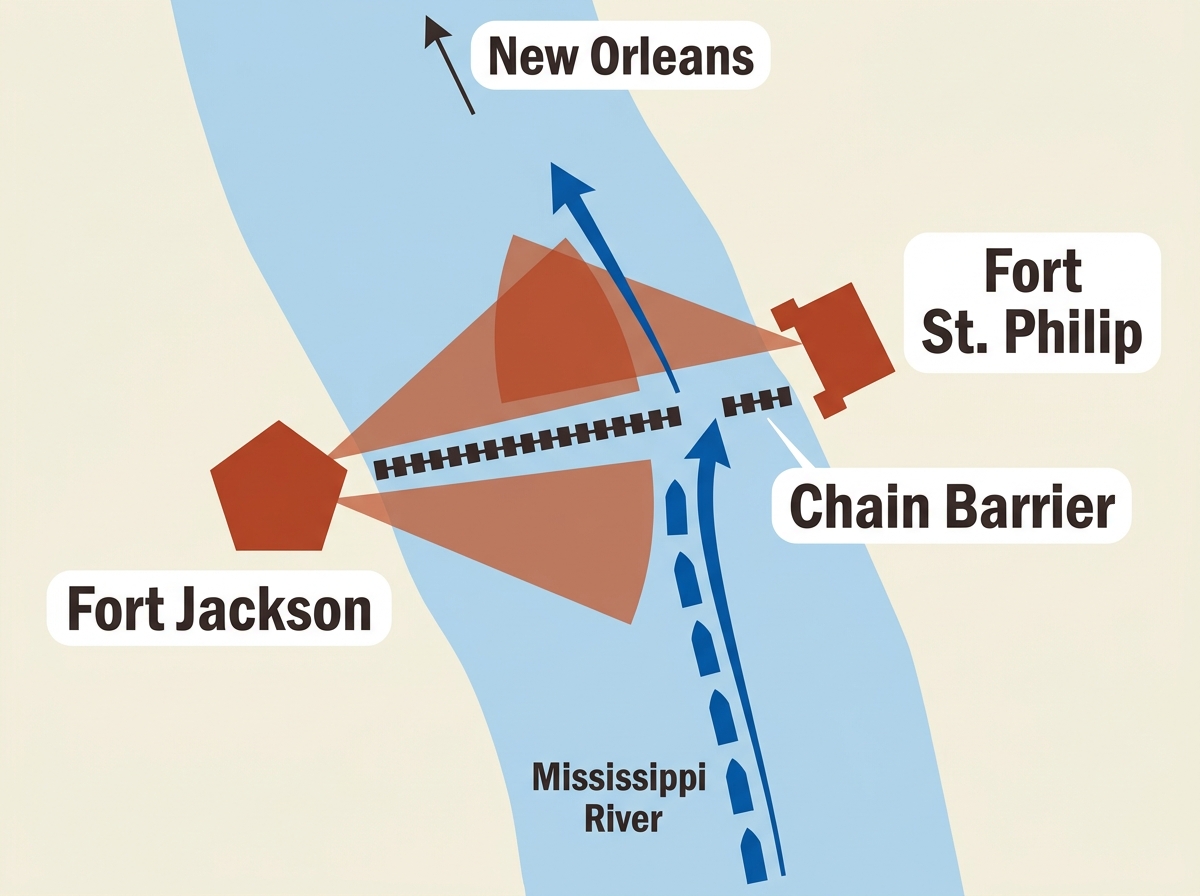
Stand on the deck of Farragut’s flagship, the USS Hartford, and you would have seen almost nothing and felt almost everything. The first guns from the forts came as flat orange flashes out of the dark on both banks, and then the noise arrived, a wall of it, so total that men shouted into each other’s faces and heard nothing. Powder smoke piled up over the water until the riverbanks vanished and the only way to know where a fort was, was to wait for its guns to flash and aim back at the light. Shot came in low across the deck and high through the rigging. The Hartford pushed up into the narrow break in the chain with the forts hammering her from either side, and the whole world shrank to the few yards of burning river the fire rafts lit.
It was one of those rafts that nearly finished her. A burning barge came drifting down at the flagship out of the smoke, and the Hartford swerved hard to dodge it and ran herself aground on the bank, dead in the water under the guns. Then a small Confederate steamer, the Mosher, shoved the burning raft up against her wooden hull and held it there, and the flagship caught fire. For a few terrible minutes the admiral’s own ship was ablaze on a riverbank in the dark, her side sheeted in flame and her gunners still firing through it, while parties beat at the fire with whatever they had and worked frantically to back her off the mud. They got the flames out. They got her free. And Farragut took the Hartford back into the channel and kept going.
All around her the Confederate fleet came out of the dark and the smoke. The cottonclad ram Governor Moore found the USS Varuna and drove into her again and again, ramming her wooden hull until the river poured in and the Varuna had to be run into the shallows to keep from sinking outright, the only Union warship lost in the passage, though most of her crew got off. The ironclad ram Manassas, that low turtle-backed thing, came charging in and rammed first the Mississippi and then the Brooklyn, but her blows glanced off without crippling either; driven hard against the bank and set afire, she broke free and drifted off down the river burning from end to end, a torch loose on black water, until she settled and sank. The big ironclad Louisiana, still helpless with her dead engines, sat moored by Fort St. Philip and fired into the passing ships like a piece of the fort itself, doing what she could without being able to move an inch. On the McRae, the Confederate commander fell mortally wounded.
And then, almost faster than it had begun, it was over. One by one the Union ships drove out of the top of the gauntlet and into clear water above the forts, and as the sky began to gray toward dawn the smoke thinned enough to count them: a battered, scorched, improbable line of warships riding above the very guns that were supposed to have stopped them dead. Thirteen or fourteen of Farragut’s ships had made it through; three had been forced to turn back, and the Varuna was gone, but the bulk of the squadron was past. Twelve Confederate vessels had been destroyed. The casualties of that single night’s run were, for a passage this decisive, remarkably light: fewer than forty Union sailors killed and roughly 135 to 170 wounded in the chaos of the gauntlet. Farragut had done the thing everyone said couldn’t be done. The forts were now behind him, still flying Confederate flags but suddenly pointless. There was nothing left between his guns and New Orleans.