In the spring of 1862, the biggest city in the Confederacy sat almost undefended at the bottom of a river, and almost nobody on the Southern side believed it was in any danger. New Orleans was the South’s great metropolis: about 168,000 people, the sixth-largest city in the United States, bigger than Charleston, Richmond, Mobile, Memphis, and Savannah put together. It was the place where more than half of all American cotton went to the sea, the outlet for goods from the entire Mississippi River valley, second only to Richmond in the value of what it manufactured. It was also the South’s great slave market, the largest slave-trading center in a country that had gone to war to keep human beings as property. The same wharves that shipped the South’s cotton to the world also sold the people forced to grow it: well over a hundred thousand enslaved men, women, and children were bought and sold here across the trade’s life, in dozens of markets scattered through the city, and roughly fourteen thousand more lived in bondage inside the city itself. Much of the machinery the Confederacy was built to protect ran through New Orleans.
That is exactly why the United States wanted it. The Union’s grand strategy for winning the war had a name, the Anaconda Plan, after the snake that kills by squeezing. General-in-Chief Winfield Scott (North), the U.S. Army’s senior commander, had the idea to wrap the Confederacy in a blockade, choke off its trade, and seize the Mississippi River to cut the South in half. Take the mouth of the Mississippi and you put a hand around the Confederacy’s throat. New Orleans was the mouth of the Mississippi. It was the single most valuable piece of real estate on the map, and the Confederacy had left it lightly guarded.
Why the city lay open
The Confederacy had stripped New Orleans almost bare, and it had done so on purpose, out of a confident misreading of where the blow would land. Southern leaders simply did not believe a fleet could come at the city from the south, up the river from the Gulf of Mexico. They were sure the threat was from upstream, from the north, and they poured their men and ships into the river forts above the city: Island No. 10, Fort Pillow, Vicksburg.
Then the upstream war went badly and drained the city of even more. Union victories at Forts Henry and Donelson in February 1862, and the bloodbath at Shiloh in early April, pulled Confederate troops away to other theaters. The Confederate river fleet under Commodore George Hollins (South) was sent upstream too. By April, the general in charge of New Orleans, Maj. Gen. Mansfield Lovell (South), had only about 3,000 short-term volunteers in the city itself (“ninety-day militia,” men who had signed up for just three months and had almost no training), and only around 1,200 of them even had muskets. The forts below the city held roughly 1,100 more, many of them untrained and foreign-born. The South’s greatest city was guarded, in the end, by two old forts and a chain across a river.
The gauntlet
What stood between the Gulf and New Orleans was a stretch of river about 75 miles (121 km) below the city, a run about the distance from Baltimore to Philadelphia, and a set of defenses that looked formidable on paper. Two forts faced each other across the water at a bend in the river. Fort Jackson, the bigger and stronger of the two, sat on the west bank, a five-sided brick fortress built decades earlier, back in the 1820s and ’30s, mounting around 74 guns. Half a mile upstream on the east bank stood Fort St. Philip, an older brick-and-earth work with about 52 guns. Between them the two forts carried somewhere between roughly 126 and 177 guns, depending on how you count, all of them trained on any ship that tried to pass. These were old coastal forts, designed a generation earlier to slow sailing ships creeping around the bend under canvas. They were not built for fast steam warships, and they were facing the wrong way for a threat coming up from the Gulf.
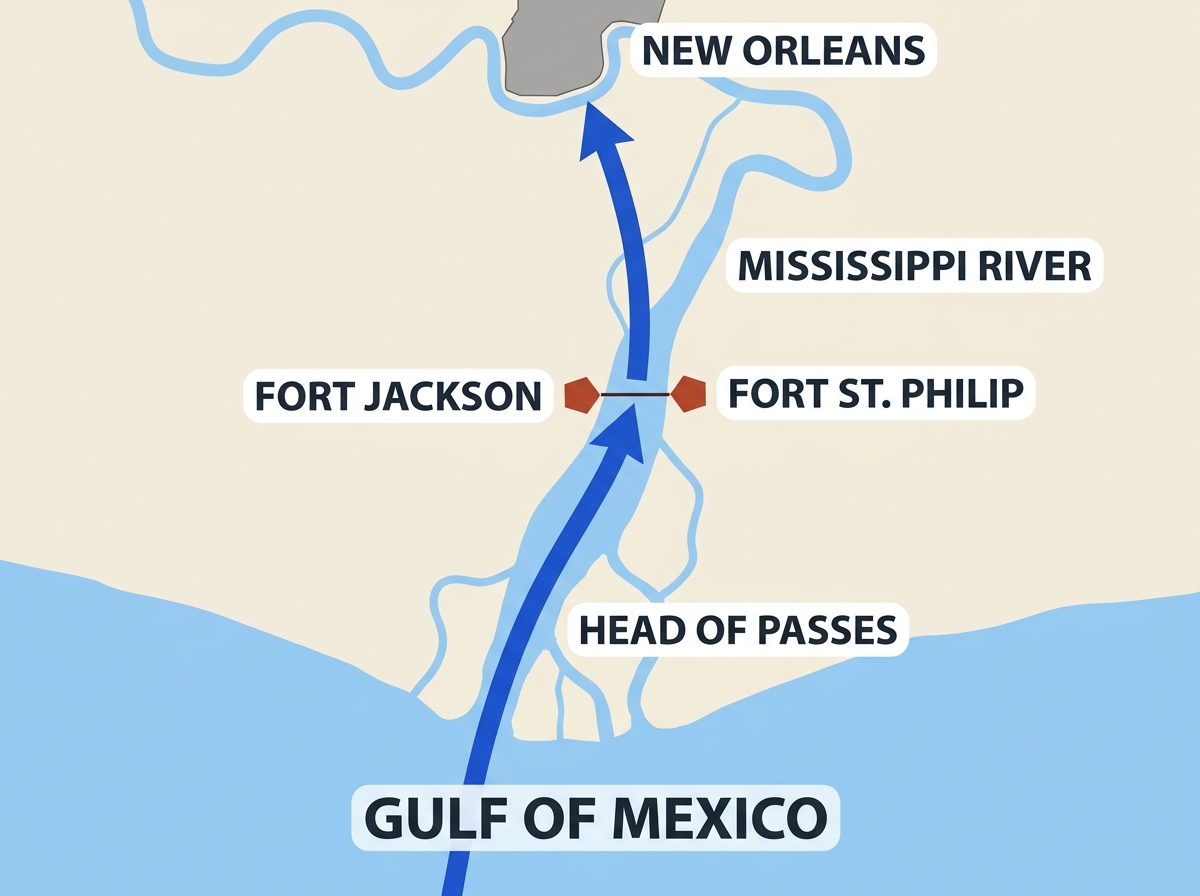
The forts were only the start of it. Stretched across the river between them was a barrier: a heavy chain cable threaded through eight derelict ships (hulks) moored in the current, a fence laid across the water to stop a fleet dead in the gun line where the forts could pound it to splinters. Floating fire rafts (barges piled with pine knots and tar, meant to be set alight and shoved downstream into wooden warships) were added to the obstacles. And lurking above the barrier was a small Confederate fleet: the converted gunboats McRae and Jackson, two state-navy vessels, and six cottonclad rams of the River Defense Fleet, a ragtag collection of ordinary river steamers the Confederacy had hurriedly armed, their bows reinforced for ramming and their sides packed with bales of cotton for cheap armor.
The two pieces the South was counting on most were the half-finished ones. The CSS Louisiana was meant to be a monster: a 264-foot ironclad (a warship sheathed in iron plate, nearly impervious to the cannon of the day), carrying sixteen guns. But she was a monster that couldn’t move. She and her sister ship were being built in competing yards that fought over the same thin pool of skilled workers, and it showed: her engines never worked properly, and she ended up moored against the bank as a floating gun battery, unable to maneuver. Her sister, the CSS Mississippi, was even less ready: launched only in late April, barely any machinery, two guns aboard, never finished. The third ironclad was the CSS Manassas, an early Confederate ram (a vessel built to sink enemies by driving an armored bow straight into their hulls), a low turtle-backed thing with a single heavy gun and a crew of about 104. The Confederacy had bet its river on iron ships, and the iron ships weren’t ready.