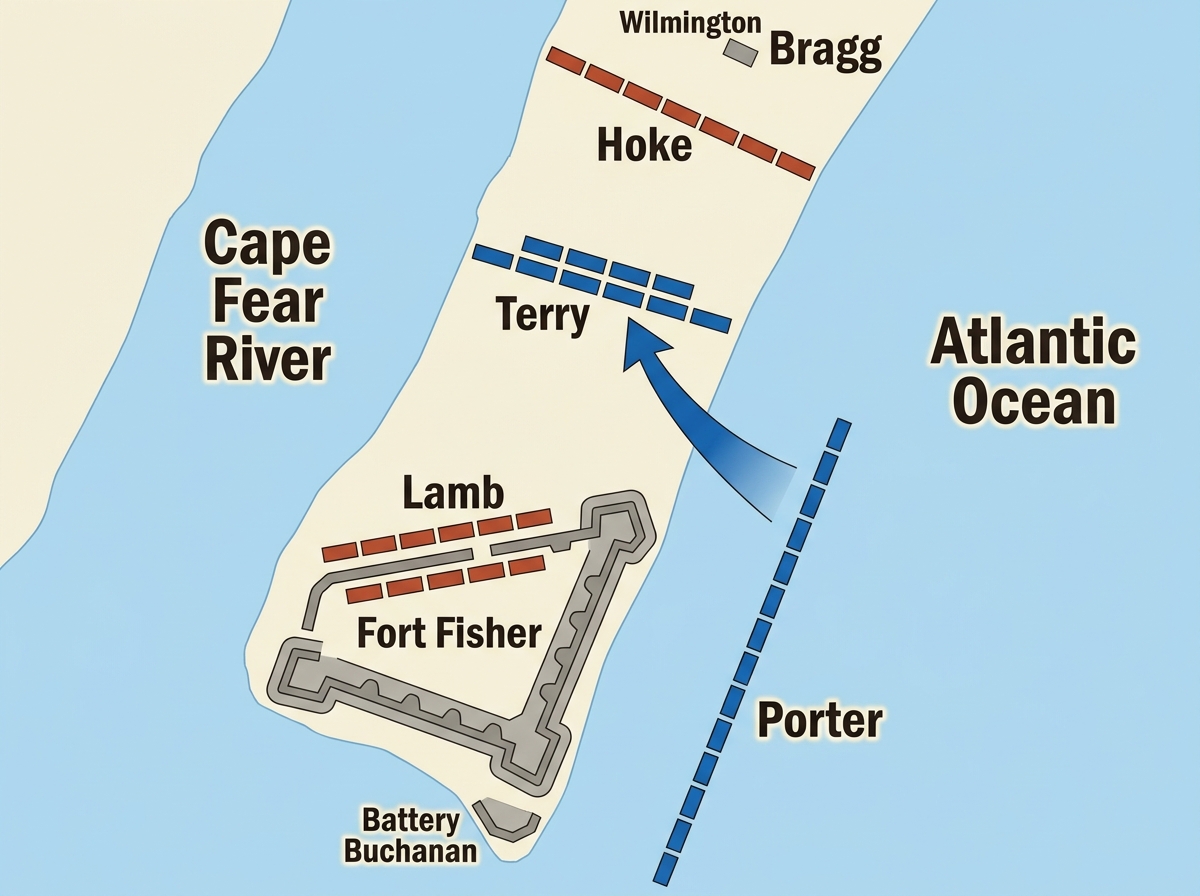
On the night of January 12, 1865, the garrison at Fort Fisher saw the sea fill up with ships. Rear Admiral David D. Porter (North) had brought back nearly the whole North Atlantic Blockading Squadron, around 58 warships, the largest fleet the United States Navy had ever gathered for a single operation up to that time. Behind the warships came the transports carrying Major General Alfred H. Terry’s (North) soldiers. Colonel William Lamb (South), the young officer who had built the fort and now commanded its garrison, watched them come and knew the December attack had only been the rehearsal.
Lamb did not have many men to meet them. The garrison numbered something under 2,000, even after reinforcements from Hagood’s brigade brought the total to about 1,900. They held a fort designed for far more, with miles of wall to cover and a fleet of 58 ships about to throw everything it had at them. And the help that might have saved them was sitting just up the peninsula, doing nothing.
The army that did not come
A few miles north of the fort stood a Confederate division of about 6,400 men under Major General Robert Hoke (South), and over them all sat the department commander, General Braxton Bragg (South), in Wilmington. On paper, Hoke’s division was the answer to everything. If Terry landed his corps on the open beach north of the fort, that force could strike the Union troops in the rear while the garrison held them in front, and crush them between the two. It was the obvious move, and it was never seriously made.
Bragg, cautious and slow as he had been through the whole war, kept Hoke’s division in its lines and let the chance pass. He sent only a fraction of it forward: a detachment of about 1,000 men was ordered toward the fort, and only some 400 of them actually got inside before the Union grip closed. The bulk of a fresh division sat idle a short march away while the fort it could have saved was taken apart. Lamb and his garrison were left to hold the Gibraltar of the South essentially alone.
On January 13, Terry put his men ashore on the beach above the fort without serious opposition. They dug a defensive line facing north, toward Hoke and Bragg, to guard their own rear, and then turned to face the fort. The trap that should have caught them never sprang. Now it was the garrison that was trapped, a few hundred yards of sand wall and 1,900 men, with an army in front of them and a fleet at their backs.