The assault came from two directions at once, and one of them was almost suicidally strange. Porter had decided that his sailors should share in the glory of storming the fort, so he assembled a landing party from the fleet: about 1,600 sailors and 400 marines, roughly 2,000 men, under Lieutenant Commander K. Randolph Breese (North). They came ashore on the beach and formed up to attack the Northeast Bastion, the high mound where the fort’s land face and sea face met, the strongest corner of the whole work.
They were sailors, not infantry, and they were armed and organized like a boarding party rather than an assault column. Many carried only cutlasses, the short heavy swords of naval combat, and revolvers, weapons for fighting hand to hand across the deck of a ship, not for crossing open sand into the teeth of a fort. The plan called for the marines to lay down covering rifle fire while the sailors rushed in waves. Instead the whole mass surged forward together in one disorganized rush, and the covering fire never properly developed.
It was a slaughter. The defenders, the same men Major General W.H.C. Whiting (South) and Colonel William Lamb (South) had held in the bombproofs through three days of shelling, came up onto the parapet and poured fire down into the packed crowd of sailors struggling across the open beach. The naval column was shot to pieces at the foot of the bastion. The men who reached the base of the wall could not climb it; the men behind them piled up and were cut down; and finally the whole charge broke and ran back along the beach. The Navy’s part of the assault failed completely, and at heavy cost.
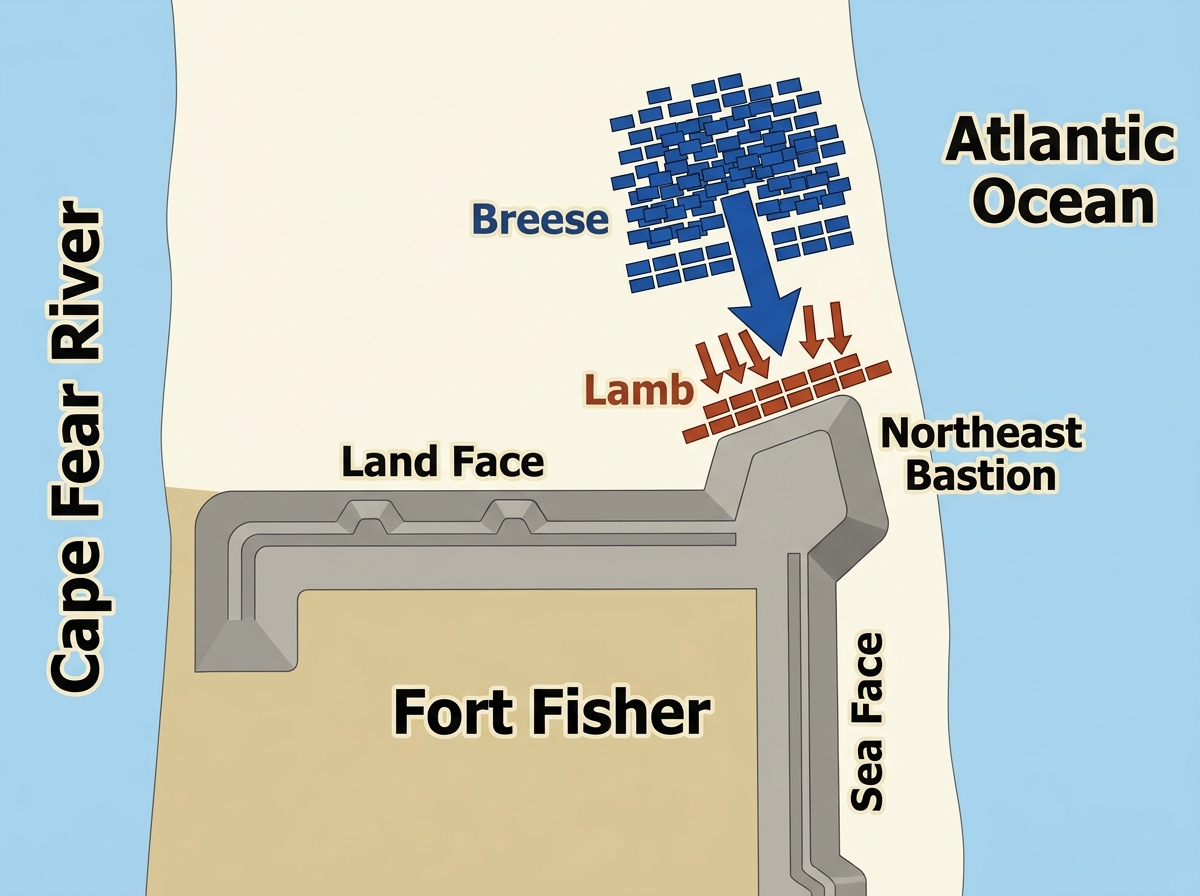
But it did one thing that mattered enormously, though no one had planned it as a feint. The sailors’ charge drew the garrison’s attention and a good part of its strength to the sea-face corner at the exact moment the real blow was landing somewhere else. While Lamb’s men were busy mowing down the sailors at the Northeast Bastion, the soldiers were already coming over the wall at the far end of the land face. The doomed charge along the beach had pulled the defenders to the wrong side of the fort.