People would later call Glorieta Pass "the Gettysburg of the West," and the phrase, however worn it has gotten, points at something real. This was no skirmish. The federal government would eventually rate Glorieta Pass at its highest possible level of strategic importance, the same tier as Gettysburg and Antietam, one of only 11 battles in the entire war to earn it. What happened over three days in this New Mexico canyon decided the fate of the Confederate bid for the Pacific. The strange part, the part that makes Glorieta unlike almost any other battle in the war, is that the side that won the fighting lost everything anyway.
Apache Canyon
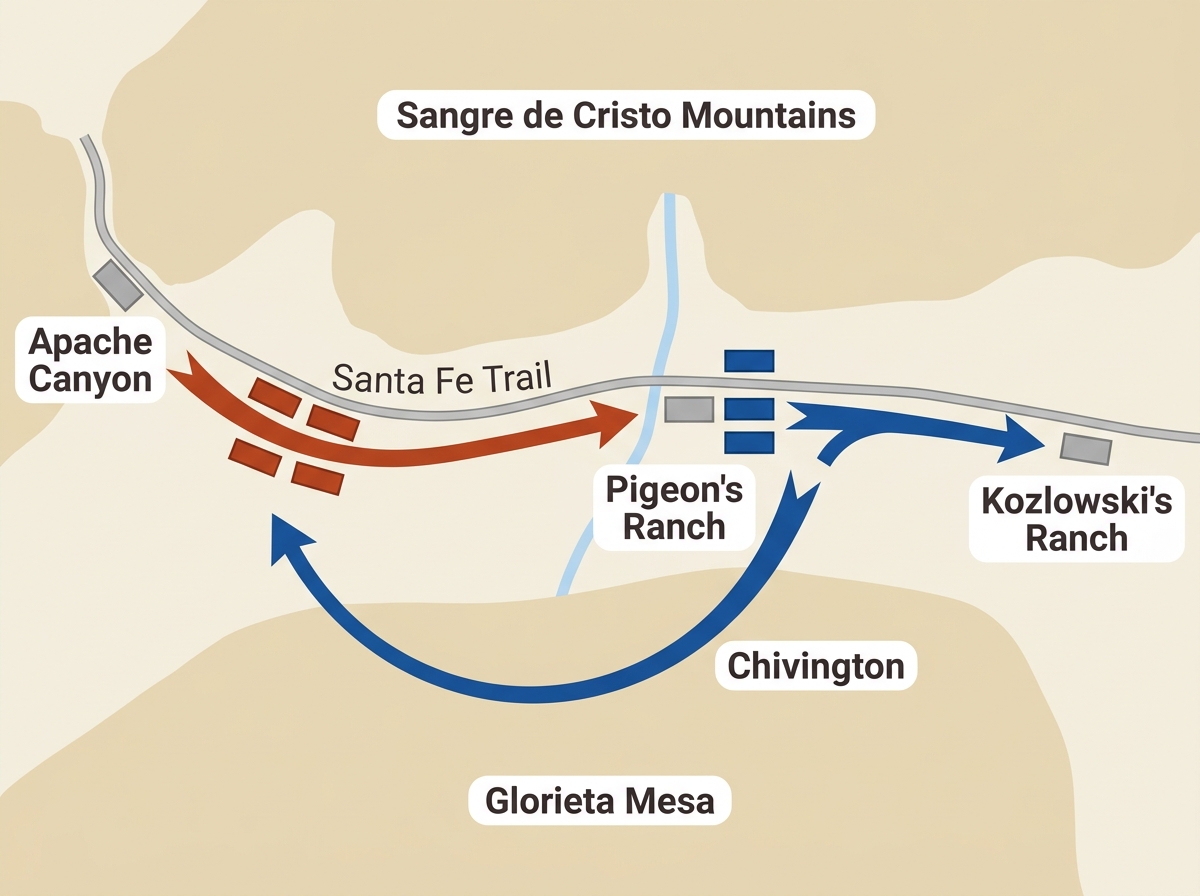
It opened on March 26, in the narrow western arm of the pass called Apache Canyon, and it opened by accident. Major John M. Chivington (North) pushed forward with about 400 picked men and came around a bend in the canyon straight into the Confederate vanguard (the leading edge of the Texan force, roughly 300 to 420 men under Major Charles L. Pyron (South)) around 2:30 in the afternoon. There was no maneuvering up to it: one moment the trail was empty, the next Pyron's cannon were firing down it, and the first Union rush broke and scattered backward under the blast.
Then Chivington did the thing the terrain begged for. The canyon walls rose steep and close on either side, so he sent his infantry scrambling straight up them, climbing above the trail onto ledges the Texans below could not easily reach, until the Confederate line was caught in a crossfire pouring down from both rims at once. While the Texans were ducking that, a mounted Colorado company spurred straight up the middle of the canyon and tore the line apart. Pyron pulled back about a mile and tried to set a new line, and the Union infantry flanked him again, swinging around his sides faster than he could form up. By around 4:00 p.m. it was over, the Confederates streaming back west with somewhere between 70 and 75 of them captured. Both sides broke off, agreed a short truce to gather their wounded, and pulled apart, Chivington east toward Pigeon's Ranch, Pyron west to Johnson's Ranch to wait for the rest of the army.
March 27 brought no fighting at all, just the sound of two armies getting bigger. Lieutenant Colonel William R. Scurry (South) arrived with the bulk of the Texan force, the main body that had been marching up the trail behind Pyron's advance guard all along, and now the senior man on the field. Colonel John P. Slough (North) came up with the main Union force. Both sides spent the day planning to attack the other the next morning. Neither knew the other was planning the same thing.
Pigeon's Ranch
The real battle came on March 28, and it began the way the first one had, with two armies blundering into each other. Slough's plan was to crush the Confederates between two forces: send Chivington with 450 to 490 men south over the high ground to come down behind the enemy and cut off their retreat from the west, while Slough himself pushed roughly 850 to 900 men straight up the Santa Fe Trail to drive them from the east, a hammer swinging the Texans onto an anvil. What Slough did not know was that Scurry was already marching east up that same trail with about 1,100 to 1,200 men, meaning to do almost exactly the same thing to him.
So the two columns walked into each other. Around 11:00 in the morning, near a stage stop and inn called Pigeon's Ranch (a low adobe way station on Glorieta Creek where travelers on the trail had stopped for years), the advance riders of each side rounded into view of each other, opened fire, and the whole absurd arithmetic of the day became plain in an instant: each commander had set out that morning to surprise an enemy who was, at that same moment, marching to surprise him.
What followed was hours of hard, close fighting, and the Texans got the better of it. Scurry threw attack after attack at the Union line, three to five assaults by various counts, and he had the numbers, about 1,100 men against Slough's 850 on the trail. The union guns held for a while, silencing Confederate artillery and breaking up charges, but Confederate sharpshooters worked their way onto a ridge above the field and pinned the Union infantry where it stood. The dying was real on both sides. Major John Shropshire (South) was killed throwing his men at the Union left. Around 3:00 p.m., Major Henry Raguet (South) was mortally wounded as Scurry curled around the Union right and broke it.
That flanking move ended it. With his right giving way in the late afternoon, Slough ordered a retreat east to Kozlowski's Ranch, skirmishing as he went until the light failed. The Texans held the field. By the only measure a soldier on the ground could see that day, they had won. Scurry put it this way in his official report on the battle:
"The loss of my supplies so crippled me that after burying my dead I was unable to follow up the victory."
That report carries one more line, scrawled by a man who did not yet understand what had been done to him: "I do not know if I write intelligently. I have not slept for three nights." He had the field, the dead to bury, three sleepless nights behind his eyes, and a victory he could not use.