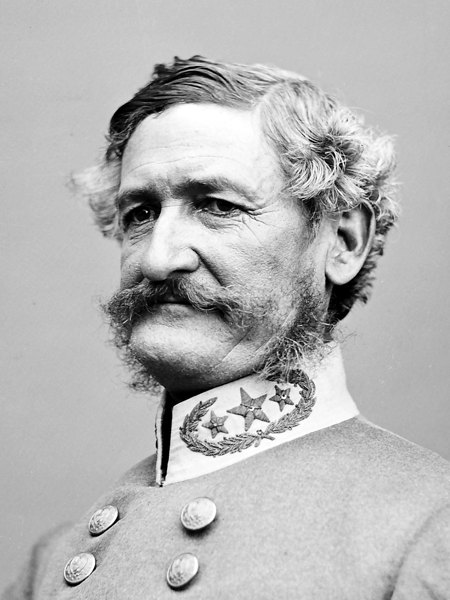
In the winter of 1862, the Civil War had a western front almost nobody back East was thinking about, and a Confederate general was about to bet a small army on the most far-reaching gamble of the whole war: the Pacific Ocean. His name was Brigadier General Henry Hopkins Sibley (South), and his plan, which he had personally sold to Confederate President Jefferson Davis the year before, was to march a force of Texans up the Rio Grande (the great river that runs the length of New Mexico, north to south), conquer New Mexico Territory (the vast stretch of land that today makes up New Mexico and Arizona, then a single sparsely settled U.S. territory, not yet a state), and keep going. Past New Mexico lay the gold fields of Colorado and the silver of Nevada. Past those lay California, with its ports and its harbors and its open door to the rest of the world. A Confederacy that reached the Pacific would have money to fund the war and seacoast the Union navy could not blockade. It was, on paper, breathtaking.
And it was, at bottom, a bid to extend slavery across the continent. Strip away the gold and the ports and the maps, and the Confederate dream of the Southwest was the same thing the Confederacy was everywhere else: an attempt to push a slaveholding republic, by force, all the way to the Pacific. The men marching up the Rio Grande were carrying that cause west with them. The rest was real estate.
A plan stitched out of nothing
Sibley raised roughly 2,500 mounted Texans (an "army" by the loose standards of the far frontier) and brought along 15 cannon. They called themselves the Army of New Mexico. They had a weakness baked into the plan from the start: there was almost nothing to eat or wear out there. New Mexico Territory was thinly populated and poorly supplied, and the Confederacy was openly counting on living off the land it conquered, recruiting New Mexicans, Utah Mormons, and Colorado miners along the way to fill out the ranks and capturing Union stockpiles to feed the men. By early 1862, the Confederate Congress had even formally organized a Confederate Territory of Arizona out of the southern half of New Mexico, paper proof of how far the ambition reached. But ambition does not feed an army, and an army that has to take its food from the enemy as it goes is an army with a knife at its own throat.
Valverde and the road to Santa Fe
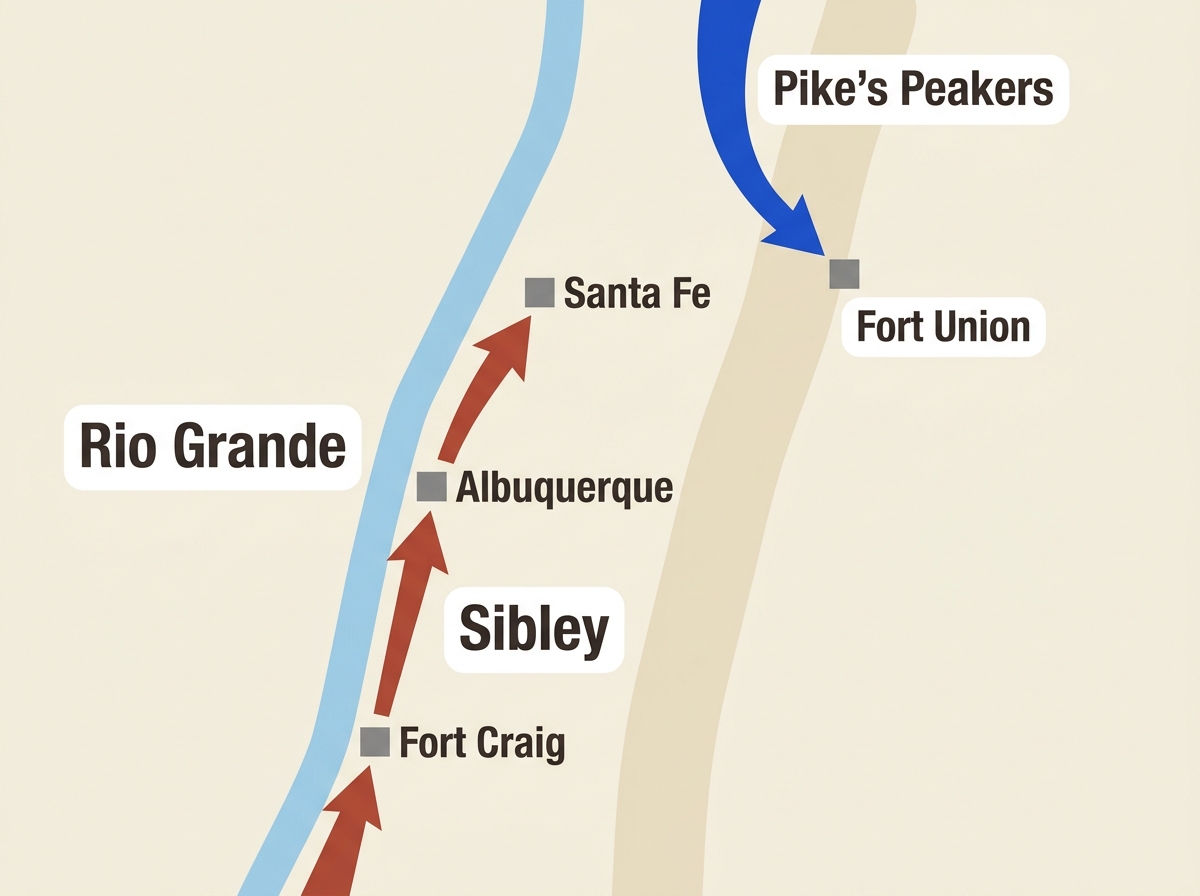
The first real test came on February 21, 1862, at a ford of the Rio Grande called Valverde, just north of Fort Craig, a Union strongpoint commanded by Colonel Edward R.S. Canby (North), who commanded all Union forces in the territory. Sibley's Texans fought Canby's garrison and won the field, driving the Union troops back inside the fort's walls. But it was the kind of victory that loses wars. Canby's men refused to surrender, pulled back into Fort Craig with their supplies, and stayed there, a Union force sitting squarely behind the Confederate line of march, denying Sibley the very stockpiles he had come to capture.
So Sibley did the only thing a hungry army can do: he kept going north and hoped for better. On March 2 his advance occupied Albuquerque. On March 13 the Confederates marched into Santa Fe, the territorial capital, and raised their flag over it. And then the prize slipped through their fingers a third time. The Texans broke into the storerooms expecting the food and forage a capital should hold, and found them stripped bare. The Union had hauled off nearly everything before the first Confederate rider came into view. Sibley now held the capital of New Mexico and almost nothing his men could eat.
That left one target worth taking: Fort Union, the main Union supply depot for the entire Southwest, about 90 miles (145 km) northeast of Santa Fe. Whoever held Fort Union held the territory. It was packed with the food, ammunition, and gear a campaign needs to survive. For Sibley, it was no longer a goal. It was a necessity. Everything an army hauled with it to stay alive (the wagon convoy of rations, cartridges, medicine, and spare gear that soldiers called the supply train) was waiting inside Fort Union for whoever got there first.
The Pike's Peakers come down the mountains
The Union's answer to all this did not come from Washington, which was busy bleeding in Virginia. It came from Colorado. The 1st Colorado Volunteers (a volunteer regiment is a unit of civilians who enlisted for the war rather than career soldiers, this one recruited straight out of the mining camps around Denver and Pike's Peak, which got them the nickname the "Pike's Peakers") set out to save the territory on foot. They marched. They marched the way almost no one in this war marched. Starting from Denver in late February, they crossed something on the order of 300 to 400 miles (480 to 640 km) of cold high country, much of it above 7,000 feet with snow still on the ground, and the final leg of it is the part that survives in every account: roughly 67 miles in about 24 hours. Men who had already walked the spine of the Rockies pushed through a day and a night without real rest, boots gone to ruin, falling out and catching up, driven by the knowledge that if they were late the territory was lost. They reeled into Fort Union around March 10 or 11, half-dead and exactly in time.
The regiment was led overall by Colonel John P. Slough (North), with the advance under Major John M. Chivington (North), a hulking former Methodist minister. On March 22, Slough's column (his marching force) left Fort Union and started south down the Santa Fe Trail (the old wagon route that ran from the Missouri frontier all the way to Santa Fe, and the only practical road through this country) looking for the Confederate army. By March 25, Chivington's advance guard had reached Kozlowski's Ranch, a stage stop east of the pass that the Union turned into its staging point. The Texans were camped at the other end of that same notch.
The notch was Glorieta Pass, and it was the gate. At the southern tip of the Sangre de Cristo Mountains (the long range running along New Mexico's eastern edge), it was the one practical way for an army and its wagons to move along the Santa Fe Trail between Santa Fe and Fort Union. If the Confederates wanted Fort Union (and they had to have it), they had to come through the pass. If the Union wanted to stop them, this was where it would happen. Both armies were walking toward the same 20-mile (32 km) stretch of canyon and ridge southeast of Santa Fe, and neither quite knew the other was so close.