The Confederates named it after the most unconquerable place they could think of. Columbus, Kentucky, sat on a high bluff over the Mississippi, bristling with so many guns that the men who built it called it "the Gibraltar of the West." Gibraltar was the famous rock-fortress guarding the entrance to the Mediterranean, the kind of place you simply cannot fight your way past. Columbus was supposed to be unbeatable. In March 1862 the Confederates abandoned it without firing a shot, because a then-obscure Union general had walked around the back of it.
The Mississippi runs the length of the continent, and in 1862 it was the South’s main road, its supply artery, and the seam that held the western Confederacy to the eastern. The Confederate States were a country built to preserve slavery, and the men in Washington had a plan to strangle that country by taking its river. The plan had a nickname: the Anaconda, after the snake that kills by squeezing. General Winfield Scott (North), the aging general-in-chief (the top commander of all Union armies at the war’s start), had laid it out: blockade the Southern coast (seal off Southern ports so no ships could get in or out), seize the Mississippi from top to bottom, and split the Confederacy in two like a log. Take the river, and you cut the cotton states of the Deep South off from the cattle, grain, and men of Texas and Arkansas. It was a slow strategy, and a sound one, and it ran through control of one long brown highway of water.
The South knew the plan as well as the North did, and had spent months fortifying the river against exactly this. Columbus was the first great cork in the bottle. It was supposed to be unbeatable from the river, and it never had to be beaten from the river at all.
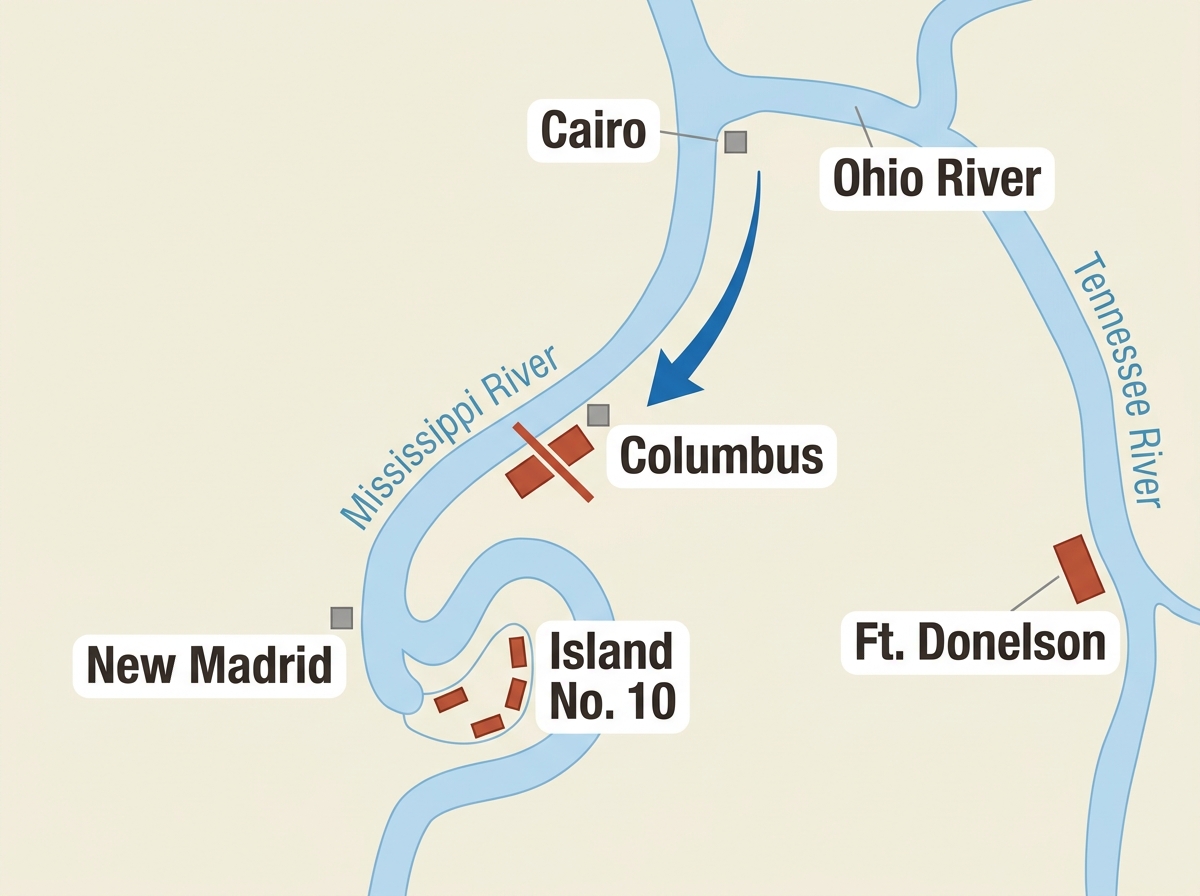
The river fortress
What broke Columbus was a back door. In February 1862, Ulysses S. Grant took Fort Henry and then Fort Donelson, two forts not on the Mississippi but on the nearby Tennessee and Cumberland Rivers, in quick succession (Fort Henry on February 6, Fort Donelson on February 16). Suddenly Union forces could march overland from those rivers and come at Columbus from behind, cutting it off from the rest of the South. A fortress you can simply walk around is no fortress. The senior Confederate commander in the West ordered Columbus abandoned, quietly, and the Confederates hauled its enormous inventory of guns downriver to build a new cork further south. This is the constant logic of the river war: a position is only as strong as the ground behind it.
Western TheatreFort Donelson: the back-door win that un-anchored the river lineThe new cork was a place called Island Number Ten. The name is exactly what it sounds like. Counting the islands in the Mississippi south from where the Ohio River joins it at Cairo, Illinois (the Union’s forward base), this was the tenth. It sat about 45 miles (72 km) downstream of Cairo at the most useful spot on the upper river: a wild double hairpin bend near the town of New Madrid, Missouri, where the Mississippi loops back on itself so sharply that the compass becomes a liar, a boat going "downstream" here being, for a stretch, pointed north. Any vessel coming down the river had to slow almost to a crawl to thread the turns, and a vessel slowing to a crawl in front of a fortress presents the thinnest part of itself, its bow (the front end, where ships are narrowest and least armored), to the guns.
And the guns were waiting. The Confederates had begun digging in here as early as August 1861. The work was started by Captain Andrew B. Gray (South) and a crew of several hundred enslaved people, impressed into service to throw up the earthworks. The batteries and entrenchments were dug, like so much of the Confederacy’s war effort, by the labor of the very people the war was being fought to keep enslaved. They dug amid chronic shortages: not enough shovels, not enough wheelbarrows, and some Confederate soldiers ordered to help refused to do manual work alongside slaves. By mid-March 1862 the bend nonetheless bristled with 52 cannon: 19 on the island itself, the rest strung along the Tennessee shore batteries (a battery being a cluster of artillery pieces fortified together) and at two forts, Thompson and Bankhead, guarding New Madrid. There was even a floating battery, the New Orleans, a hulk loaded with nine heavy guns and moored in the current to add its fire. The whole thing was designed to make running the gauntlet downriver, sailing straight past a line of enemy guns all firing at you at once, a form of suicide.
The river fortress · New Madrid
The Union officer sent to crack all this open was Brigadier General John Pope (North), commanding a brand-new force called the Army of the Mississippi, some 23,000 to 25,000 men. Pope was a West Point man (class of 1842), brisk and confident, and his commanders had handed him a hard assignment: take Island Number Ten. Pope started by going for the soft target first. Rather than batter the island, he marched on New Madrid, the fortified town on the Missouri bank upstream of the island, the place where the bend began.
He got there fast and squeezed hard. His column left Commerce, Missouri, on February 28, skirmished its way down, and began the siege of New Madrid on March 3 (a siege being the surrounding of a fortified town to cut it off and force its surrender). He took the village of Point Pleasant on March 7 to choke off the river below the town, and then he waited for the one thing the Confederates inside dreaded: heavy siege artillery, big enough to crack fortifications. The guns arrived on March 12, a nasty surprise for the Confederate commander, Brigadier General John P. McCown (South), who had not expected Pope to have anything that heavy. They opened fire on March 13. That night, under cover of a hard rainstorm, McCown gave up the town and slipped out, spiking some of his cannon (driving an iron spike into the touch-hole, the small firing vent, so the enemy could not fire the gun) and abandoning the rest: Fort Thompson with its 14 guns, Fort Bankhead with 7, plus tents, wagons, horses, mules, and ammunition. In the morning a pair of Confederate deserters walked up under a white flag, and Pope, finding the place empty, fired off a telegram dripping with disbelief:
"To my utter amazement the enemy hurriedly evacuated the place last night leaving everything."
So Pope had New Madrid, 33 captured cannon, and a fresh problem he could not solve with another telegram.
Here was the impasse, and it was a real one. Pope now held the Missouri bank above the island, with 23,000 men itching to finish the job and not one way to get them across the river. The Mississippi here is wide, deep, and fast, and the island’s batteries commanded the crossing. To put his army on the Tennessee side, where it could trap the garrison (the troops stationed to hold a fortress), Pope needed gunboats below the island to cover the crossing, to keep the Confederate shore guns suppressed with their own fire while his men crossed in the open. (In river language, "above" means upstream and "below" means downstream, regardless of which way the compass points in that crazy bend.) His friendly gunboats were all on the wrong side of the guns. To get them where he needed them, they would have to run past the fortress, and the man who owned the gunboats was not at all sure he wanted to try.