The obvious answer to a fortress is to knock it down, and for three weeks the Union tried exactly that, tried to blast open the next lock on the Confederacy’s river highway. Flag Officer Andrew Hull Foote (North) led the Western Gunboat Flotilla. "Flag Officer" was the rank used by senior Union Navy commanders before "admiral" was formally created, effectively the fleet’s commander; a flotilla is a fleet of smaller warships. His was the strange and formidable little navy of the western rivers: seven ironclads (warships sheathed in iron plate so cannonballs bounced off) plus a flotilla of mortar rafts (a mortar being a stubby, high-angle cannon that lobs a heavy shell up and over, raining it down from above; a raft being just that, the mortar bolted to a floating platform). Foote brought all of it up opposite the island on March 15 and started hammering. He was not eager to do the other thing, to run his fragile boats straight past the guns. He hoped, instead, to simply pound the island into surrender from a safe distance upstream.
It did not work. The mortar shells, 200-pound monsters that could be flung up to about 2 miles (3.2 km), came down all over the bend and did very little. The ironclads traded fire and got hurt doing it: on March 17 the Cincinnati was struck repeatedly, the Benton took four direct hits, and a gun aboard the St. Louis burst and killed three of its own sailors. There was one flash of offensive nerve in the long stalemate: on the night of April 1, under cover of a rainstorm, Colonel George W. Roberts (North) led some forty picked men of the 42nd Illinois Infantry in a small-boat raid onto the Tennessee shore, drove off the startled Confederate pickets, and spiked the guns of Battery No. 1 before shoving off back to the fleet. Crews also picked at the floating battery New Orleans, eventually shooting away its moorings so it drifted helplessly out of the fight. But after weeks of bombardment the verdict was plain: the high hopes pinned on all that artillery were, in the words of one account, "dashed." The island would not be bombed into surrender. The ironclad captains could sit upstream and trade shots forever without cracking the bend. The answer, when it came, came from a quarter no one was watching: not the navy, but a single colonel with six hundred soldiers and a long look at the flooded backcountry.
The engineering feat
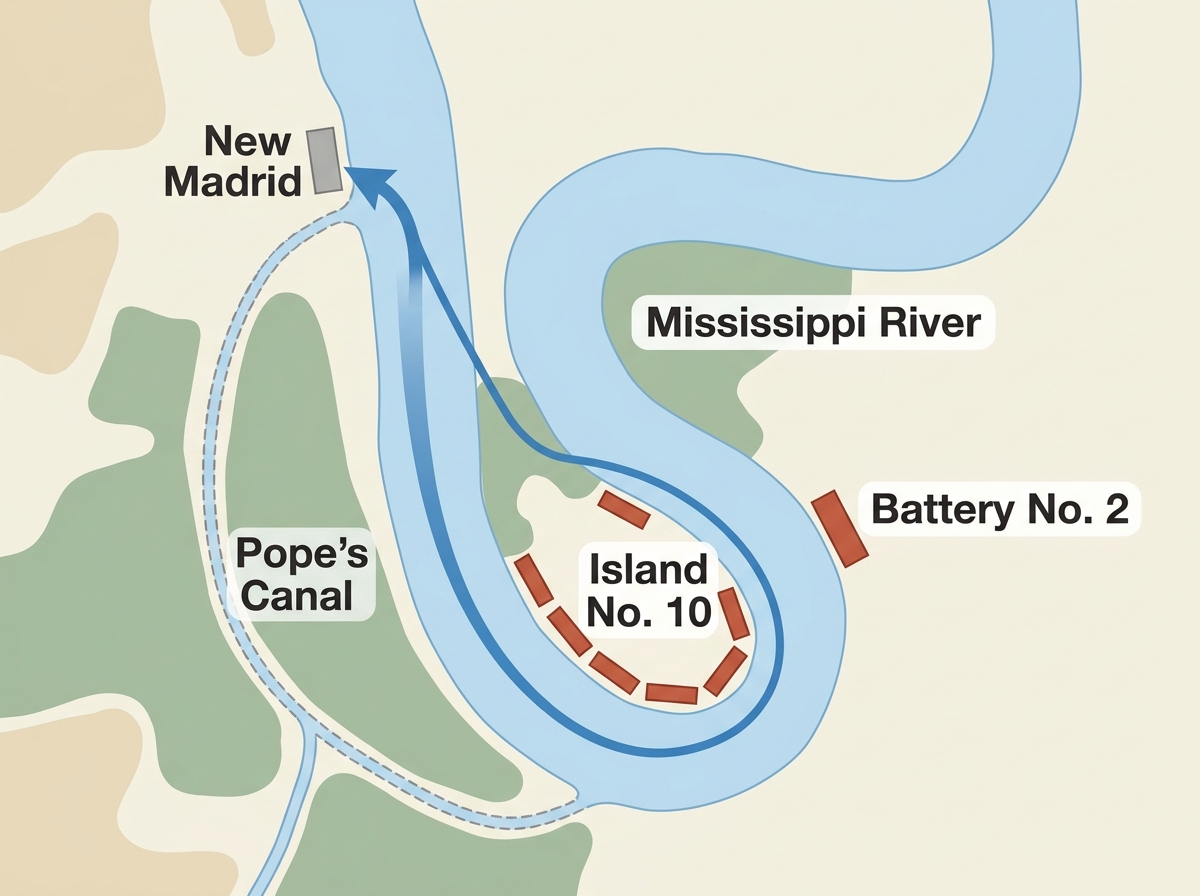
The idea belonged to Colonel Josiah W. Bissell (North), who commanded a unit called the Engineer Regiment of the West, about 600 men whose job was building, not fighting. Surveying the flooded backcountry on the Missouri side in mid-March, Bissell saw something nobody else had: a way to go around the island entirely without ever exposing a boat to its guns. The spring floods had drowned the low country west of the river into a maze of swamp and bayou (a bayou being a slow, marshy side-channel). If you could chop and dredge a navigable channel through that flooded timber, you could float transports from the Mississippi above the island, through the swamp on the safe Union-held side, and back out onto the river below the island, near New Madrid. A canal (a man-made water channel) through a forest that happened to be underwater.
It was an audacious, ridiculous piece of engineering, and Bissell’s men built it. The channel ran roughly 12 miles (19 km) long, 50 feet (15 m) wide, and 4½ feet (1.4 m) deep, and they cut it in 19 days, finishing around April 4. They worked from rafts, sawing standing trees off 8 feet above the waterline, then looping hawsers (thick ropes) around the stumps and dragging them out by the brute pull of steamboat capstans (the winch drums that haul anchor chain). In open water they ran saws below the surface to cut submerged trunks. The Confederates knew the project was underway and were sure it would fail. It did not fail. Pope put it best in his own report, calling the work
"prosecuted with untiring energy and determination, under exposures and privations very unusual even in the history of warfare."
The catch: the canal was just deep enough for transports and supply boats, and not nearly deep enough for the heavy ironclad gunboats. Pope could now move men around the island. He still could not move firepower around it.
The engineering feat · The gunboat runs
So the gunboats would have to run the gauntlet after all, straight down the river, in front of every cannon on the island. Commander Henry Walke (North), captain of the ironclad USS Carondelet, volunteered to go first, and at a conference on March 29 he talked the reluctant Foote into letting him try. Walke then turned his warship into a floating fortress of improvisation. His crew laid spare barge planks over the unprotected deck, coiled surplus anchor chain over the vulnerable spots, wound an 11-inch hawser around the pilothouse (the enclosed cockpit where the ship’s pilot steers, the most exposed spot on the vessel), and stacked cordwood around the boilers. They lashed a coal barge piled with baled hay to the river side of the ship to soak up incoming shot. They rerouted the steam exhaust aft to muffle the engine’s hiss. Twenty-three sharpshooters from the 42nd Illinois Infantry climbed aboard as extra guns, and the sailors armed themselves with pistols, hand grenades, and cutlasses (short curved swords) in case Confederate soldiers tried to board the ship. The pilot was William R. Hoel (North), a 20-year veteran of these waters. The engineers were under orders to wreck the engines rather than let the ship be captured.
They went on the night of April 4–5, into a moonless dark with a thunderstorm rolling overhead, the perfect cover. And then the Carondelet gave herself away: soot built up in her smokestacks and caught fire, a sudden bright torch in the blackness, and Confederate lookouts at Battery No. 2 spotted her at once. The shore batteries opened up. Forty-seven shots were fired at the gunboat as she ran the loop. Exactly two of them hit, and both buried themselves harmlessly in the coal barge lashed to her side. She grounded briefly, refloated, and after about two hours of running the gauntlet she tied up safe below the island at New Madrid. The thing everyone had called suicide had cost no one a scratch.
Two nights later, the USS Pittsburg under Lieutenant Egbert Thompson (North) did it again. Thompson had asked for a short delay, then made his run on the night of April 6, through another thunderstorm, and reached the safe water downstream by 5 a.m. undamaged. Now Pope had two ironclad gunboats below Island Number Ten, exactly the firepower he had been missing. Walke’s run was more than a stunt: it was a glimpse of the future. The idea that a steam warship could simply barrel past fixed shore guns instead of dueling them to a standstill would be used again and again, by David Farragut at New Orleans, Port Hudson, and Mobile, and by Union Admiral David Dixon Porter (North) at Vicksburg. The river war had just learned a new trick.
Off the fieldIronclads: the river navy that made running the guns possible