Taylor had arranged his roughly 9,000 men in a rough crescent, bent like a horseshoe, along the western, northern, and eastern tree lines rimming the clearing, with the open field in front and the Union column pouring into it. Brigadier General Alfred Mouton’s (South) division held the left, east of the road; Major General John G. Walker’s (South) Texas infantry division held the right, west of the road; Brigadier General Thomas Green’s (South) cavalry covered the flanks. The Federals, deploying in the clearing, were forming a line with the woods curling around three sides of them and did not fully grasp it.
Around four o’clock in the afternoon, after the long wait, Taylor ordered the assault. Mouton’s division (South) charged first, east of the road, straight at the Union line along the rail fence and Honeycutt Hill, and ran into a wall of fire. The charge was bloodily repulsed in its first rush, and Mouton himself was killed leading his men, along with several of his regimental commanders. Command of the division passed on the spot to Brigadier General Camille Armand Jules Marie, Prince de Polignac (South), a genuine French nobleman who had crossed an ocean to command a brigade of Texans for the Confederacy and now inherited a whole division by battlefield promotion in the middle of a firefight in the Louisiana woods.
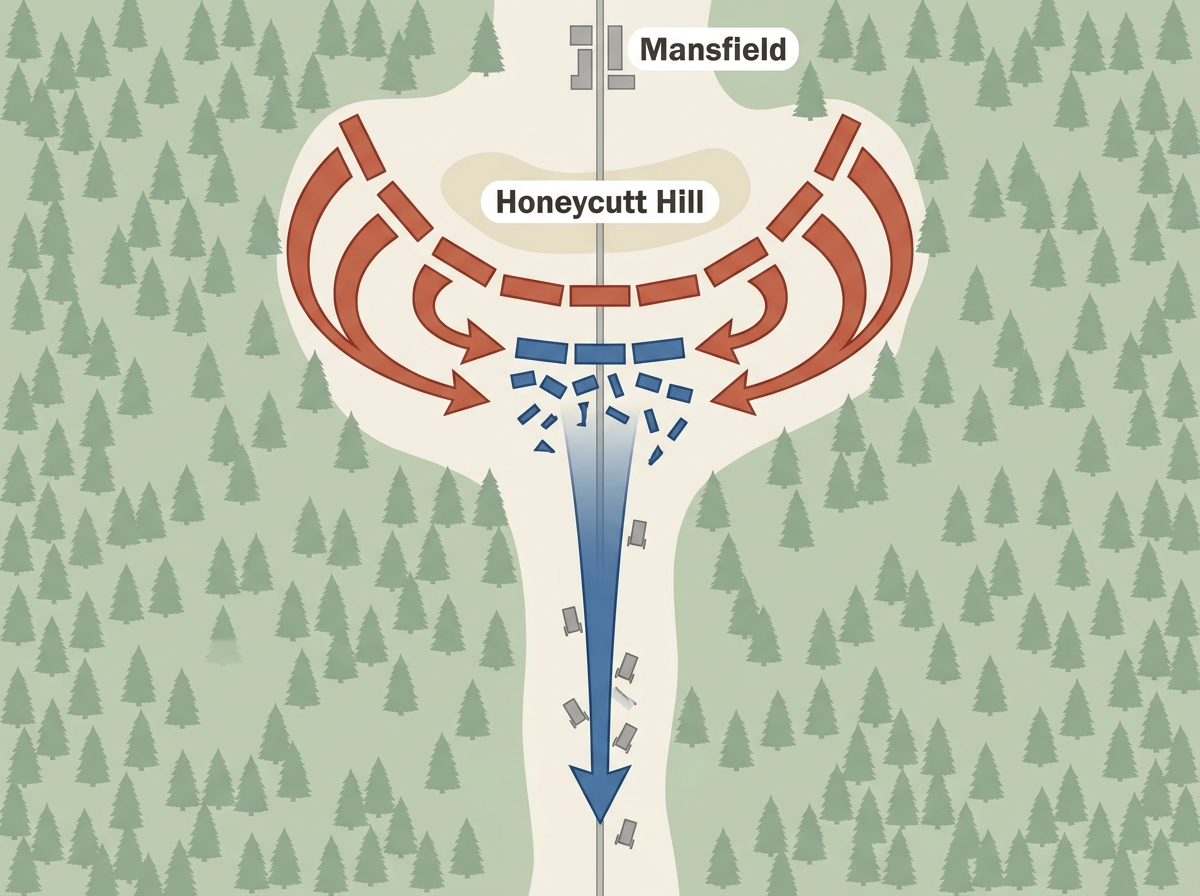
West of the road, Walker’s Texas division (South) did the thing the crescent was built to do: it wrapped around the Union flank (the exposed side of a formation) and rolled the line up from the side, while Green’s (South) cavalry pressed the edge. A battle line can absorb a blow to its front; it cannot absorb being folded in from the end, where each man’s flank and rear are suddenly open. The Union line broke, and then the road that had strung Banks’s army out turned a defeat into a disaster.
The broken Union front fled south, back down the single road, and slammed straight into its own wagon train, the 300-odd wagons still jammed nose to tail in the lane behind them. There was nowhere to go. The retreat collided with its own baggage and congealed into a stampede; the Confederates would strip about 20 cannon, 156 wagons, and a thousand horses and mules off the jammed road. Men threw away their rifles and cartridge boxes to run faster, sprinting back through a Confederate crossfire pouring in from both tree lines. Brigadier General Thomas E. G. Ransom (North), commanding the leading infantry detachment, was wounded trying to rally the wreck. The captured-and-missing figure dwarfs the killed, the fingerprint of a rout rather than a stand-up fight: the Union lost roughly 2,100 to 2,235 men here, but only about 113 killed and some 580 wounded, against around 1,500 captured or missing, swept up wholesale as the line dissolved.
Banks (North) rode into the flood and tried to stop it, calling on his men not to desert him, and the men ran past him anyway, the political general pleading on the road while his army poured around him toward the rear.