A battle plan usually starts with two armies facing each other. This one started with Van Dorn deciding, on purpose, to face Curtis from the wrong direction. Rather than charge Curtis's prepared bluffs along Little Sugar Creek, he would march his whole exhausted army by night in a great loop, clear around the Union right (the right-hand end of Curtis's line as he faced south) and up onto the high ground behind them, and come down on Curtis from the north, from his rear, the undefended back of the army, cutting his supply line and pinning him against his own defenses. Cut that line and Curtis's men would have no food and no fresh bullets coming up, and an army with neither cannot fight for long. It was reckless to the edge of crazy. If it worked, Curtis would be trapped facing the wrong way with rebels at his back. If it didn't, Van Dorn would have an exhausted army strung out on bad roads with its supplies somewhere over the horizon.
It half-worked, which turned out to be the worst possible outcome.
The night march around the rear
That night, Van Dorn's army filed onto a side road called the Bentonville Detour and began the long march around Curtis's flank (the exposed side or end of an army's line). The going was miserable: icy, rocky ground in the dark, and at one point a stretch of road the Federals had blocked with felled trees, which Price's men had to spend hours clearing. The army was split into two wings (the two halves of a divided army) by the bulk of Pea Ridge itself: Price's Missourians swung around the northern end of the ridge to come down a road called the Telegraph Road toward a landmark called Elkhorn Tavern, while McCulloch's wing skirted the western edge of the ridge to strike near the hamlet of Leetown. The two wings were supposed to converge and crush Curtis between them.
And here Van Dorn made the mistake that would lose the battle, though it wouldn't show its teeth until the next day. By marching all the way around Curtis to get behind him, he had cut his own army off from its supply and ammunition wagons, which were left far to the rear, near the old camps, on the other side of Union-held ground. His soldiers were carrying the forty rounds in their cartridge boxes (the leather pouches on each soldier's belt that held his paper-cartridge ammunition) and not much more. There was, for the moment, no way to get more bullets to them.
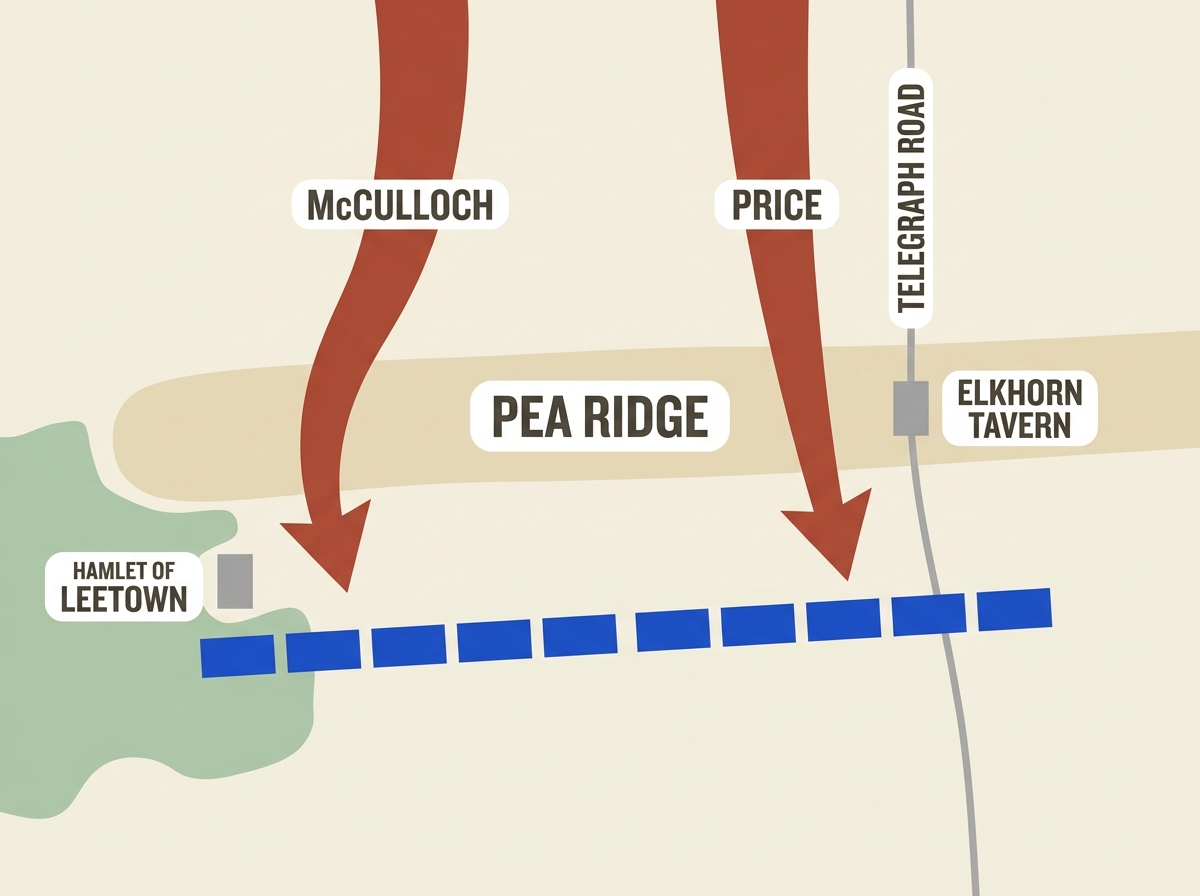
When morning came on March 7, Curtis discovered the rebels were behind him, to the north, rather than in front. What he did next is one of the cooler tactical responses of the early war. He turned his entire army around. The whole Army of the Southwest pivoted 180 degrees on the spot, so that what had been the rear became the new front, facing north toward Pea Ridge, and the creek line he'd spent days fortifying, the strong position the whole campaign had been built around, became his rear, abandoned in a single morning. He sent Colonel Eugene Carr's (North) 4th Division (a division being the largest of those nested units, several thousand men) up the Telegraph Road to hold Elkhorn Tavern against Price, and Colonel Peter Osterhaus (North) and Colonel Jefferson C. Davis (North), no relation to the Confederate president of the same name, west toward Leetown to meet McCulloch. Van Dorn had gone to enormous trouble to attack the Union from an unexpected direction, and Curtis had simply turned to meet it.
Van Dorn had marched all night to hit Curtis from behind. Curtis turned his whole army around in a morning and hit back.
The western wing loses its head
Out west near Leetown, McCulloch's wing came on hard at first. Confederate cavalry charged into the Union positions, scattered the Federal horsemen, and captured three guns from a Union battery (a battery being a cluster of several cannon that work and move as one unit). For a while it looked like the western wing might roll right over the smaller Union force in front of it.
Then, in a span of minutes, that whole wing lost its leadership. Around mid-morning, McCulloch rode forward alone to scout the Union line personally near a belt of trees on the edge of a field. He was wearing his usual black velvet civilian suit, because he disliked Confederate uniforms, and a bullet from a Union skirmisher (a soldier sent out ahead of the main line to harass the enemy and probe for weak spots) among Osterhaus's men killed him on the spot. (A soldier of the 36th Illinois Infantry, infantry being soldiers who fight on foot, later claimed the shot.) His staff officers, hoping to keep the wing from coming apart, tried at first to hide his death from the troops. Command passed to Brigadier General James McIntosh (South), who was killed by the same Union skirmishers less than fifteen minutes later, leading an advance from the front. In under a quarter of an hour, the western wing had lost both of its top two commanders.
It got worse from there. Command should next have fallen to Colonel Louis Hébert (South), but Hébert had led about 2,000 infantry into the dense timber of the surrounding woods, gotten lost and disoriented, and been captured in the confused fighting, never even knowing that he was, by then, the ranking officer left on that part of the field. Behind him, the next senior colonel wasn't told for hours that everyone above him was dead, captured, or gone. The result was that the entire western wing devolved onto Pike, the Indian Territory commander, a lawyer and poet with no real combat experience, who could only gather the wreckage and order a withdrawal by mid-afternoon. Half of Van Dorn's army had been decapitated and pulled itself off the field in the space of a single morning.
The only large Native force in a major battle
The troops under Pike were the only sizable Native American force to fight in a major Civil War battle. He'd marched in with around 900 men: two regiments of Cherokee Mounted Rifles (cavalry, men on horseback armed with rifles), one under Colonel Stand Watie (South), firmly pro-Confederate, and one under another colonel whose men were largely Unionist sympathizers pressed into Confederate service against their will, plus a small squadron of Texas cavalry. (Other Native units had been organized but didn't reach the field in time.) Pike had raised these regiments under treaty terms that said plainly they would not be required to leave Indian Territory, and Van Dorn's command had overridden that promise to pull them into Arkansas. The men fighting at Pea Ridge had been told they would never have to fight here.
Stand Watie was a major figure in his own right, and a deeply divisive one. He was one of the Cherokee leaders who had signed the Treaty of New Echota in 1835, the treaty that forced the Cherokee removal and the Trail of Tears (the army-driven westward march of 1838–1839 that killed an estimated 4,000 Cherokee), which made him a bitter political rival of the Cherokee Nation's principal chief and a polarizing man among his own people. He would later become the only Native American promoted to general on either side of the war, and the last Confederate general in the field to surrender, on June 23, 1865, more than two months after the war's main armies had given up at Appomattox that April.
Why were Cherokee soldiers fighting for a Confederacy built on slavery at all? The reasons were tangled. The Five Tribes (the Cherokee, Choctaw, Chickasaw, Creek, and Seminole, the five Native nations the U.S. had removed to Indian Territory) had economic and cultural ties to the South, and slavery existed in Indian Territory itself, where enslaved African Americans made up roughly one in seven of the population. The Confederacy had also offered the tribes treaty protections that the U.S. government had repeatedly promised and failed to deliver. The result was a Cherokee Nation split against itself, with men on both sides, and at least one Cherokee regiment whose Unionist soldiers would begin deserting to the Federal side during the battle itself. After their early success that morning, many of these Native troops, knowing the promise that they would not have to fight outside Indian Territory had already been broken, refused to make further frontal assaults and pulled back.
An ugly episode, and what we don't know
Early in the Leetown fighting, Pike's Cherokees and the Texas cavalry surprised a small Union column, a couple of companies (a company being roughly 80 to 100 men) of Iowa cavalry that had pushed north of the main line up a farm lane. They wounded the Iowans' commander, scattered his men, and helped capture the Union guns mentioned earlier. After that fight, in the woods near the farm, about eight of the Iowa dead were found scalped, and several others mutilated.
No eyewitness left any account of who actually did it. Both Cherokee soldiers and Texas cavalrymen were present, and from the surviving evidence there is no way to say which men committed it. What can be said is the scale: of roughly 800 to 900 Native soldiers on the field, probably fewer than a dozen took part in any mutilation. Pike was horrified when he learned of it after the battle and issued orders against any repeat. The Northern press made the most of it and pilloried Pike and his troops, but the act itself was the work of a handful of unidentified men, and it does not describe how the Cherokee soldiers as a whole fought that day.
Both armies marched into those woods believing they were the ones doing the surprising. By afternoon, neither side could say for certain who had done what among the trees.