The Civil War was, at bottom, a war over slavery, and nowhere was that uglier or more tangled than in Missouri. (The Confederacy was the breakaway government formed by eleven Southern states that, starting in 1861, declared themselves an independent country no longer part of the United States, "leaving the Union," or seceding, in order to keep slavery legal. The United States, fighting to force them back, is called the Union, the Federal side, or just the North; all three names mean the same side.) Missouri was a border state (a slave state that sat on the line between North and South and had not left the Union), and it was the great prize of the West. It had a slave-owning population, a pro-Confederate governor who'd been chased out, a rival rebel state government claiming to speak for it, and seats waiting in the Confederate Congress (the breakaway South's own parallel legislature in Richmond, Virginia). Whoever controlled Missouri controlled the upper Mississippi River, the great highway of the continent's interior, the supply artery running from the Midwest down to New Orleans; splitting the South's hold on it was one of the Union's central war aims. The fight that ended at a tavern in the Arkansas hills in March 1862 was the climax of a year-long struggle over a single question: would Missouri, a slave state on a knife's edge, be dragged into the slaveholders' Confederacy.
The short answer, by the time it was over, was no. But getting to no cost a lot of men, and it came down to one of the strangest battles of the war.
A war that wouldn't end
It had started badly for the United States. In August 1861, at the Battle of Wilson's Creek in southwestern Missouri, a Confederate force under Brigadier General Benjamin McCulloch (South) and Major General Sterling Price (South), major general being a rank above brigadier general, a distinction that would matter a great deal in a moment, beat a Union army and killed its commander, Brigadier General Nathaniel Lyon (North), the first Union general killed in the war. The victory left the southwestern corner of the state in rebel hands. Price's Missourians pushed north, and that September captured a Federal garrison (a Federal, meaning Union, post holding a town) at Lexington, Missouri. For a moment it looked as if Missouri might be pried loose from the Union by force.
Trans-MississippiWilson’s Creek: the bloody summer fight that opened the contest for MissouriIt didn't hold. Price pushed north without McCulloch, and when no reinforcements came, he was forced south again, still without McCulloch. The two men feuded bitterly all that fall over who was in charge and what to do. Price was a Missouri politician-turned-general commanding the Missouri State Guard (the state's own pro-Confederate militia); McCulloch was a former Texas Ranger with a Confederate commission (an officer's rank granted by the Confederacy), a frontier fighter who trusted neither Price nor his plans. By rank, Price (major general) outranked McCulloch (brigadier general), but McCulloch commanded his own separate Confederate force and simply would not take Price's orders. They had between them everything they needed to take Missouri, and they would not share a command long enough to try. The Confederate bid for the state stalled out on its own internal squabbling.
The man who came to break it for good was Brigadier General Samuel R. Curtis (North), a trained engineer put in charge of Union forces in southwest Missouri on Christmas Day, 1861. Where Van Dorn, the man he would eventually face, was a gambler who solved problems with a roll of the dice, Curtis was a man who solved them with a shovel and a map. He built an army, the Army of the Southwest, around 12,100 men, and did something Union commanders in the East seemed incapable of: he moved. Through the dead of winter he chased Price's Missourians southwest across the state, never letting them stop and regroup. By late February 1862 he had pushed them clean out of Missouri and into the hills of northern Arkansas. The Confederates burned Fayetteville behind them, torching its stores so the pursuing Federals couldn't use them, and fell back into the Boston Mountains, with Curtis's army right on their heels.
One general over two feuding ones
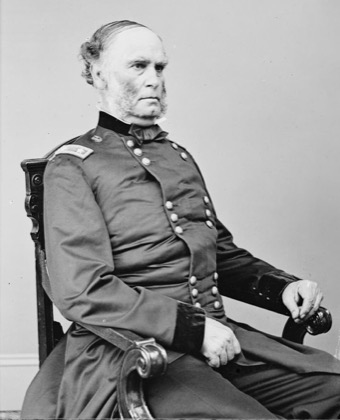
Jefferson Davis, the Confederate president, finally fixed the Price-versus-McCulloch problem the way you fix two quarreling subordinates: he put a third man over both of them. That man was Major General Earl Van Dorn (South), who took formal command of the new Confederate Army of the West on March 2, 1862. For the first time in the campaign, Price and McCulloch answered to the same general, and they answered to him because they had failed each other. Van Dorn was ambitious to the point of recklessness, and he arrived with a plan that was nothing if not grand: unite Price's Missourians and McCulloch's Texans and Arkansans into one army, smash Curtis, retake Missouri, and seize St. Louis, the commercial gateway to the Mississippi and a major Union arsenal (a depot of weapons and military supplies). He reportedly wrote to his wife that he meant to have St. Louis, and after that, the war in the West would open up.
On paper he had the men to do it. At Fayetteville, Van Dorn assembled roughly 16,000 troops: about 8,000 under McCulloch, about 7,000 Missourians under Price, plus a force of Native American troops from Indian Territory (the federal land set aside for Native nations, in what is now Oklahoma) under Brigadier General Albert Pike (South). That gave him better than three men for every two of Curtis's. It was the largest, best-organized Confederate effort ever mounted to retake Missouri.
Van Dorn had assembled more men against Curtis than any Confederate force would ever again bring to bear in the entire region west of the Mississippi. He meant to use every one of them.
Beaten before a shot was fired
Then Van Dorn threw a good part of that advantage away before the battle even began. Impatient to attack, he held a council of war (a meeting of his senior officers to plan the operation) and ordered an immediate offensive despite his army being in no shape for one. The men marched out at dawn on March 4 into a blizzard, stripped down to the bone for speed: one weapon, forty rounds of ammunition, three days' rations, no tents, no heavy winter clothing. They had roughly 50 miles (80 km) of rough mountain road to cover in three days, through severe winter weather. Van Dorn himself was sick, reportedly with the after-effects of flu or pneumonia, and rode part of the way lying in a wagon.
The march wrecked them. Men arrived frozen, starving, and exhausted, having burned through their three days' rations with no resupply in sight, soldiers asleep on their feet in the snow, falling out of the column too worn to keep walking. Price, who knew his Missourians and had watched them stagger in, is said to have begged Van Dorn to let the worn-out, hungry men rest. By the time the army reached the Union position, exhaustion, straggling (men dropping out of the march, too sick or spent to continue), and illness had cut Van Dorn's effective fighting strength from around 16,000 down to perhaps 12,000 fit men. Some sources count only about 14,000 "effective" troops to begin with. Either way, a sizable fraction of his army had been beaten by the road before it ever saw the enemy.
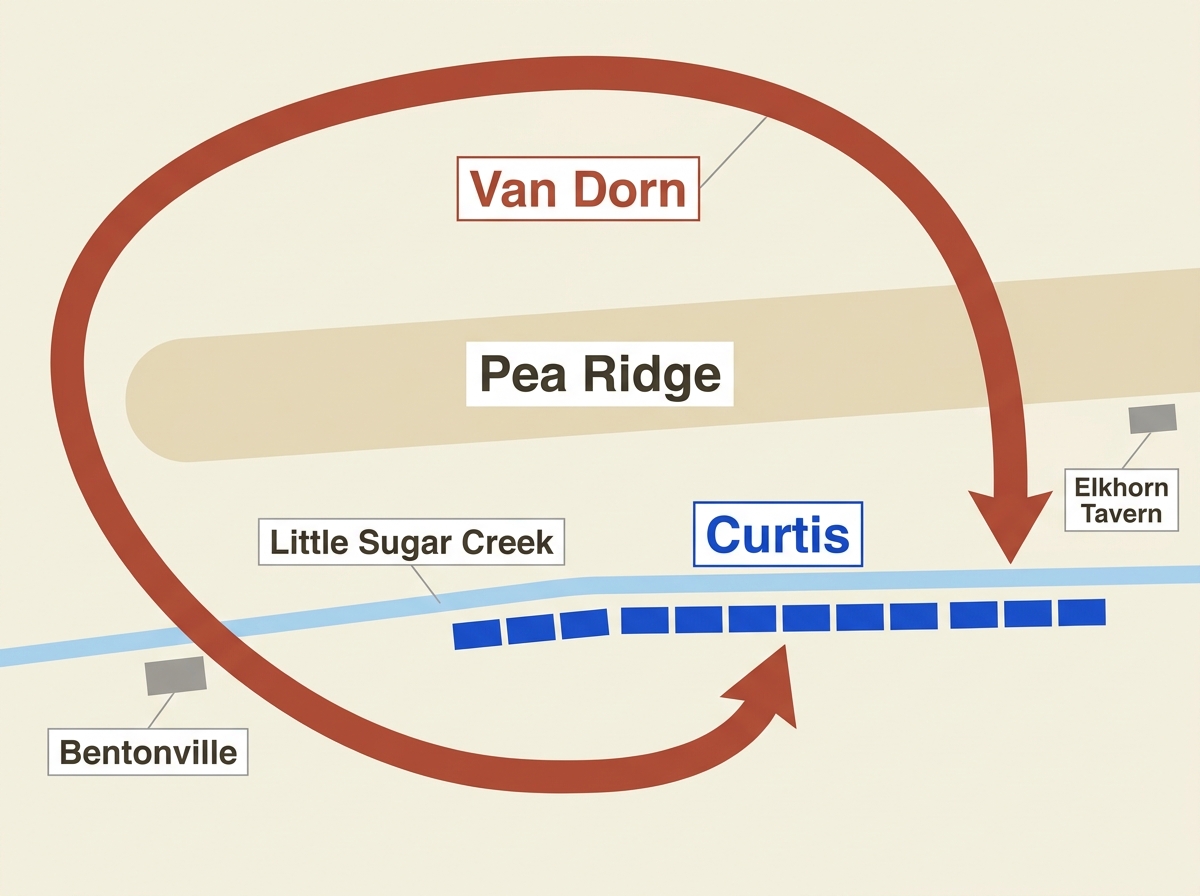
Curtis, meanwhile, had done the opposite. He had dug in. The engineer in him picked a strong defensive line along the bluffs north of Little Sugar Creek, a few miles southeast of a long ridge called Pea Ridge, centered on the main north-south road. He had left detachments (smaller units broken off from the main army) behind to guard his supply line (the chain of wagons and roads that brought food and ammunition up to the army in the field), which reduced his force to about 10,250 men. But the position was excellent, and the line faced south, straight down the road the Confederates would have to come up to attack him. On March 6, Confederate cavalry found Curtis's line and brushed back the rear guard (the troops assigned to protect the back of a marching column) of Brig. Gen. Franz Sigel (North), a German immigrant general beloved by the many German-American soldiers in Curtis's ranks, who had been slow getting out of nearby Bentonville. That evening, looking at Curtis's prepared defenses, Van Dorn decided not to hit them head-on. He decided to go around.
An army of this period nested like a set of boxes: a division ran to several thousand men, broken down into brigades, then regiments (roughly 500 to 1,000 men each), then companies (80 to 100). Cavalry (soldiers on horseback) were grouped into squadrons. Keep that scale in mind as the units below break, scatter, and reform.