Major General Nathaniel P. Banks (North) marched his Army of the Gulf up from Baton Rouge in the south and in from Bayou Sara, a landing just upriver to the north, a pincer closing from both ends, and by May 22, 1863 he had surrounded Port Hudson’s landward earthworks and sealed Gardner (South) and his garrison inside. Banks held something like a four-to-one advantage in numbers, perhaps 30,000 men against fewer than 7,500, and he expected the math to settle the matter quickly. He would assault the works, carry them by weight of numbers, and be done. He did not understand the ground. Five days into the siege he ordered the first attack, and the ground taught him.
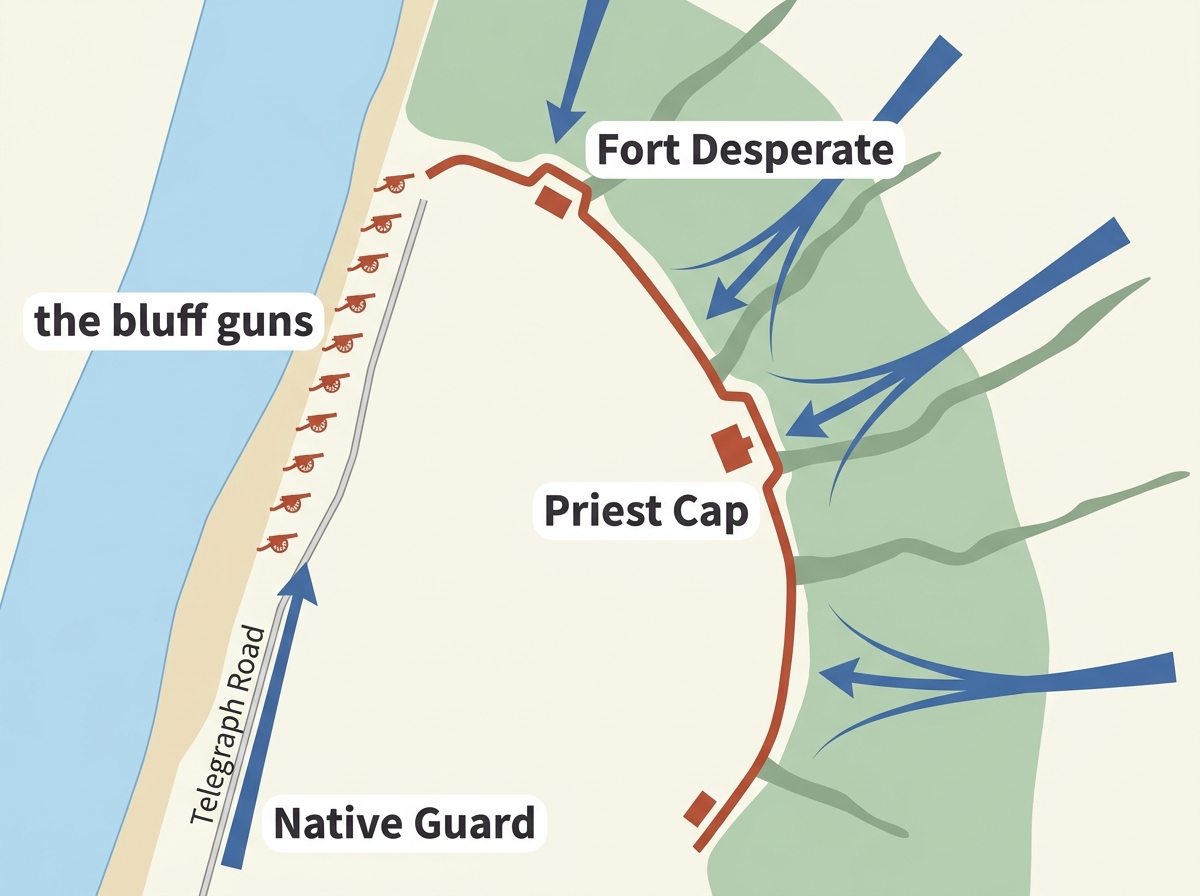
On May 27, 1863, Banks sent his divisions forward against the earthworks. (His army was built in nested pieces, smallest to largest: a company of roughly a hundred men, ten of them making a regiment of about a thousand, several regiments a brigade, several brigades a division, so a single division was thousands of men, and Banks was throwing several at once.) It was supposed to be a coordinated blow, his subordinate generals Godfrey Weitzel (North), Cuvier Grover (North), Christopher Augur (North), and Thomas Sherman (North) striking together so the defenders couldn’t shift men to meet one threat at a time. It came apart instantly. The attacks went in piecemeal, one group at a time, funneled by those deep forested ravines into narrow approaches where a broad assault line dissolved into a thin file of men climbing and stumbling through swamp and cane. The Confederates on the parapets (the packed-earth walls along the top of the works, where a defender could stand and fire down with only his head and rifle exposed) simply waited and shot them down.
A New York soldier in one of those broken lines remembered the men ahead of him going down in the cane like wheat, the survivors flattening into the mud and the felled timber the defenders had laid as obstacles, unable to go forward into the muzzles and unwilling to be the first to run, pinned there through the long hot afternoon while the wounded between the lines called for water that no one could carry to them. By the end of the day Banks had lost on the order of 1,995 men (roughly 293 killed, 1,545 wounded, 157 missing) to take ground he did not take. Gardner lost about 235. The works were untouched.
The Native Guard’s charge and Captain Cailloux
On that day, on the Confederate right, the larger meaning of the war walked onto the field. Among the regiments Banks committed were the 1st and 3rd Louisiana Native Guard: United States Colored Troops, Black soldiers raised in Union-occupied New Orleans (the city Farragut had taken the year before), many of them men who had been enslaved until the war reached them. They were ordered into the assault by Brigadier General William Dwight (North). This was one of the first major combat actions by Black soldiers in the Civil War. It came before the more famous fights of that summer: Milliken’s Bend, another Mississippi River fight upstream where Black regiments held off a Confederate attack, followed about two weeks later in June; and the assault of the 54th Massachusetts (the celebrated Black regiment later dramatized in the film Glory) on Fort Wagner, a sand fort guarding Charleston harbor, in July. Port Hudson came first.
The Confederacy existed to keep human beings enslaved. The men of the Native Guard were charging the works of a slaveholders’ republic, and a great many of them were charging to destroy the very system that had owned them. The South was fighting to keep slavery; these soldiers were fighting to end it, with their own bodies, in the open, against the guns.
The Native Guard’s orders were close to hopeless. They were sent across open ground, including a floating pontoon-bridge approach along Telegraph Road, the road running up to the works, straight into what the records describe as heavy crossfire from rifles, field artillery, and the heavy coast guns on the bluff. They crossed it, were torn apart, fell back, reformed, and went forward again and again, taking heavy losses each time, until staying any longer would have meant annihilation and they were forced to retreat. They did not break and run. They went in, and went in again, into fire that could not be survived in the open, and that is what people remembered.
Leading Company E of the 1st Native Guard was Captain André Cailloux (North), pronounced “ka-YOO.” He had been born enslaved in Plaquemines Parish in 1825 and freed in 1846, at twenty-one, by manumission, his owner formally setting him free. By the war he was a free man of color (the antebellum, pre-war term for a Black person who was not enslaved), a cigar maker, a property owner, and a community leader, one of the roughly 11,000 free Black people in old New Orleans. As a captain he was among the first African American officers in any North American army, and he drew equal pay with white officers of his rank, $60 a month. He gave his commands in both English and French so that all his men could follow them.
On May 27 he led his company into that crossfire and did not come back. A shot shattered his left arm, and he kept going, waving his men forward with the sword in his right hand, until an artillery shell struck him and killed him.
The day after the failed assault, a truce let the Union army go out and recover its dead and wounded, but the burial parties retrieved the white dead and left the Native Guard where they had fallen, in front of the Confederate works on the contested right. When the bodies began to rot in the sun and the stench reached the Confederate line, a Southern officer asked Banks’s permission to bury them himself; Banks, the record has it, refused, saying in effect that he had no dead in that area, disowning his own Black soldiers even in death. So Cailloux’s body lay where it fell for about 47 days, through the whole rest of the siege, until the fort surrendered. When his men finally recovered him, they identified him by a ring they recognized. A captain of the United States, killed leading a charge, was left to lie on the ground he died taking, because of the color of his skin.
Banks tries once more
Banks tried once more. After an opening bombardment on June 13, he demanded Gardner surrender; Gardner refused, replying in substance that his duty was to defend the position and so he declined to give it up. Before dawn on June 14, 1863, around 3:30 in the morning, Banks threw a second assault at the Priest Cap and the Citadel. It was the same story written in more blood: another bloody repulse, roughly 1,792 Union casualties against about 47 Confederate. Brigadier General Halbert Paine (North) was hit and lost a leg. One Union officer who lived through it described the open space before the works strewn with men in blue, dead and dying, and the ditch at the foot of the parapet filled with the living and the dead, the survivors clawing at the face of the earthwork within a few yards of the muzzles.
Two assaults, two repulses: nearly 3,800 men down in two doomed charges, to take nothing, against a few hundred defenders standing behind dirt. The works had won. Banks could not make himself stop reaching for a frontal victory. After June 14 he called for a thousand volunteers to form a special storming party, a “forlorn hope” that would lead one more charge and bridge the ditches with bundles of cane; some 1,300 men stepped forward to near-certain death, and the assault was scheduled, postponed, and finally never made, overtaken by events. Banks had at last accepted what the ravines had been telling him since May 22: Port Hudson would not be stormed. It would have to be starved.