On the morning of October 23, 1864, Major General Sterling Price (South) was boxed in. To his west, between him and escape into Kansas, stood Major General Samuel R. Curtis (North) and the Army of the Border along a low stream called Brush Creek, just south of Westport. To his east, across the Big Blue River at Byram's Ford, Major General Alfred Pleasonton (North) and his cavalry were closing on the Confederate rear. Outnumbered better than two to one across the whole field, Price made the only choice an aggressive general had: he would throw his weight forward against Curtis first, try to smash through to the west, and clear a road out before Pleasonton could come up behind him and shut the trap.
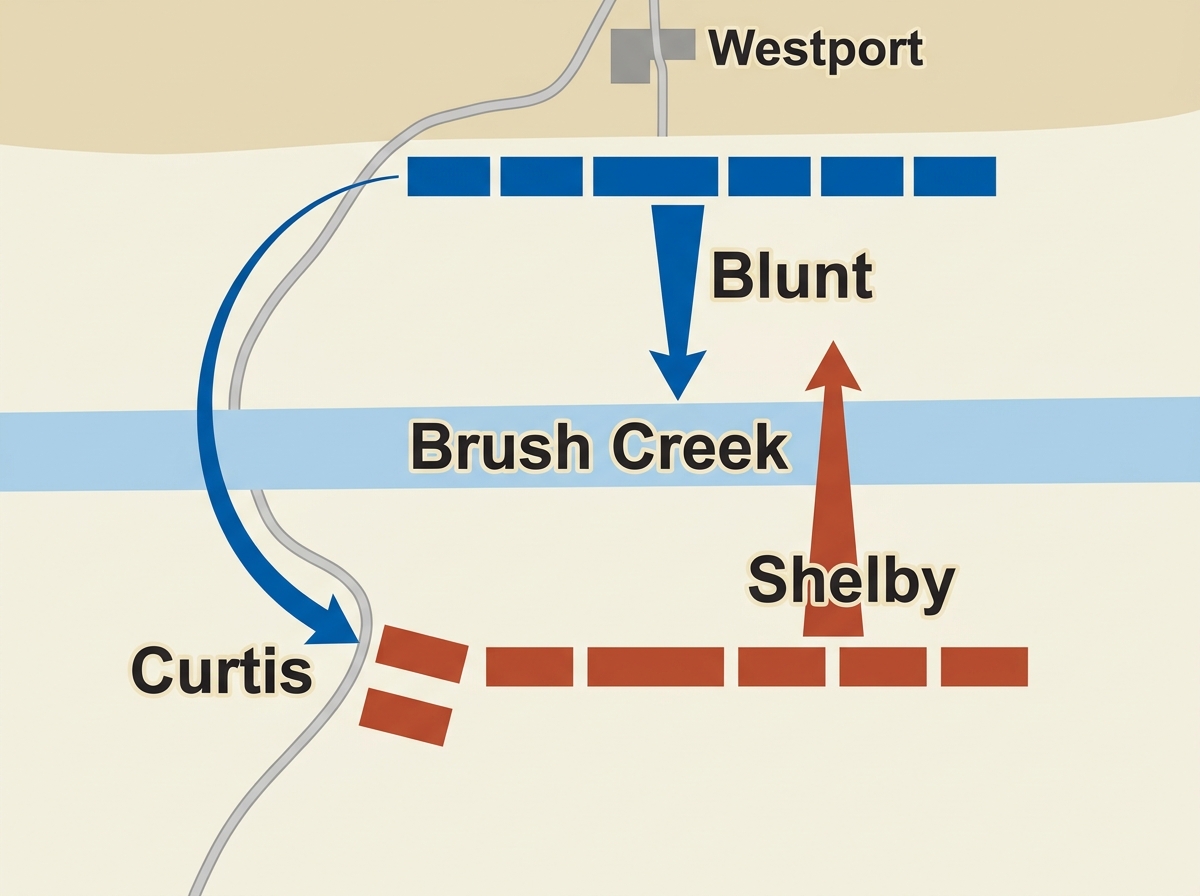
The fight opened at dawn along Brush Creek. Major General James G. Blunt (North), Curtis's most aggressive subordinate, had laid out the Union line on the high ground south of Westport and now sent his brigades down across the icy creek into the open fields beyond, ground that is a city park today. They ran straight into the best the Confederacy had west of the Mississippi. Brigadier General Joseph O. Shelby (South), with his veteran cavalrymen fighting on foot, counterattacked hard and drove the Union assault back across the creek. For a while the morning belonged to the South. Shelby pushed the Federals back toward the streets of Westport itself, and it looked as though Price might actually batter his way through to the west.
A farmer and a ravine
Then the battle turned on a piece of local knowledge. As the fighting stalled, a Missouri farmer named George Thoman, angry at Confederate raiders who had been stealing from the countryside, came to Curtis and showed him a hidden creek bed, a ravine that ran around the flank of Shelby's position. Curtis took it. He personally led part of his force, with the guns of a Wisconsin battery, up through the gully and onto the exposed side of the Confederate line, while Blunt's men pressed the front. Shelby was suddenly being hit from two directions at once, and his men were running low on ammunition, with no easy way to resupply this far from any Confederate base. The momentum of the morning drained away. The Union line that had nearly been pushed into Westport now began to push back.
The other jaw closes
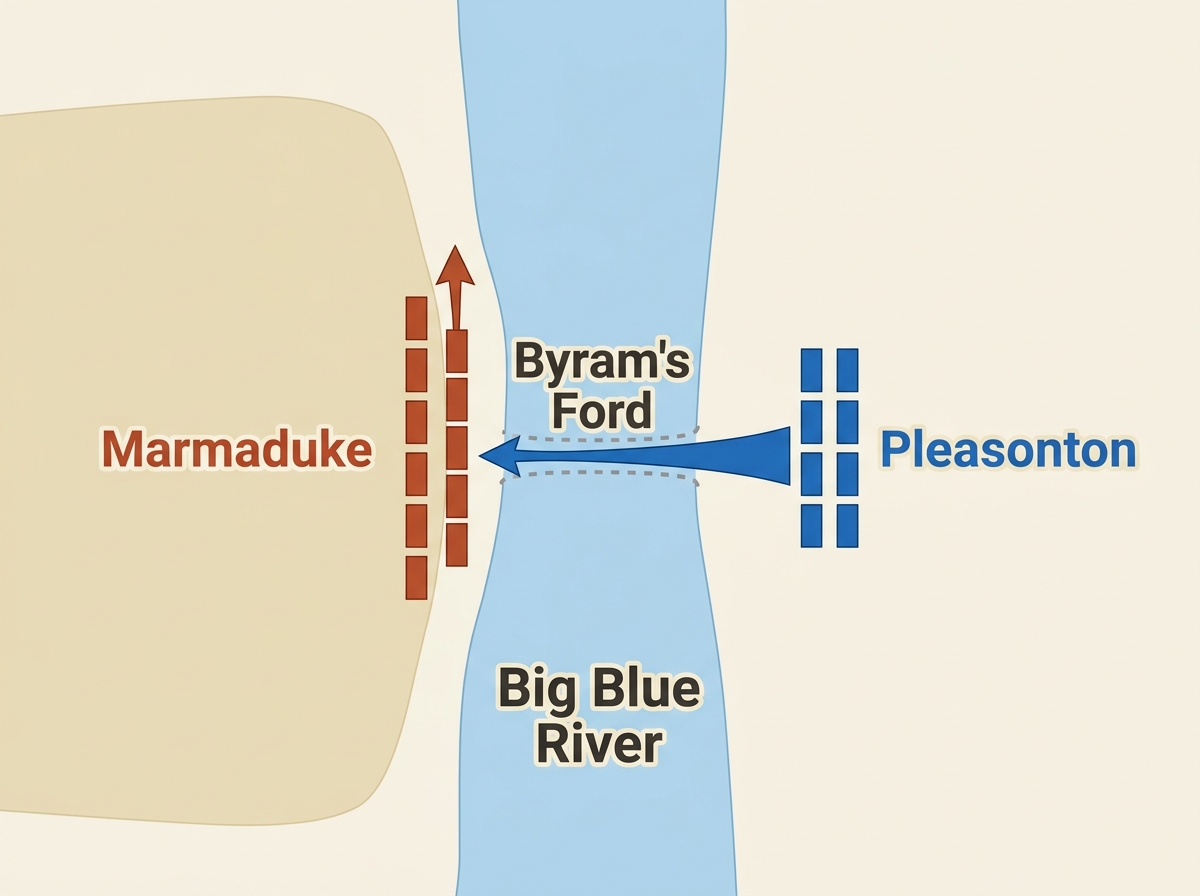
Three miles to the east, the second half of the trap was shutting. Starting around eight in the morning, Pleasonton's troopers hit the Confederate division holding the Big Blue at Byram's Ford, the division of Brigadier General John S. Marmaduke (South). Marmaduke's men held the west bank and the crossing for a couple of hours under heavy fire, but the Union cavalry forced the ford by about eleven, scrambled up the bank, and broke out into the open ground beyond, driving Marmaduke's division back toward the rest of Price's army. Now the Confederates were taking pressure from the west, from Curtis and Blunt, and from the east, from Pleasonton, at the same time. The two Union forces that had spent three days closing on Price had finally met around him.
Price's army began to come apart. Caught between converging attacks with its ammunition failing and its line bent back on itself, the Confederate force broke off the fight and started south, away from both jaws of the trap, abandoning ground it had bled for that morning. Some of the retreating men set the dry prairie grass alight to throw up a curtain of smoke and screen the withdrawal. Shelby fought a stubborn rear-guard action to keep the retreat from turning into a rout, and largely succeeded, but there was no mistaking what had happened. The largest battle ever fought west of the Mississippi River, with something like 30,000 men engaged over the wider field, had ended with the Confederate army in flight.