By the fall of 1864, the Confederacy was running out of room. William T. Sherman (North) had taken Atlanta in September and was about to cut loose for the sea. Robert E. Lee was pinned in the trenches around Petersburg and Richmond. The blockade had strangled Southern trade, foreign recognition was a dead hope, and the one thing standing between the Confederacy and the end was the United States election in November, where Abraham Lincoln faced the voters with the war still unwon. If the North lost its nerve and voted him out, a new administration might let the South go. If it did not, the war was lost. The Confederacy needed something loud, and it needed it fast.
Out west, a Missourian thought he could provide it. Major General Sterling Price (South) had commanded the Missouri State Guard in the war's first summer and had spent the years since aching to take his home state back. Price was a former governor of Missouri, a big, heavy man near sixty, and the Confederate commander of the Trans-Mississippi, General Edmund Kirby Smith (South), gave him an army and turned him loose. The plan was a raid on the grandest scale: march up through Missouri, gather recruits, capture war materiel, take St. Louis or the capital at Jefferson City if he could, and above all make enough noise to draw Union troops away from Sherman and Lee and to shake Northern confidence before the election. He crossed into Missouri in September 1864 with something like 12,000 men, many of them poorly armed, and a column of wagons that grew longer with every town he passed.
A raid that bogged down
It did not go as drawn up. Price found St. Louis too strongly held to attack and Jefferson City too well fortified to storm, so he gave up on both and turned west, following the Missouri River across the state toward Kansas City and the border. As he marched, his army swelled with raw recruits and Missouri bushwhackers (homegrown Confederate partisan raiders) but slowed under the weight of the booty he was hauling, a wagon train stretched out for miles, loaded with plunder and trailing herds of cattle. An army that was supposed to move fast and hit hard had turned into a slow-moving parade dragging its own loot, and two Union forces were converging on it from opposite directions.
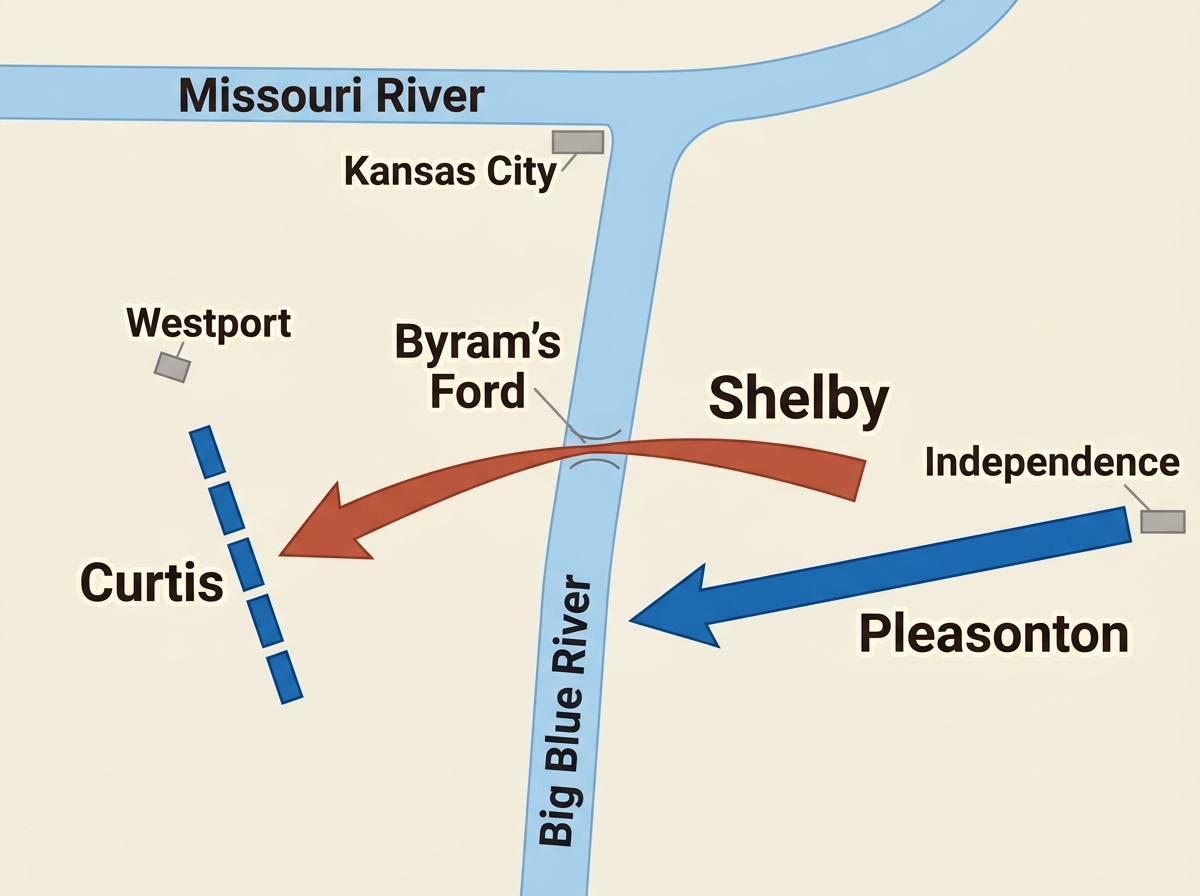
In front of him, to the west, was Major General Samuel R. Curtis (North), the Union commander who had broken the Confederate army in the region at Pea Ridge two years earlier. Curtis had thrown together an improvised force he called the Army of the Border, regular troops stiffened with thousands of Kansas state militia, and planted it across Price's path along the state line. Behind Price, to the east, came a hard-riding Union cavalry column under Major General Alfred Pleasonton (North), roughly 5,500 troopers driving the rear of the Confederate column and never letting it rest. Price was being squeezed from both ends.
Trans-MississippiPea Ridge: where Curtis broke the Confederate army in the region two years beforeThree days of running fights
For three days the squeeze tightened. On October 21, Price's lead division shoved Curtis's men back from the Little Blue River, east of Independence, but the fight cost him hours he did not have. On October 22, Pleasonton's troopers caught the Confederate rear at Independence and battered it through the streets of the town, while up ahead Brigadier General Joseph O. Shelby (South), Price's best subordinate, forced a crossing of the Big Blue River at Byram's Ford by outflanking the Union defenders and driving them back toward Westport. Price had won his way forward another day, but he had won it slowly, and the slowness was killing him. By the night of October 22 his army of perhaps 8,500 effective men was caught in the angle between two rivers, Curtis's force planted in front of him to the west and Pleasonton's cavalry closing on the Big Blue behind him to the east. There was no longer anywhere to run that did not mean a fight. In the morning he would have to break one of the jaws of the trap or be crushed between them.