Lyon's plan was the kind of plan you only make when you've run out of safe ones. His army was already badly outnumbered, roughly 5,400 men against something like 12,000. The textbook answer to being outnumbered is to keep your force together, where its weight counts for the most. Lyon did the opposite. He split his already-tiny army in two and sent the halves on an all-night march to hit the sprawling Confederate camp from two directions at once at dawn. It was audacious, it was reckless, and for a few hours on the morning of August 10, 1861, it very nearly worked.
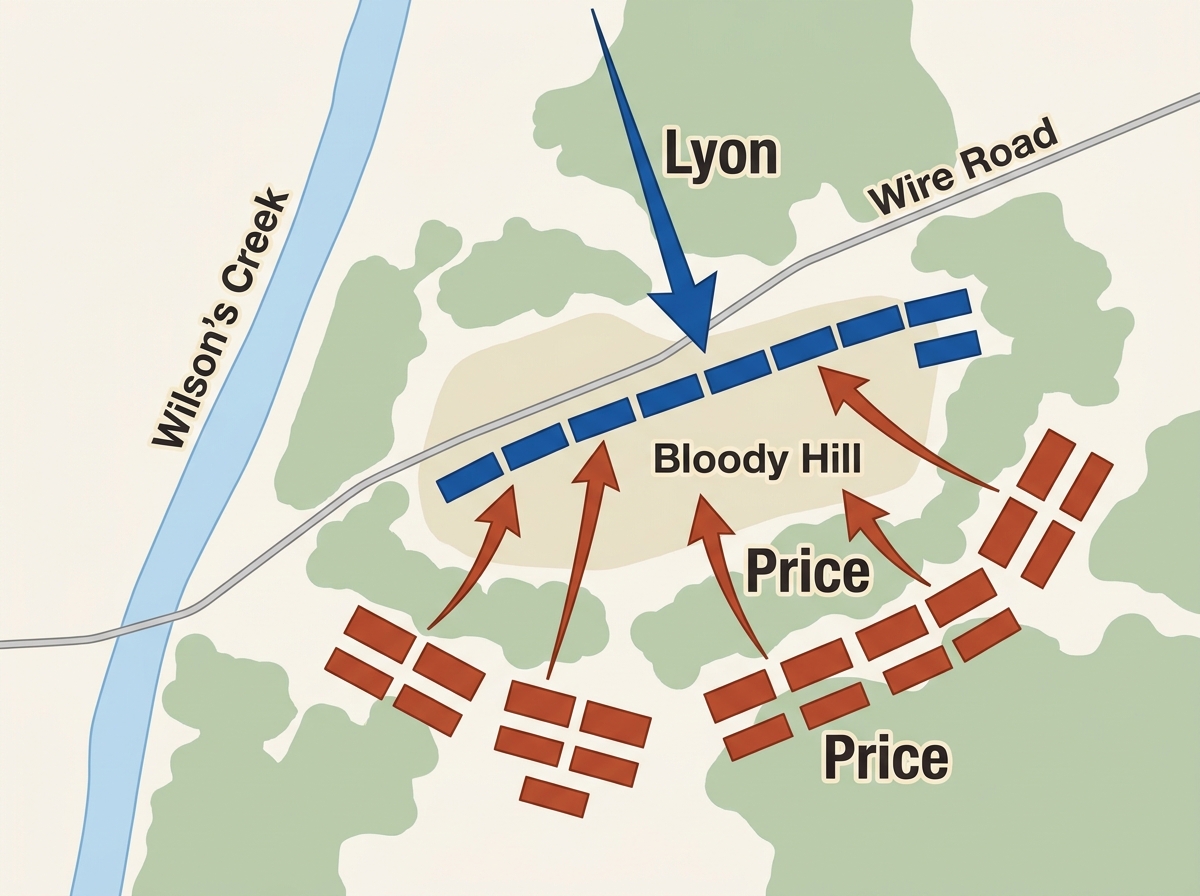
Split the small army in two
His own main column, about 4,200 men, would come down on the Confederate camp from the north at first light. At the same time, Colonel Franz Sigel (North) would take a flanking column of roughly 1,100 to 1,200 men (a flank being the side of an enemy formation, the vulnerable spot away from where it's facing) and swing on a wide loop all the way around the Confederate position to strike it from the south. If both blows landed at once at dawn, the Confederates would be caught between two fires and unable to turn their full weight on either column. The plan was actually Sigel's idea, not Lyon's, and other officers objected to dividing a force this small in front of an enemy this large. Lyon took it anyway, partly because Sigel was a popular German-born officer whose standing made him politically awkward to overrule.
The whole gamble depended on surprise and on timing, both columns moving through the dark and hitting together. And it depended on a piece of luck nobody could have planned: the Confederates had drawn up their own surprise attack on the Union camp for the night of August 9 and called it off because of a light rain. Both armies, it turned out, had been planning to ambush each other on the very same night. Only one of them actually went.
Out of the dark
Before dawn on August 10, Lyon's column came out of the dark and ran straight over the Confederate pickets and cavalry, who had no idea an army was on top of them. A quirk of the terrain (the steep creek valley seems to have swallowed the sound) kept Brigadier General Benjamin McCulloch (South) and Major General Sterling Price (South) from hearing the opening gunfire for as much as half an hour; the two generals were reportedly still at breakfast when word finally reached them. When their scouts did come in, they breathlessly reported the Federals were attacking with "twenty thousand men and 100 pieces of artillery," a wildly inflated number that briefly threw the Confederate command into confusion. Meanwhile Lyon drove the rebel cavalry back and pushed his men uphill onto a low, brush-covered plateau on the east bank of the creek, high ground that rose maybe a hundred feet above the valley floor and had no name yet. The soldiers who fought and died on it that morning would give it one: Bloody Hill. The artillery battery of Captain James Totten (North), a battery being a cluster of cannon worked as a single unit, unlimbered (unhooked the guns from their horse teams and set them up to fire) and opened on the camp below, setting tents ablaze and throwing Price's men into disarray. For a moment, the audacious plan looked like genius.
How Sigel's column came apart
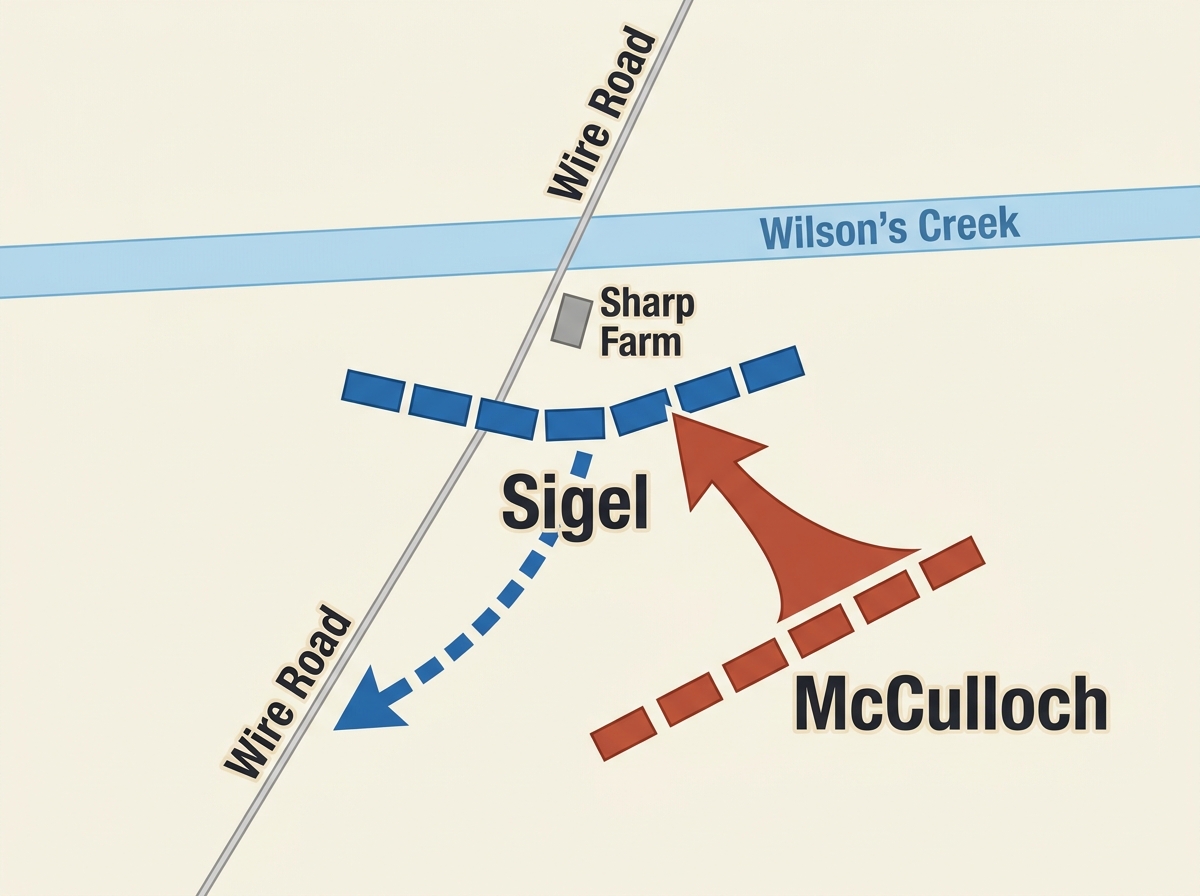
Down on the south end, Sigel's half of the plan opened even better than Lyon's. His guns caught the southern edge of the Confederate camp at the Sharp farm and shredded it; his artillery scattered the Southern cavalry and camp followers, sending hundreds of horsemen fleeing, and his men scooped up over a hundred prisoners in the first minutes. Sigel pushed up onto the Wire Road, the main road linking Springfield to Fort Smith, Arkansas, planting his column squarely across the Confederate line of supply. He believed the plan was working. He was so sure of it that he stopped being careful. He failed to post proper skirmishers (soldiers thrown out ahead of the main line to scout it and watch for an approaching enemy) out front to screen his line, and he made no attempt to link up with Lyon.
That carelessness met the worst possible enemy: the uniforms hadn't been sorted out yet. This was the rawest period of the war, before blue-for-Union and gray-for-Confederate was anything like universal, and regiments (a regiment being a fighting unit of roughly a thousand men) wore whatever their states had managed to dress them in. So when a body of gray-clad soldiers came marching toward Sigel's line, his men assumed they were friends, specifically the 1st Iowa Infantry, a Union regiment that happened to wear gray, and held their fire. They were not the 1st Iowa. They were the 3rd Louisiana Infantry (South), Confederate troops who also happened to be in gray, part of a counterattack McCulloch had organized once he grasped what Sigel had done. The Louisianans walked to within about 40 yards (37 m) of Sigel's trusting line and then let loose a single annihilating volley straight into it. Sigel's column shattered and ran. He lost five of his six cannon. The colonel himself escaped capture only by hiding in a cornfield and slipping back toward Springfield with a single orderly (a personal aide). One mistaken glance at a gray coat had erased half of Lyon's army from the battle.
Wave after wave
With Sigel routed and gone, the Confederates could turn their whole weight on Lyon alone on Bloody Hill, and they did, in three great surging assaults up the slope. Price organized his State Guard along the south face of the hill, and the battle became a brutal uphill grind: Missourians climbing into the muzzles of Lyon's line, formations three and four ranks deep firing while prone, kneeling, and standing all at once, the fighting closing to shotgun range and at one point to within twenty feet of the Union cannon. Price himself took a painful wound in the side during the fighting and stayed in the saddle. A Pulaski Arkansas battery had set up its cannon near the creek ford at first light and bought Price the time he needed to get organized, then traded blows with Totten's guns in a duel so thick with smoke that, as the Arkansas battery's commander, Captain William E. Woodruff Jr. (South), put it, his gunners could only aim by the enemy's muzzle-flashes.
"The gunners of my pieces were obliged to give direction to their pieces by the flash." Capt. William E. Woodruff Jr., commanding the Pulaski Arkansas battery.
For all their numbers, the Confederates could not break the hill. A Texas cavalry unit even tried a circuitous charge around to strike the Union position from behind, and it too was thrown back. And part of the reason the larger army kept failing was that its two halves never quite became one army. McCulloch held a Confederate commission; Price held only a Missouri State Guard commission and was, technically, an allied commander rather than a subordinate one. The two men had quarreled for a month before agreeing to fight together at all, and the friction never went away; McCulloch at times maneuvered his Confederate troops on his own rather than in lockstep with Price's Missourians.